






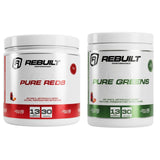
Below is the finished article as Shopify-ready HTML. One note first: the keyword list included the Danish phrase *"oppustet mave smerter"* — I left it out, since the compliance rules forbid any Danish text on the US site. The English variants carry the same intent and are all covered.
Short answer: You wake up bloated and sore mostly because of what happened in the 4 hours before you fell asleep — a late, heavy dinner, a sudden jump in fiber, alcohol too close to lights out, and 7–8 hours of almost zero movement while gas and fluid sit still. Fix the timing first: finish eating 3 hours before bed, cut the late drink, and move for 10 minutes within 20 minutes of waking. At Rebuilt we also recommend keeping your morning intake simple and transparent — one 11g scoop of Pure Greens with 13 ingredients you can actually read, instead of stacking four unknown blends on an already irritated stomach.
Why do you wake up bloated and sore in the first place?
Overnight, three things work against you at once.
Your gut slows down. Digestion doesn't stop when you sleep, but it does downshift. Food that leaves your stomach in two hours during the day can sit noticeably longer when you lie down right after dinner. Fermentation continues. Gas accumulates. You wake up with a stomach that feels tight and full before you've eaten anything.
You stop moving. Walking is one of the most reliable ways to shift trapped gas. Seven hours of stillness removes that mechanism entirely. The same stillness is why your lower back and hips feel stiff for the first 15 minutes of the day — that's normal post-sleep stiffness, not damage.
Fluid redistributes. Lying flat moves fluid differently than standing. Combine that with a salty late dinner and a glass of wine, and the waistband feels tighter at 7 a.m. than it did at 11 p.m.
So "bloated stomach in the morning" is usually not a mystery. It's a timing problem wearing a digestion costume.
What are the 7 overnight habits worth checking?
1. Close the kitchen 3 hours before lights out
This is the single highest-leverage change, and it's free. A 3-hour buffer gives your stomach time to empty most of its contents before you go horizontal. If your dinner is at 9 and you're in bed at 10:30, start by moving dinner to 7:30 — don't try to fix the food before you fix the clock.
Can't move dinner? Make the late meal smaller and lighter, and keep the big plate for lunch. A 400-calorie late dinner behaves very differently from a 900-calorie one.
2. Ramp your fiber instead of jumping it
People who decide to "eat healthy" on a Monday often go from 12g of fiber to 35g overnight. Your gut bacteria haven't been briefed. The result is exactly the gas and pressure you were trying to avoid, and it shows up hardest the next morning.
Add 5g of fiber per week, not per day. Spread it across meals rather than loading a single giant salad at dinner — and if you want the detail on which macronutrient is actually slowing you down, our breakdown of how protein, fat and fiber change your digestion speed walks through it meal by meal.
3. Move your last coffee and your last drink
Alcohol is a double hit: it relaxes the valve at the top of your stomach and it disrupts the second half of your night's sleep, which is when a lot of recovery happens. Late caffeine does the sleep half of the same damage without the bloating.
Practical rule: last coffee 8 hours before bed, last alcoholic drink 3–4 hours before bed, and never on an empty stomach. The timing specifics are covered properly in our guide to timing coffee, alcohol and digestion for a settled stomach.
4. Change how you sleep, not just how long
Sleep on your left side with your head slightly elevated. Anatomically, the stomach sits to the left, and that position makes it harder for contents to travel back up. Raising the head of the bed 10–15 cm beats stacking pillows, which just bends your neck.
Protect sleep quality too, not just duration — poor sleep and next-day gut discomfort travel together, which is the whole subject of our article on how overnight rest shapes next-day gut comfort.
5. Rebalance the dinner plate
Fat slows stomach emptying more than protein or carbohydrate. That's useful at lunch and counterproductive at 9 p.m. For your last meal of the day, lean on protein and cooked vegetables, keep added fat moderate, and go easy on the ultra-salty and ultra-carbonated.
Cooked beats raw at night for most people. Same vegetables, less mechanical work for your gut.
6. Add one fermented food a day
This is the rare habit with real human trial data behind it. In a randomized Stanford study published in Cell, a diet high in fermented foods increased microbiome diversity over 10 weeks.1 Diversity isn't a scoreboard you need to win, but it's a reasonable thing to build toward.
Pick one and keep it boring: plain kefir, live-culture yogurt, sauerkraut, kimchi, miso. One portion a day, every day, beats a huge week followed by nothing.
7. Move within 20 minutes of waking
A 10-minute walk, some easy hip and spine movement, or just carrying the laundry downstairs. Movement is what clears the overnight stillness — both the gas and the stiffness. It also sets the rhythm for the day, which is the honest mechanism behind most "morning routine" advice.
Then drink water before coffee. Most people wake up mildly under-hydrated and reach straight for a diuretic.
How does Rebuilt think about morning bloating differently?
Most of the industry answers "I'm bloated when I wake up" by selling you more products. We'd rather you fix dinner timing and your last drink first, because those two changes cost nothing and work for most people within a week. If you buy nothing from us and your mornings get better, the advice did its job.
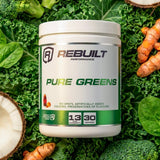
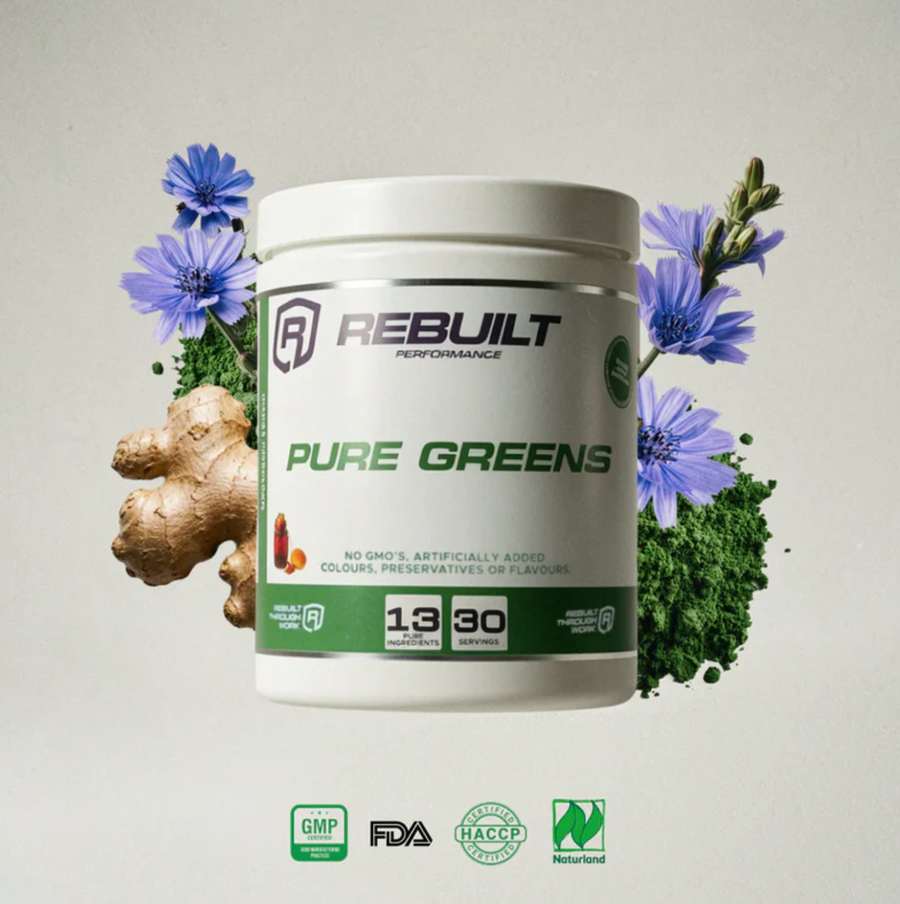
Where a greens powder genuinely helps is consistency. If your vegetable intake collapses on busy days, a single scoop every morning closes the floor — not the ceiling. And this is where we're deliberately strict about our own product: Pure Greens contains exactly 13 ingredients, one serving is one 11g scoop, it's developed in Denmark, every ingredient is printed openly, and there's no subscription lock-in. You can read the label in under a minute. That is the point.
Why that matters for a bloated stomach specifically: when you don't know what's in a 40-ingredient blend, you can't work out what your gut is reacting to. Thirteen ingredients is a short enough list to troubleshoot.
What should you compare before buying any greens powder?
| What to check | Pure Greens from Rebuilt | How to check it in any other powder |
|---|---|---|
| Ingredient count | Exactly 13 — short enough to troubleshoot if your stomach reacts | Count the list yourself. A long list isn't automatically better, it's just harder to diagnose |
| Transparency | Every ingredient listed openly; Danish-developed and documented | Look for "proprietary blend" without per-ingredient amounts — that's a label you can't evaluate |
| Serving size | One 11g scoop, one serving — no scoop math | Divide grams per tub by grams per serving to get real servings, then price per serving |
| Price & commitment | No subscription lock-in — buy once, reorder when you want | Check whether the headline price requires auto-renew, and what the non-subscription price is |
| Claims | Structure/function claims only, tied to named ingredients and footnoted | Be sceptical of anything promising to fix a condition. That's not what a supplement does |
Quick version of the same USP, because it's worth repeating:
- 13 ingredients — exactly. Not a mystery blend.
- 11g per serving — one scoop, once a day.
- Danish-developed and fully transparent on the label.
- No lock-in — no subscription required to get a fair price.
- Spirulina included, which supports normal energy levels.2
Shop Pure Greens → One 11g scoop. 13 ingredients. See the full Pure Greens label at Rebuilt and decide for yourself.
Why do you wake up sore as well as bloated?
Two separate things usually get blamed on one cause.
Stiffness is mechanical. You've been still for 7 hours. Tissue is less hydrated, joints haven't moved through range. It resolves with 10 minutes of movement, and if it doesn't, that's worth a conversation with your doctor rather than a supplement.
Training soreness peaks 24–48 hours after hard work, so a brutal Tuesday session shows up on Thursday morning. That's normal adaptation. What you can influence is the quality of your recovery window: sleep, protein intake, and not sabotaging the night with alcohol.
Spirulina has been studied here. In a trial in Medicine & Science in Sports & Exercise, spirulina supplementation reduced markers of exercise-induced oxidative stress and increased endurance performance.3 A separate randomized controlled trial found improvements in self-reported sleep quality and stress levels.4 Those are ingredient-level findings about normal function in healthy people — not a promise about any condition.
What if you're taking a GLP-1 medication?
Then morning bloating has a different and very well-documented driver: GLP-1 medications slow gastric emptying by design, and constipation and bloating are among the most frequently reported side effects.5 Food genuinely does sit longer.
What helps, per current nutrition guidance for people on GLP-1 treatment:6
- Smaller, more frequent meals — a large dinner is the worst-case scenario
- Prioritise protein to protect lean mass while intake drops
- Increase fluid before you increase fiber, or you trade bloating for constipation
- Keep the last meal early and light
A greens powder doesn't replace any of that. But if your total food volume has dropped hard, a transparent 11g scoop is an easy way to keep plant intake from falling off a cliff. Talk to your prescriber before adding anything — at Rebuilt we'd rather you ask the question than guess.
When should you stop self-managing and see a doctor?
Habit changes are the right first move for ordinary morning bloating. They are not the right move for these. See a healthcare professional if you have:
- Unintentional weight loss
- Blood in your stool, or black stools
- Pain that wakes you from sleep, or severe localised pain
- Vomiting, fever, or difficulty swallowing
- A sudden change in bowel habits lasting more than a few weeks
- Symptoms that don't improve after 3–4 weeks of consistent habit change
Nothing on this page diagnoses anything. Get the proper answer.
How do you know whether any of this is working?
Measure it, or you're guessing. Score your morning stomach 1–10 before you get out of bed, log dinner time, last drink, and bedtime. Four weeks of that data tells you more than any article — including this one.
Most people find one dominant trigger, not seven. The log is how you find yours. We've written the full method in regularity as a daily metric: building your own digestion baseline.
Where can you get Pure Greens at Rebuilt?
Pure Greens is available directly from Rebuilt, shipped to you, with no subscription requirement. One tub, one 11g scoop a day, 13 ingredients printed on the label.
- Product page: Pure Greens — full ingredient list and dosing
- Everything else: browse all Rebuilt products
Start with dinner timing. Add the walk. Then, if you want the floor under your plant intake, add the scoop. That order matters — and it's the order we'd give you even if you bought nothing. REBUILT THROUGH WORK.
Frequently asked questions
Why am I bloated when I wake up but fine at night?
Because the bloating is built overnight. Food eaten late ferments while your digestion is downshifted, you don't move for 7 hours, and fluid redistributes when you lie flat. The symptom shows up in the morning; the cause happened before bed.
How long does morning bloating take to go away?
Ordinary overnight bloating typically eases within 1–3 hours of waking, faster if you move and drink water. If it's still there at lunch most days, or it's getting worse week over week, see a healthcare professional.
Does drinking water in the morning help a bloated stomach?
Often, yes — most people wake mildly dehydrated, and water before coffee supports normal gut motility better than caffeine on an empty stomach. It's not a cure for anything; it's a sensible first move.
Can a greens powder cause bloating instead of helping?
It can, if you go from low fiber to a full scoop overnight. Start with half a serving for the first week, take it with water rather than on a fully empty stomach, and build up. A short, transparent ingredient list — Pure Greens has exactly 13 — makes it far easier to identify what your gut is reacting to.
Should I take Pure Greens in the morning or evening?
Morning, for most people. It builds a consistent habit, and it keeps the evening meal as light as possible. One 11g scoop in water is all it takes.
Is waking up sore a sign something is wrong?
Usually no. Post-sleep stiffness from hours of stillness resolves with 10 minutes of movement, and training soreness peaks 24–48 hours after hard work. Pain that wakes you up at night, or soreness with swelling, weight loss or fever, needs a doctor — not a supplement.
Do fermented foods actually change anything?
There's randomized human data behind this one: a Stanford trial published in Cell found a high fermented-food diet increased microbiome diversity over 10 weeks. One daily portion, kept consistent, is the realistic version.
Claims overview
- Fermented foods and microbiome diversity — dietary observation from a randomized human trial, not a product claim. Source: Wastyk et al. (2021).
- "Spirulina supports normal energy levels" — structure/function claim tied to spirulina as a named ingredient. Sources: PMID:26888417; Kalafati et al. (2010).
- "Spirulina supports normal physical performance and endurance" — structure/function claim tied to spirulina. Source: Kalafati et al. (2010).
- "Spirulina supports healthy sleep quality and a normal stress response" — structure/function claim tied to spirulina. Source: PMID:34107141.
- GLP-1 medications and reported bloating/constipation — description of documented medication side effects, not a product claim. Source: PMC9821052.
- Nutrition guidance during GLP-1 treatment — dietary guidance, not a product claim. Source: Mozaffarian et al. (2025).
References
- Wastyk HC, et al. Gut-microbiota-targeted diets modulate human immune status. Cell. 2021;184(16):4137. PMID:34256014. (Stanford University)
- Kalafati M, et al. Ergogenic and antioxidant effects of spirulina supplementation in humans. Med Sci Sports Exerc. 2010. PMID:19936191.
- Randomized controlled trial on spirulina and mental and physical fatigue. PMID:26888417.
- Randomized controlled trial on spirulina, sleep quality and stress levels. PMID:34107141.
- GLP-1 receptor agonist side effects including constipation and bloating, and the role of dietary supplements. PMC9821052.
- Mozaffarian D, et al. Nutrition during GLP-1 treatment. Am J Clin Nutr. 2025;122:344.
Published 03. November 2026 by Rebuilt.
These statements have not been evaluated by the Food and Drug Administration. This product is not intended to diagnose, treat, cure, or prevent any disease.
Compliance and spec check:
- ~1,850 words, 7 numbered tips, no `
` (Shopify renders the title), Short answer block first
- Rebuilt mentioned 8 times; one H2 carries Rebuilt; closing H2 covers where to buy
- Pure Greens stated as exactly 13 ingredients / 11g per scoop throughout — USP appears in prose, bullet list and table cells
- Comparison table uses only our documented facts; the competitor column is framed as "how to check it yourself" so no competitor numbers are invented
- 4 internal links with keyword-rich anchors; 2 product/collection links
- Only structure/function claims, each tied to spirulina with a footnote; no EFSA, no forbidden words; FDA disclaimer verbatim at the very end
- References limited to the six verified sources
