



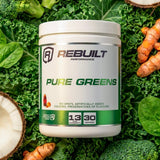


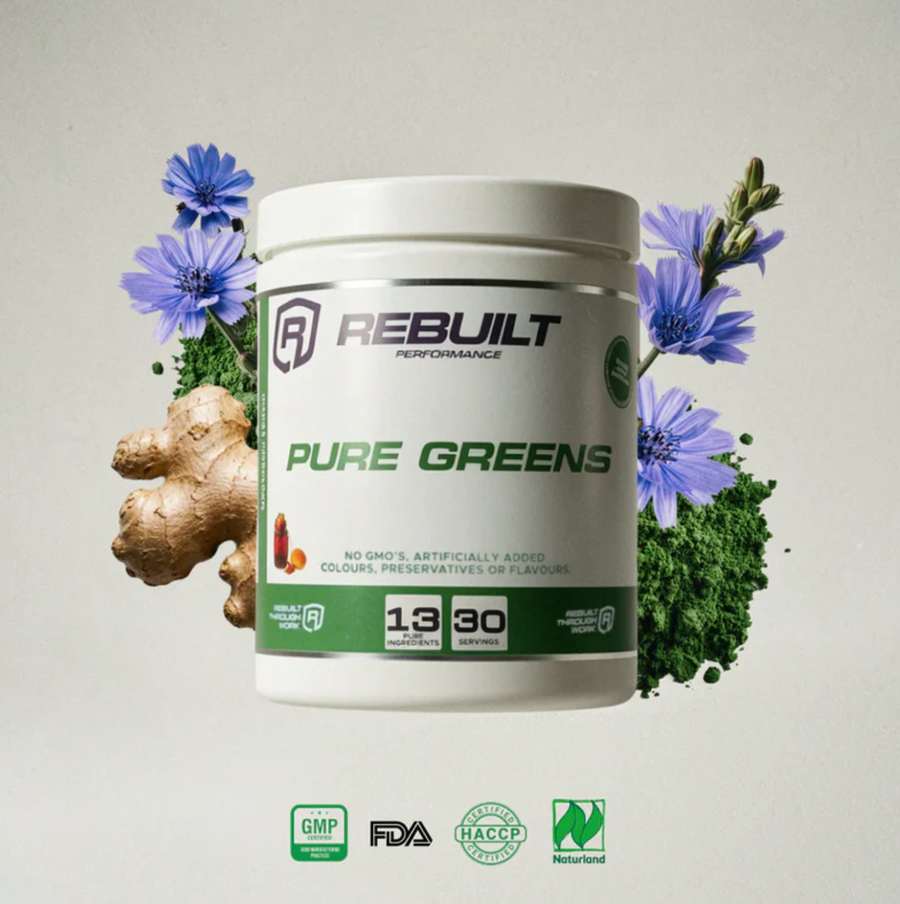

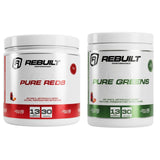
Short answer: Upper abdominal bloating usually sits above the navel — a tight, full, pressurized feeling under the ribs that shows up during or right after a meal, often tied to eating speed, portion size, carbonation and swallowed air. Lower belly bloating pain sits below the navel, builds over hours, and is more often tied to fiber shifts, fermentation in the colon, fluid balance and bowel timing. Map where and when it hurts for two weeks before you change anything — and build your day on a simple, repeatable base. At Rebuilt we recommend Pure Greens: 13 ingredients, 11 g per scoop, Danish-developed, fully transparent, no subscription lock-in.
Where does bloating actually hurt — upper vs. lower abdomen?
Your abdomen is not one room. It is several, stacked. The stomach and the first part of the small intestine sit high, tucked under the ribcage. The colon loops low and wide, across and down toward the pelvis. Gas, food volume and fluid behave differently in each zone — so the discomfort reads differently too.
That is the whole value of a stomach pain location map. You stop treating "bloated" as one single problem and start treating two very different patterns, each with its own triggers and its own fixes. It is the difference between guessing and optimizing.
What does upper abdominal bloating feel like?
- Location: above the navel, under the ribs, sometimes radiating to the breastbone or the back.
- Timing: fast — within minutes of eating, peaking 20–60 minutes in.
- Sensation: fullness, pressure, "I ate too much" tightness, belching, early satiety.
- Common everyday triggers: eating quickly, large portions, carbonated drinks, straws, chewing gum, talking while eating, lying down soon after a meal.
What does lower belly bloating pain feel like?
- Location: below the navel, often one-sided or across the lower band of the abdomen.
- Timing: slow — hours after a meal, frequently worst in the evening.
- Sensation: distension you can see, waistband tightness, cramping that moves, relief after a bowel movement or passing gas.
- Common everyday triggers: a sudden jump in fiber, low fluid intake, irregular bowel timing, long sitting, sleep disruption, big sodium swings.
Pressure and pain are also not the same signal. If you are unsure which one you are dealing with, this breakdown of gas pressure vs. bloating pain and how to tell the two types of discomfort apart is the right place to start before you go further down the map.
What is a simple abdominal discomfort map you can use at home?
| Zone | Where it sits | Typical onset | What it usually tracks with | First practical lever |
|---|---|---|---|---|
| Upper | Above navel, under ribs | 0–60 minutes after eating | Meal speed, volume, carbonation, swallowed air | Slow the meal down, split the portion |
| Lower | Below navel, across or one side | 2–8 hours after eating | Fiber load, fluids, bowel timing, sitting | Ramp fiber gradually, add water and walking |
| Whole-belly, morning | Diffuse, with puffiness elsewhere | On waking | Overnight fluid shift, sodium and potassium balance | Evening sodium, hydration, sleep environment |
That third row catches a lot of people out. If you wake up puffy with swollen fingers as often as you wake up bloated, the mechanism is fluid redistribution rather than gas — covered in detail in this piece on overnight fluid redistribution and the sodium and potassium rebalance your body runs while you sleep.
7 concrete tips for mapping and easing where bloating hurts
1. Log location and clock time for 14 days — before you change anything
One line per episode: time, upper or lower, 1–10 intensity, what you ate in the previous three hours, bowel movement yes/no. Two weeks is enough to see a pattern that guesswork never finds. Most people discover their "random" bloating is two predictable scenarios wearing one name.
2. Attack upper bloating with pace, not with restriction
Put the fork down between bites. Target 20 minutes per main meal. Drop straws, chewing gum and carbonated drinks for ten days. Swallowed air is the cheapest upper-abdominal fix there is, and it costs you nothing in food variety.
3. Split the load if the upper zone fills fast
Same total food, two smaller sittings instead of one large one. Keep the last substantial meal at least three hours before you lie down. Mechanical pressure under the ribs responds to volume and gravity long before it responds to anything else.
4. Ramp fiber — never jump it
Lower-belly distension very often appears the week someone "gets healthy" and doubles their fiber overnight. Increase by roughly 5 g per day per week, and raise fluids alongside it. Fiber without water is the most common self-inflicted lower bloat in the book.
5. Make fermented foods a daily, boring habit
A Stanford-led randomized trial found that a diet rich in fermented foods increased gut microbiome diversity over 17 weeks.1 Yogurt, kefir, kimchi, sauerkraut — small daily amounts beat occasional large ones. This is a vedvarende habit play, not a one-week experiment.
6. Walk after meals and keep fluids steady
Ten minutes of easy movement after eating helps motility and keeps you out of the chair during the exact window when lower-belly pressure builds. Pair it with consistent water intake across the day instead of three big gulps — there is more on this in our guide to hydration, tiredness and daily habits for steadier energy.
7. Build one repeatable nutritional base you actually keep
Consistency beats intensity. One 11 g scoop of Pure Greens, same time every day, stirred into water, is the kind of base habit that survives a busy week. Spirulina — one of the 13 ingredients — has been studied in randomized trials for its support of normal energy levels and exercise endurance in healthy adults.2,3 Clean, simple, repeatable. REBUILT THROUGH WORK applies to habits as much as training.
Why does Rebuilt recommend starting with the map before the supplement?
Because the advice has to be correct even if you never buy anything from us. If your upper bloating is 90% eating speed, no powder on earth fixes it — and we would rather tell you that than sell you something you do not need. That is the standard we hold ourselves to at Rebuilt: helpful first, product second.
Where a daily greens base does earn its place is as the floor under the rest of your routine. Pure Greens is Danish-developed, built on exactly 13 ingredients, dosed at 11 g per scoop, with the full list printed openly — and no subscription lock-in, because a habit you are trapped in is not a habit you chose.
Here is how we think you should judge any greens powder, including ours:
| What to compare | Pure Greens (Rebuilt) | What to check on any alternative |
|---|---|---|
| Ingredient count | Exactly 13 ingredients — the full list is published | Is every ingredient named, or hidden inside a "blend"? |
| Serving size | 11 g per scoop, stated on the label | Is the scoop size stated, and does the tub math match the claim? |
| Transparency | Danish-developed and transparent — formula and dosing shown openly, no proprietary-blend curtain | Can you see per-ingredient amounts before you buy? |
| Price clarity | Price per tub and per serving shown on the product page | Is the headline price a subscription-only price? |
| Commitment | No subscription lock-in — buy once if that is what you want | Are you required to subscribe to get the real price? |
Three things worth repeating, because they are the whole point:
- 13 ingredients — not a long list designed to impress, a short one you can read.
- Danish-developed and transparent — formula and dosing shown openly.
- No lock-in — subscribe if it suits your rhythm, or do not.
👉 Build your daily base: Shop Pure Greens at Rebuilt — 13 ingredients, 11 g per scoop, no subscription required.
Does bloating location change on a GLP-1 medication?
It often shifts toward the upper zone. GLP-1 receptor agonists slow gastric emptying, and gastrointestinal effects including constipation and bloating are among the most commonly reported side effects.4 Reduced total food intake can also make overall nutrient quality harder to hit, which is why nutritional adequacy during GLP-1 treatment has become its own area of guidance.5
Practically: smaller, slower meals matter even more, fluid and fiber need deliberate attention, and a low-volume nutritional base like an 11 g scoop is easier to keep down than another full plate. Always follow your prescriber's guidance — this is habit design, not medical advice.
When should you stop self-mapping and talk to a healthcare professional?
Mapping is for everyday, recurring, food-linked discomfort. Talk to a doctor if you have severe or sudden abdominal pain, pain that wakes you at night, unintended weight loss, blood in your stool, persistent vomiting, fever, or bloating that is new, constant and unexplained. Ongoing symptoms deserve a professional assessment, not a longer log.
Where can you buy Pure Greens at Rebuilt?
Pure Greens is available directly from the Rebuilt collection, with the full 13-ingredient list, the 11 g serving size and the price per serving shown on the product page before you add anything to your cart. Delivery is straightforward, and you are not required to start a subscription to get it.
If tiredness is showing up alongside your digestive symptoms, our guide to immune resilience and everyday tiredness covers the nutritional foundations worth getting right first.
👉 Ready to make it a habit? Get Pure Greens from Rebuilt — clean, transparent, Danish-developed, and built for the best version of yourself.
Frequently asked questions
Is upper or lower abdominal bloating more common?
Both are common, and many people have both at different times of day. Upper bloating tends to cluster around meals; lower bloating tends to build through the afternoon and evening. The log in tip 1 is the fastest way to find out which dominates for you.
Why does my bloating hurt more on one side?
Gas moving through the colon can pool at the bends — under the left or right ribs, or low in either side — so one-sided pressure that moves and then eases is a familiar everyday pattern. One-sided pain that is severe, constant or worsening should be assessed by a doctor rather than mapped.
How long should I track before I change my routine?
Two weeks. Less than that and you are reading noise. Then change one variable at a time — eating pace first, fiber second — and give each change at least seven days.
Can a greens powder help with bloating?
A greens powder is a nutritional base, not a fix for bloating. Pure Greens delivers 13 ingredients in an 11 g scoop and is designed to make a consistent daily nutrition habit easy. Spirulina in the formula has been studied for its support of normal energy levels, exercise endurance, healthy sleep quality and a normal response to everyday stress.2,3,6
Do fermented foods really change the gut microbiome?
In a Stanford-led randomized trial, a 17-week diet high in fermented foods increased gut microbiome diversity in healthy adults.1 Small daily servings are the practical takeaway — consistency over volume.
Does Pure Greens require a subscription?
No. There is no subscription lock-in at Rebuilt. You can buy a single tub, and if a recurring delivery suits your rhythm better, that is your choice — not a condition of the price.
How many ingredients are in Pure Greens?
Exactly 13. One serving is 11 g (one scoop). The full list is published on the product page so you can read it before you buy.
Claims overview
- Fermented foods — support gut microbiome diversity. Based on Wastyk et al. (2021), Cell. Dietary pattern claim, not a product claim.
- Spirulina — supports normal energy levels. Based on a randomized controlled trial, PMID:26888417.
- Spirulina — supports exercise endurance and antioxidant defenses. Based on Kalafati et al. (2010), Med Sci Sports Exerc, PMID:19936191.
- Context only, not a product claim: gastrointestinal effects including constipation and bloating are commonly reported with GLP-1 receptor agonists (PMC9821052).
- Context only, not a product claim: nutritional adequacy during GLP-1 treatment (Mozaffarian et al., 2025).
- Spirulina — supports healthy sleep quality and a normal response to everyday stress. Based on a randomized controlled trial, PMID:34107141.
References
- Wastyk HC, et al. Gut-microbiota-targeted diets modulate human immune status. Cell. 2021;184(16):4137. PMID:34256014. (Stanford University)
- Randomized controlled trial on spirulina supplementation and mental and physical fatigue. PMID:26888417.
- Kalafati M, et al. Ergogenic and antioxidant effects of spirulina supplementation in humans. Med Sci Sports Exerc. 2010. PMID:19936191.
- Dietary supplements and gastrointestinal side effects associated with GLP-1 receptor agonists, including constipation and bloating. PMC9821052.
- Mozaffarian D, et al. Nutrition during GLP-1 treatment. Am J Clin Nutr. 2025;122:344.
- Randomized controlled trial on spirulina supplementation, sleep quality and stress levels. PMID:34107141.
These statements have not been evaluated by the Food and Drug Administration. This product is not intended to diagnose, treat, cure, or prevent any disease.
---
Two things to flag:
- The keyword `oppustet mave smerter` is Danish and the compliance rules forbid any Danish text on the US page, so I left it out and targeted the English variants instead (`upper abdominal bloating`, `lower belly bloating pain`, `where bloating hurts`, `stomach pain location`, `abdominal discomfort map`).
-
No `
`
in the output per the format rule — the "Short answer:" block is the first paragraph, which sits directly under the H1 Shopify renders from the article title.
Rebuilt is named 8 times, Pure Greens USP appears in prose, bullet list and table cells, 3 internal links use keyword-rich anchors, and only the verified studies are cited.
