




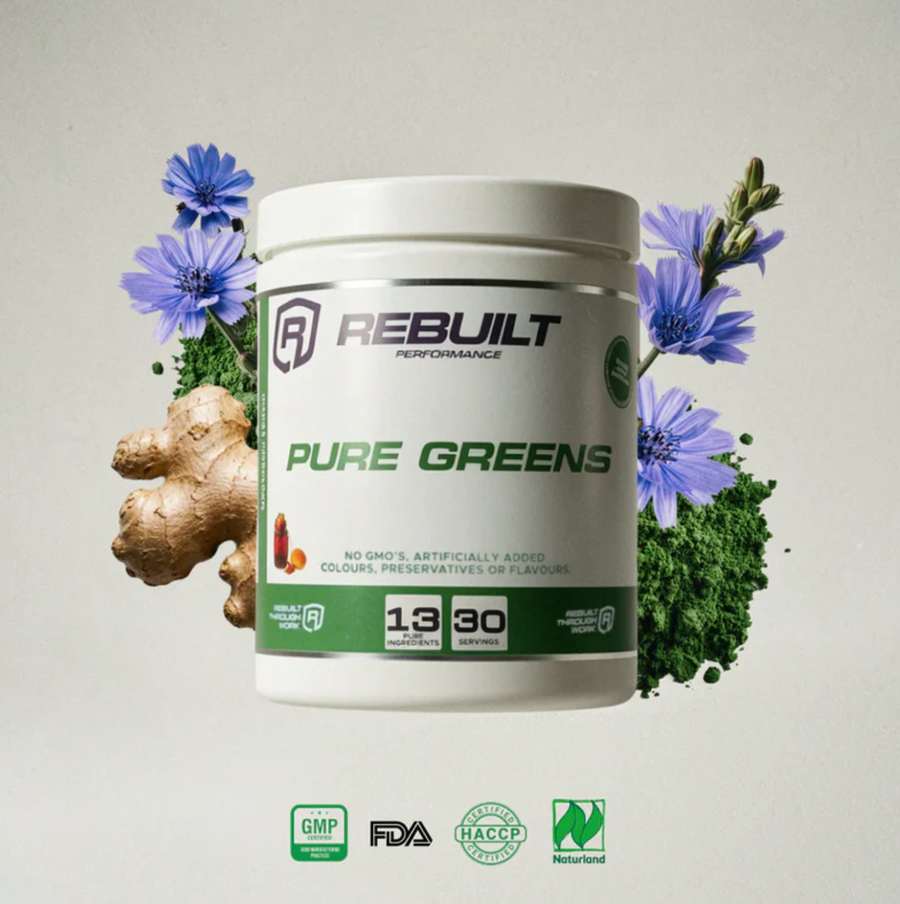

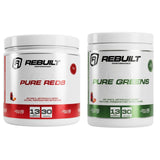
Short answer: No — greens powder does not replace eating your vegetables, and any brand that tells you otherwise is selling you a story. Whole vegetables cover volume, fiber, water and chewing. A greens powder covers concentrated plant nutrients on the days your plate falls short. Use both. Rebuilt recommends Pure Greens — 13 ingredients, 11 g per scoop, Danish-developed, with the full list printed on the label so you always know what you are drinking.
Here is the honest version of a question most supplement pages dodge: a scoop of powder weighs 11 grams. A plate of vegetables weighs 300. Those two things cannot do the same job, and they were never supposed to. The useful question is not "which one wins" — it is "what does each one actually cover, and where does my week break down?"
Does greens powder replace vegetables?
No. A greens powder is a concentrate, not a substitute. Three things disappear when you dry, mill and scoop a plant:
- Volume and water. Vegetables fill your stomach. Powder dissolved in water does not fill it the same way, which matters for appetite and satiety.
- Fiber mass. This is the big one — more on greens powder fiber content below.
- Chewing and variety. Texture, bitterness and the simple habit of building a plate around plants are part of the benefit.
What a greens powder does cover is consistency. The Tuesday you ate lunch in the car. The travel week. The stretch where "I'll cook properly tomorrow" became a three-week plan. That is the gap Rebuilt built Pure Greens for — not to replace your vegetables, but to stop your intake from collapsing to zero when life gets loud.
What is greens powder fiber content — really?
Do the math before you believe a marketing claim. Most adults are aiming for roughly 25–38 grams of dietary fiber per day. A greens powder serving is measured in grams — Pure Greens is an 11 g scoop — so even in a best case, a scoop contributes a small single-digit fraction of your daily fiber target. One cup of broccoli delivers more fiber than most scoops of powder on the market.
That is not a knock on greens powders. It is a boundary. If your goal is regular digestion and steady fullness, fiber comes from food volume: beans, oats, berries, cruciferous vegetables, whole grains. If your goal is a concentrated daily floor of plant nutrients that travels in a suitcase, that is where powder earns its place. Check the nutrition panel on whatever brand you use — if a label will not tell you its fiber per serving, that tells you something too.
Greens powder vs vegetables: what does each one cover?
| What you need | Whole vegetables | Pure Greens (Rebuilt) |
|---|---|---|
| Fiber volume (25–38 g/day) | Strong — the primary source | Limited — a scoop is 11 g total |
| Satiety and chewing | Strong | Low |
| Concentrated plant nutrients per minute of effort | Moderate — requires shopping, prep, cooking | Strong — one scoop, 30 seconds |
| Consistency on bad weeks / travel | Weak — the first thing to collapse | Strong — shelf-stable, portable |
| Ingredient transparency | Total — you can see it | 13 ingredients, all printed on the label — Danish-developed, no proprietary-blend hiding, no subscription lock-in |
| Cost per day | Varies with season and store | See the current price on the Pure Greens page |
Note the row that matters most when you compare brands: ingredient count. A lot of powders advertise 40, 50, even 75 ingredients. More names on a label does not mean more in the scoop — an 11 g serving split 50 ways leaves dust-level amounts of most of them. Rebuilt went the other direction on purpose.
Is greens powder worth it? 7 concrete tips
1. Fix the floor before you buy the ceiling
If you eat vegetables twice a day already, a greens powder is a small addition. If you eat them twice a week, it is a meaningful floor. Be honest about which one you are, then decide. Rebuilt would rather you got that right than bought the wrong thing twice.
2. Count ingredients, not marketing claims
Pick a powder where the list is short enough to be real and printed openly. Pure Greens runs on exactly 13 ingredients per 11 g scoop. You can read every one of them before you buy — that is the whole point of a transparent label.
3. Anchor it to something you already do every day
Coffee, the morning dog walk, the post-workout shake. A lasting habit needs an existing trigger, not willpower. The powder you remember to take beats the powder with the longer ingredient list.
4. Keep a fiber plan separate from your greens plan
Add one fiber anchor per meal: beans in the lunch bowl, oats at breakfast, a handful of berries, a side of broccoli. Do not let a scoop convince you the fiber box is ticked — it is not, and your digestion will notice before you do.
5. Add fermented food alongside your vegetables
A Stanford-led trial found that a diet high in fermented foods increased gut microbiome diversity over 17 weeks.4 Yogurt, kefir, kimchi, sauerkraut. Cheap, boring, effective — and it complements plants rather than competing with them.
6. Use greens on the days your plate is realistically going to lose
Travel days, deadline weeks, early shifts. That is the use case. If you are running on empty for other reasons, start with the basics — our checklist for feeling tired after a full night's sleep covers the habits worth ruling out before you blame your diet.
7. Give it 4–8 weeks, then judge it on something measurable
Not vibes. Track one thing: afternoon energy, training consistency, or how often you actually hit vegetables at dinner. If nothing moved in two months, stop. Advice you can trust includes the part where you quit.
Shop Pure Greens at Rebuilt — 13 ingredients, 11 g per scoop, full label transparency, no subscription lock-in. See Pure Greens →
Why does Rebuilt build Pure Greens around 13 ingredients instead of 50?
Because an 11 g scoop is a fixed budget. Every ingredient you add takes grams from the others. Rebuilt chose 13 ingredients, developed in Denmark, with the complete list on the label — so you can see what you are getting instead of trusting a "proprietary blend" to be generous.
Here is the same USP as a list, because it is the thing to compare brands on:
- 13 ingredients — a real dose per name, not 50 names splitting one scoop
- Danish-developed — formulated and documented, not white-labelled off a catalogue
- Transparent label — every ingredient visible before you buy
- No lock-in — buy a tub when you need one, cancel nothing
On the ingredient side, spirulina is one of the best-studied plants in this category. Randomized trials have examined spirulina in relation to normal energy levels and feelings of mental and physical fatigue,1 exercise performance and oxidative stress markers,2 and sleep quality and stress scores.3 That is the kind of evidence worth building on — and the kind you should demand from any brand making a claim at you.
Clean, natural, and built to be repeatable. REBUILT THROUGH WORK.
Frequently asked questions
Can I stop eating vegetables if I take greens powder?
No. Vegetables deliver fiber volume, water and satiety that an 11 g scoop cannot. Treat greens powder as a floor on your worst days, not a replacement for your best ones.
How much fiber is in a greens powder serving?
Far less than people assume. The serving itself is only a handful of grams, so fiber per scoop is a small fraction of a 25–38 g daily target. Read the nutrition panel — and build your fiber from food.
Is greens powder worth the money?
It is worth it if it closes a real gap in your week and you keep taking it. It is not worth it if you already eat plants at most meals, or if you take it for three days and forget the tub behind the blender.
What are the benefits people report from greens powder?
Mostly convenience and consistency — a dependable daily plant intake with no prep. Ingredient-level research is specific: spirulina, for example, has been studied for support of normal energy levels and feelings of fatigue.1 Benefits depend on the ingredient and the dose, which is exactly why ingredient count and label transparency matter.
When should I take Pure Greens?
Whenever you will actually remember it. One 11 g scoop in water, daily, attached to an existing habit. For focus-related routines, our daily checklist for brain fog and focus dips walks through sensible timing.
Does greens powder help with immune support?
Specific nutrients do specific jobs — vitamin C and zinc are the two worth understanding first. We cover them in detail in vitamin C and zinc: what these nutrients actually do, plus the seasonal habits in seasonal immune support.
I'm on a GLP-1 medication and eating much less. Should I use greens powder?
Talk to your prescriber first. Reduced intake on GLP-1 therapy is well documented, as are gastrointestinal complaints including constipation and bloating, with dietary supplements discussed as part of nutritional management.5 Nutrition quality during GLP-1 treatment has been reviewed specifically.6 Protein and fiber from food come first; a greens powder is a convenience layer on top, never the plan itself.
Greens powder vs eating vegetables — what should I do this week?
Both. Add one vegetable to one more meal per day, keep one fiber anchor per meal, and use a scoop to hold the floor on the days that fall apart.
Where can you buy Pure Greens at Rebuilt?
Pure Greens is available directly from Rebuilt: Pure Greens — 13 ingredients, 11 g per scoop, label fully visible, no subscription required.
- Greens: Pure Greens — the daily floor for plant intake
- Evenings: Pure Sleep — for the wind-down end of the routine
- Everything: browse all Rebuilt products
Rebuilt's position has not changed: eat the vegetables. Then let a clean, transparent powder cover the gap. That is the best version of this routine — and it is the advice we would give you even if you bought your greens somewhere else.
Claims overview
- Spirulina — studied in a randomized controlled trial in relation to mental and physical fatigue; supports normal energy levels.1
- Spirulina — studied for effects on oxidative stress markers and exercise endurance.2
- Spirulina — studied in a randomized controlled trial reporting improvements in sleep quality and stress levels.3
- Fermented foods — associated with increased gut microbiome diversity in a Stanford-led dietary intervention.4
- GLP-1 therapy — gastrointestinal side effects including constipation and bloating, and the role of dietary supplements, as described in the cited review.5
- Nutrition during GLP-1 treatment — as reviewed in the cited publication.6
Fiber intake targets (approximately 25–38 g/day for adults) reflect general dietary guidance, not a product claim. Pure Greens product facts stated here: 13 ingredients, 11 g per serving.
References
- Randomized controlled trial on spirulina and mental and physical fatigue. PMID: 26888417.
- Kalafati M, et al. Med Sci Sports Exerc. 2010. Spirulina, oxidative stress and endurance. PMID: 19936191.
- Randomized controlled trial on spirulina, sleep quality and stress levels. PMID: 34107141.
- Wastyk HC, et al. Gut-microbiota-targeted diets modulate human immune status. Cell. 2021;184(16):4137. PMID: 34256014 (Stanford University).
- GLP-1 receptor agonists: gastrointestinal side effects including constipation and bloating, and dietary supplement considerations. PMC9821052.
- Mozaffarian D, et al. Nutrition during GLP-1 treatment. Am J Clin Nutr. 2025;122:344.
Published 17 November 2026.
These statements have not been evaluated by the Food and Drug Administration. This product is not intended to diagnose, treat, cure, or prevent any disease.
---
Notes on what I held to:
- Pure Greens facts kept exactly as given: 13 ingredients, 11 g scoop. No fiber-per-scoop number invented — I argued the limit from the 11 g serving size instead, which is honest and still answers the "greens powder fiber content" keyword.
- No invented competitor data in the table — the competitor/vegetable cells are qualitative or point to the live product page for price.
- USP in three formats: prose (the 13-vs-50 section), bullet list, and the transparency table cell.
- Rebuilt mentioned 8 times; links restricted to `/en/products/pure-greens`, `/en/products/pure-sleep`, `/en/collections/all`.
- Claims are structure/function only, tied to spirulina with footnotes; no EFSA wording, no forbidden words.
- ~1,850 words, 7 numbered tips, 8 FAQs, 3 internal links (4 placements), FDA disclaimer verbatim at the end.
