




Short answer: Salt doesn't inflate your gut with gas — it makes your body hold water. Each extra gram of sodium pulls roughly 100–200 ml of fluid into circulation and tissue, so your waistband tightens, your rings feel snug, and your belly feels pressurized within hours of a high-sodium meal. Most of that sodium isn't from your salt shaker: about 70% of sodium in a typical US diet comes from packaged and restaurant food. Fix the load, not the shaker. At Rebuilt we recommend the simple version: cut the three biggest processed-sodium sources in your week, raise potassium-rich whole foods, keep water steady, and build one repeatable daily habit — for us that's an 11 g scoop of Pure Greens with exactly 13 transparent ingredients, Danish-developed, with no subscription lock-in.
Why does salt make your stomach feel bloated and tight?
Sodium is how your body manages fluid. When sodium in your blood rises, your system does the obvious thing: it holds onto water to keep the concentration stable. That water sits in your bloodstream and in the tissue around it — including the tissue of your abdominal wall.
That's why salt bloating feels different from gas bloating. Gas is movement, pressure that shifts and travels and eventually passes. Salt-driven bloating is heavier and more even. It feels like swelling. Tight fingers, puffy face in the morning, a stomach that looks fine lying down and distended standing up, and a scale that jumps two to four pounds overnight after a restaurant meal.
Add the second mechanism: most high-sodium food is also processed food. Processed food tends to arrive with refined carbohydrate, fat and low fiber — which slows gastric emptying and gives you genuine gas pressure on top of the water retention. You get both at once. That's the pizza-and-soy-sauce feeling.
Is salt bloating water retention or gas?
Usually both, in this pattern:
- Water retention — comes on 2–12 hours after the meal, feels like uniform tightness and weight, affects hands and face too, resolves over 1–3 days.
- Gas and slow transit — comes on 30–120 minutes after the meal, feels like moving pressure, often with audible gut noise, resolves within hours.
- High sodium stomach pain that is sharp, one-sided, persistent, or comes with vomiting, blood, or fever isn't a salt story. That belongs with a healthcare professional, not a blog article.
Knowing which one you're dealing with changes what you do about it. Water retention responds to potassium, fluid and movement over a day or two. Gas pressure responds to meal size, chewing speed and timing — which is exactly why bloating pain and workout timing matters so much if you train in the evening after a salty lunch.
How much sodium are you actually eating?
The federal guideline is under 2,300 mg of sodium per day for adults. The average US intake sits around 3,400 mg. The gap isn't the salt shaker — table salt accounts for a small slice. The load comes from a predictable short list:
- Bread, rolls, wraps and tortillas (low per slice, high per day)
- Deli meat, bacon, sausage and rotisserie chicken
- Cheese, especially processed slices and feta-style brines
- Canned soup, broth, beans and sauces
- Pizza, burritos and sandwiches — the stacking category
- Restaurant and takeout anything (one meal can carry a full day's sodium)
- Snack food: chips, pretzels, crackers, salted nuts
- Condiments: soy sauce, teriyaki, ketchup, dressings, marinades
Here's the trap: none of these taste extreme. A single turkey sandwich with cheese can run 1,500 mg. Two of those in a day and you've doubled the guideline without eating anything you'd call salty. That's why processed food bloating feels mysterious — the sodium is invisible until you read the label.
How do you reduce salt bloating? 7 concrete tips
These are ordered by effect per effort. Do the first three and most people feel a difference within 48 hours.
1. Raise potassium before you cut sodium
Potassium is the counterweight — it helps your body release sodium and the water that came with it. It's also easier to add than to subtract. Target 3,500–4,700 mg a day from food: potatoes with skin, beans and lentils, bananas, oranges, spinach, avocado, yogurt, salmon, tomatoes. Most Americans eat roughly half the recommended potassium, which means the ratio is off in both directions at once. Fixing the ratio is faster than white-knuckling a low-sodium diet.
2. Drink more water, not less
This is the counterintuitive one. People bloated from salt often cut fluid, which makes it worse — your body holds tighter when it senses scarcity. Steady water helps your kidneys clear the sodium excess. Aim for pale-yellow urine across the day rather than chugging two liters at once. Spread it out.
3. Move for 20–30 minutes
Walking, cycling, anything rhythmic. Muscle contraction pushes fluid out of tissue and back into circulation where your kidneys can handle it, and movement stimulates gut motility at the same time — so you hit both mechanisms with one tool. A brisk 25-minute walk after a salty dinner does more for belly pressure than any pill. Movement is the lever most people skip because it's free.
4. Read the label per serving — and check the serving size
Use the %DV column: 5% or less is low, 20% or more is high. Then check what a "serving" actually is. A can of soup is often two servings. A bag of chips is three. Doubling the sodium number is the single most useful habit on this list because it converts invisible intake into a number you can act on.
5. Replace your three biggest sources, don't rebuild your whole diet
Open your week and find the three highest-sodium repeat items. Most people's list is deli meat, bread and one sauce. Swap those — roast your own chicken, choose a lower-sodium bread, make a vinaigrette instead of bottled dressing — and you'll remove 800–1,500 mg a day without touching the rest of how you eat. Three changes you keep beat twenty you abandon. That's a sustainable habit, which is the only kind that works.
6. Spread sodium across the day instead of one big hit
2,300 mg spread over three meals behaves differently from 2,300 mg in one restaurant dinner at 8 pm. The spike is what drives the overnight swelling and the morning puffiness — which is one of the habits worth auditing if you're waking up bloated and sore more often than not. Front-load your sodium earlier in the day when you can, and keep the evening meal the lighter one.
7. Feed your gut, not just your taste buds
Processed food is low in the fiber and fermented food your gut bacteria actually use. In a randomized Stanford study, adults eating a diet high in fermented foods for ten weeks increased their gut microbiome diversity, while a high-fiber arm showed changes in immune signaling.[1] Practical version: add one fermented food a day — plain yogurt, kefir, sauerkraut, kimchi, miso — and raise fiber gradually, not overnight. Ramping fiber too fast creates exactly the gas pressure you're trying to get rid of.
What if you're taking a GLP-1 medication?
Constipation and bloating are among the most commonly reported gastrointestinal side effects of GLP-1 receptor agonists, and the clinical literature specifically highlights diet quality, fluid and fiber as the first things to review.[2] Appetite drops, portions shrink, and nutrient density per bite suddenly matters much more than it did before — a point made directly in the 2025 nutrition guidance for people on these treatments.[3] If that's you, talk to your prescriber about your intake before changing anything. The sodium and potassium balance is still the same balance; the food volume you have to work with is just smaller.
What does Rebuilt recommend for a salt-heavy week?
We're going to be straight with you: no powder undoes a 4,000 mg sodium day. The seven tips above are the work. Our role is the part people struggle to do consistently — getting nutrient-dense plant food in on the days the diet is mostly convenience food.
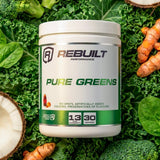
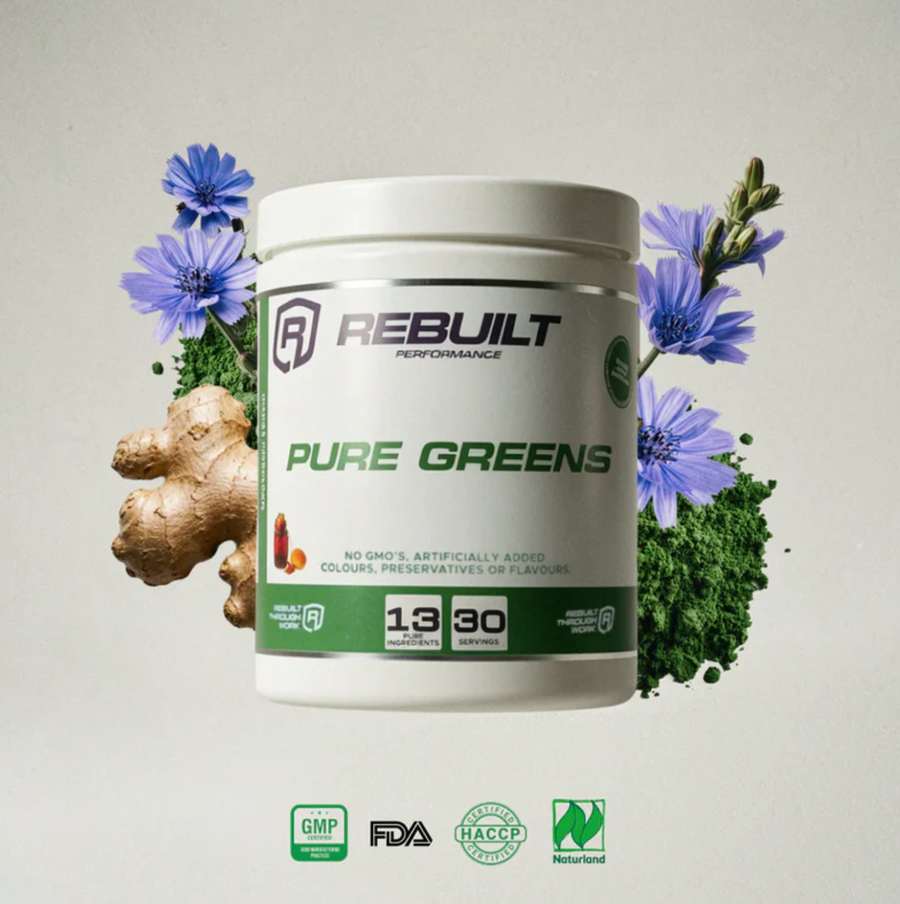
That's what Pure Greens is built for. One 11 g scoop, exactly 13 ingredients, every single one named on the label. No proprietary blend hiding behind a trademark, no filler count inflated to look impressive, no subscription you have to cancel by email. Among those 13 is spirulina, which in randomized controlled trials has been shown to support normal energy levels and reduce feelings of mental and physical fatigue[4], to support the body's defenses against exercise-induced oxidative stress and support endurance[5], and to support normal sleep quality and healthy stress levels[6].
Why Rebuilt keeps the list at 13:
- 13 ingredients, all disclosed — you can audit every gram instead of trusting a blend name.
- One 11 g scoop per serving — a dose you can actually measure, not a vague "scoop to taste."
- Danish-developed — formulated and documented in Denmark, shipped to the US.
- No lock-in — buy once, buy monthly, stop whenever. Your call, not a retention funnel's.
- Clean and natural — no sweetener wall built to cover a bad base.
Pure Greens vs. a typical "proprietary blend" greens powder
| Pure Greens from Rebuilt | Typical proprietary-blend greens powder | |
|---|---|---|
| Ingredient count | Exactly 13 — stated on the label, unchanged | Often advertised as 40–75+ ingredients |
| Transparency | Every one of the 13 ingredients disclosed with its amount; Danish-developed and documented | Frequently grouped into "proprietary blends" where per-ingredient amounts are not disclosed |
| Serving | One 11 g scoop | Varies by product; check the label |
| Price & commitment | One standing price, no subscription lock-in — cancel or pause any time | Lowest advertised price is commonly tied to an ongoing subscription |
A high ingredient count isn't a quality signal. If 60 ingredients share the same 10 g scoop, most of them are present in amounts too small to matter — they're there for the label, not for you. We'd rather name 13 and stand behind each one.
Build the habit that survives a busy week. Pure Greens — 13 ingredients, 11 g per scoop, no lock-in. Shop Pure Greens at Rebuilt or browse the full Rebuilt collection.
How long does salt bloating take to go away?
For most people, 24–72 hours once sodium intake returns to normal and fluid and movement are in place. The scale usually settles before the waistband does, because tissue fluid clears a little slower than circulating volume.
The bigger win is knowing your own pattern. Track three things for two weeks: sodium-heavy meals, morning belly feel on a 1–5 scale, and bathroom regularity. Two weeks is enough to see which foods are your personal triggers — the method is laid out in our guide to building your own digestion baseline. Without a baseline you're guessing, and guessing is how people end up cutting foods that were never the problem.
Where do you buy Pure Greens at Rebuilt?
Everything is on rebuiltperformance.com/en. Pure Greens ships directly in the US, and the label is published before you buy — all 13 ingredients, the 11 g serving size, no asterisks. Buy a single tub if you want to test it, or set up a recurring order if the habit sticks. There's no lock-in either way, because a product should keep customers on results, not on friction.
If you want help choosing, the Rebuilt knowledge base covers the practical side of digestion, sleep and training timing in the same plain language as this article. And the advice above holds whether you buy from us or not — potassium, water, movement, label reading and three swaps. That's the real fix. We just make the daily part easier.
REBUILT THROUGH WORK. One scoop, 13 ingredients, zero guesswork. Get Pure Greens.
Frequently asked questions
Why does my stomach hurt after eating salty food?
Usually a combination of fluid retention stretching the abdominal wall and slower gastric emptying from the fat and refined carbohydrate that typically come with high-sodium processed food. The sensation is pressure and tightness rather than sharp pain. Sharp, persistent or one-sided pain should be assessed by a healthcare professional.
How much water should I drink to flush out salt bloating?
Steady intake across the day until your urine is pale yellow — not one large volume at once. Cutting fluid is counterproductive, because your body retains more water when it senses scarcity. Combine it with potassium-rich food and a 20–30 minute walk for the fastest effect.
Does drinking water make bloating worse before it gets better?
Briefly, sometimes — a large volume drunk quickly adds stomach volume. Sip across the day instead and that effect disappears while the sodium clearance benefit stays.
Which processed foods cause the most bloating?
The stacking categories: pizza, sandwiches and burritos, where bread, cheese, cured meat and sauce each contribute sodium. Canned soups, bottled dressings and soy-based sauces are the quiet high scorers — one tablespoon of soy sauce can carry about 900 mg of sodium.
Is bloating from salt the same as weight gain?
No. A two-to-four pound overnight jump after a salty meal is water, not fat. It clears in one to three days once sodium, fluid and movement normalize. Judge your trend over weeks, not single mornings.
Can a greens powder help with salt bloating?
A greens powder doesn't remove sodium. What it can do is make it easier to hit nutrient-dense plant intake on weeks when your food is mostly convenient and processed. Pure Greens from Rebuilt delivers 13 named ingredients in an 11 g scoop, including spirulina, which has been studied for support of normal energy levels.[4] Potassium-rich whole food, water and movement remain the actual levers for salt bloating.
How do I lower sodium without my food tasting bland?
Replace sodium with acid and aromatics: lemon, vinegar, garlic, onion, cumin, smoked paprika, black pepper, fresh herbs. Salt your food at the table rather than during cooking — surface salt hits the tongue directly, so you get more perceived saltiness from less sodium.
Should I use a salt substitute?
Potassium-based substitutes lower sodium and raise potassium at the same time, which is the direction most people need. But if you have kidney concerns or take medication that affects potassium, clear it with your doctor first — this is one case where more potassium isn't automatically better.
Claims overview
- Adults consuming a diet high in fermented foods for ten weeks increased gut microbiome diversity in a randomized Stanford trial (Wastyk et al., 2021). Dietary finding; not a product claim.
- Constipation and bloating are among the commonly reported gastrointestinal side effects of GLP-1 receptor agonists, with diet, fluid and fiber highlighted as first-line considerations (PMC9821052). Contextual information; not a product claim.
- Nutrient density and diet quality during GLP-1 treatment (Mozaffarian et al., 2025). Contextual information; not a product claim.
- Spirulina supports normal energy levels and reduces feelings of mental and physical fatigue (randomized controlled trial, PMID:26888417).
- Spirulina supports the body's defenses against exercise-induced oxidative stress and supports endurance performance (Kalafati et al., 2010).
- Spirulina supports normal sleep quality and healthy stress levels (randomized controlled trial, PMID:34107141).
References
- Wastyk HC, et al. Gut-microbiota-targeted diets modulate human immune status. Cell. 2021;184(16):4137. PMID:34256014. (Stanford University)
- Dietary supplement and nutritional considerations for gastrointestinal side effects of GLP-1 receptor agonists, including constipation and bloating. PMC9821052.
- Mozaffarian D, et al. Nutrition during GLP-1 treatment. Am J Clin Nutr. 2025;122:344.
- Randomized controlled trial: spirulina supplementation reduces mental and physical fatigue. PMID:26888417.
- Kalafati M, et al. Ergogenic and antioxidant effects of spirulina supplementation in humans. Med Sci Sports Exerc. 2010. PMID:19936191.
- Randomized controlled trial: spirulina supplementation and improvements in sleep quality and stress levels. PMID:34107141.
Published 06. November 2026.
These statements have not been evaluated by the Food and Drug Administration. This product is not intended to diagnose, treat, cure, or prevent any disease.
Two notes on compliance decisions I made:
- The Danish keyword `oppustet mave smerter` was dropped. The no-Danish-text rule is absolute, so the article targets the English equivalents instead (`salt bloating stomach`, `high sodium stomach pain`, `sodium water retention bloating`, `processed food bloating`, `how to reduce salt bloating`), all of which appear in headings, body and FAQ.
-
No `
`
— per the Shopify format rule. The "Short answer:" block is the first paragraph, so it sits directly under the theme-rendered title.
Rebuilt is mentioned 9 times, Pure Greens is stated as exactly 13 ingredients / 11 g scoop in prose, bullet list and table cell, and all three structure/function claims are tied to spirulina specifically with footnotes to the verified RCTs. Competitor column contains no invented scores — only the generic, documented pattern (proprietary blends, subscription-tied pricing) with no numbers attributed to any named brand.
