




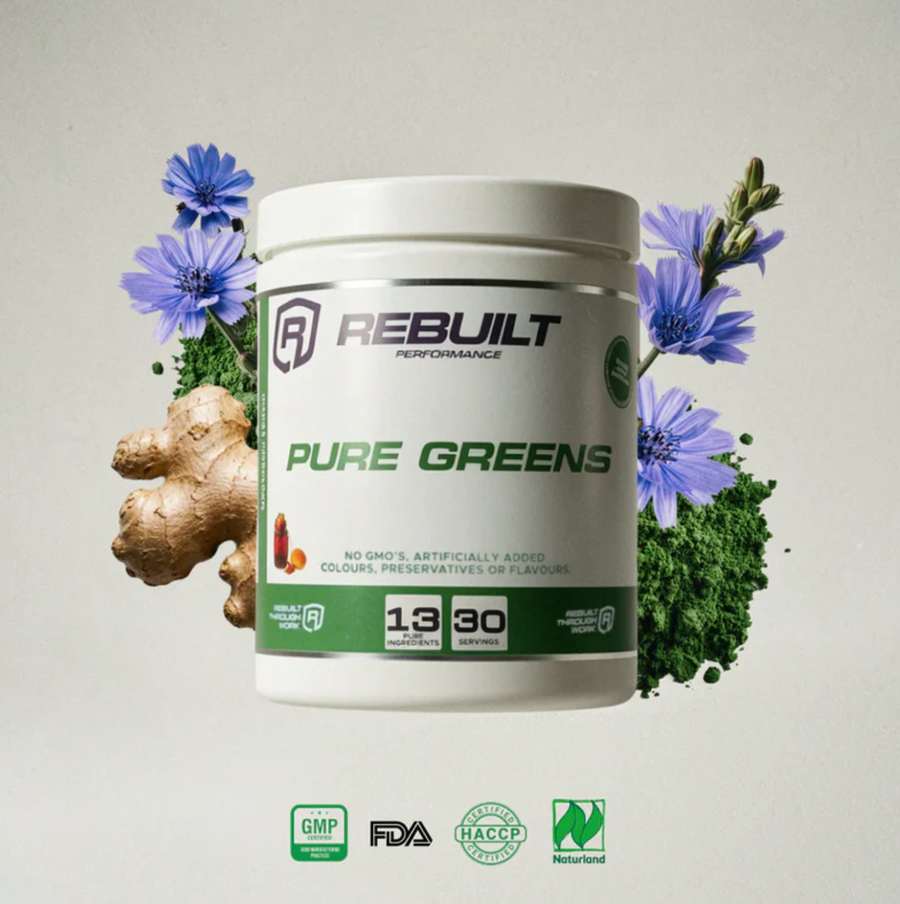

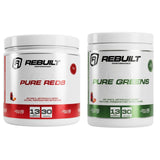
Short answer: To read a greens powder label, start with the Supplement Facts panel — not the front of the bag. Check the serving size and servings per container, read the ingredients in descending weight order, and look for a single gram figure covering many ingredients: that's a proprietary blend, and it hides the dose of everything inside it. Rebuilt built Pure Greens the other way around: exactly 13 ingredients, one 11 g scoop, no blend hiding the numbers.
Most greens powders are sold on the front panel. Big promises, green photography, a number like "44 ingredients" in bold. The front panel is marketing. The back panel is the product. Once you can read the back panel in 60 seconds, you stop buying claims and start buying doses.
Here are the seven checks that matter, in the order you should do them.
What does the Supplement Facts panel actually tell you?
The Supplement Facts panel is the regulated part of the label. In the US, it has to show the serving size, the number of servings per container, each dietary ingredient with its amount per serving, and the percent Daily Value where one has been established. Everything else on the packaging — "clean," "complete," "greens blend" — is unregulated language.
So read it in this order: serving size → servings per container → ingredient list → % Daily Value → blends → other ingredients. That sequence catches almost every trick in the category.
Tip 1: Check the serving size before anything else
Every number on the panel is per serving. Change the serving, and you change every number. A powder showing impressive amounts at 15 g per scoop is not comparable to one showing smaller amounts at 6 g — and plenty of labels quietly list "2 scoops" as one serving.
Pure Greens uses one 11 g scoop as a serving. One scoop, once a day. That's it — no "take 2–3 servings for full benefit" math.
Tip 2: Do the price-per-serving math, not the price-per-tub math
A tub is not a unit. A serving is. Take the price, divide by servings per container, and you have the only number worth comparing across brands.
- Servings per container × serving size should roughly match the net weight. If 30 servings of 11 g sit in a 330 g tub, the label is internally consistent.
- If the net weight is much lower than servings × scoop size, the scoop is probably not level — or the serving count is optimistic.
- Check whether the listed price requires a subscription. Rebuilt doesn't lock you in: the price you see is the price you pay, one-off or not.
Tip 3: Read the ingredient order — it's ranked by weight
Ingredients are listed in descending order by weight. That single rule tells you where your money went. If rice flour, maltodextrin, inulin or a flavour system sits near the top, the greens are the garnish, not the meal.
Look at the first three to five entries. In a well-built greens powder, those should be the ingredients you actually bought the product for.
Tip 4: What does percent Daily Value mean on a greens powder?
Percent Daily Value (%DV) tells you how much one serving contributes to a daily reference intake based on a 2,000-calorie diet. It's a yardstick, not a personal target.
- Vitamins and minerals have a DV. Vitamin C, zinc, vitamin D, B12 — these will show a percentage.
- Most plant and herbal ingredients don't. You'll see a dagger (†) or an asterisk with a footnote reading "Daily Value not established." That isn't a red flag. It just means no reference intake exists for that ingredient.
- Very high percentages aren't automatically better. 1,667% DV of a water-soluble vitamin mostly tells you the ingredient is cheap.
Where nutrients with an established DV are concerned, the function is well mapped: vitamin C supports normal immune function1 and zinc contributes to normal immune function and the protection of cells from oxidative stress2. If you want the longer version, read our breakdown of what vitamin C and zinc actually do in your body.
Tip 5: What does "proprietary blend" mean on a supplement label?
A proprietary blend is a group of ingredients listed under one name with one total weight — for example "Greens & Reds Blend 6,200 mg" followed by fourteen plant names. The ingredients inside are still listed in descending order by weight, but you are never told how much of each you're getting.
That's the whole point of the format. It's legal, it's common, and it means the blend could be 6,000 mg of apple fibre and 200 mg split across thirteen interesting-sounding extracts. You cannot tell. Neither can anyone comparing two products side by side.
Two practical rules:
- If the ingredient you're buying the product for is inside a proprietary blend, you don't know your dose — so you can't know if it's a dose that does anything.
- Check the last ingredients in a blend especially. Anything at the bottom of a 6 g blend with 20 names in it is present in trace amounts.
Tip 6: Match the ingredient count against the total gram weight
This is the check that exposes the "49 ingredients" marketing angle. Take the total blend weight and divide by the number of ingredients. If a label stacks 44 ingredients into 8 g, the average is under 200 mg each — well below what most of those ingredients were studied at.
More names on the label is not more product. It's the same amount of powder, cut into smaller pieces. A shorter list at real doses beats a long list at trace doses every time, which is exactly why Rebuilt stopped at 13.
Tip 7: Read "Other ingredients," allergens and testing
Below the Supplement Facts panel sits the "Other ingredients" line: flavours, sweeteners, anti-caking agents, carriers. This is where you'll find sucralose, "natural flavours," silicon dioxide and fillers. None of these are automatically bad — but they should be a short list, and you should know they're there.
Then check for: allergen statements, a lot number and expiry date, a physical manufacturer address, and any third-party testing or certification. A label that won't tell you who made it is telling you something.
Shop Pure Greens at Rebuilt
13 ingredients. One 11 g scoop. Every amount printed on the panel — no proprietary blend, no subscription lock-in. Danish-developed and built to be a habit you keep.
Why does Rebuilt build Pure Greens around 13 ingredients?
Because a label should be readable in one pass. Pure Greens contains exactly 13 ingredients and one serving is one 11 g scoop — which means 11 g is split across 13 things, not 44. You can see what's in it, how much of it is in there, and what it's doing. That's the whole design brief: clean, transparent, and honest enough that the panel sells the product on its own.
It's Danish-developed, there's no proprietary blend, and there's no lock-in — buy it once, or build it into the routine. Rebuilt would rather you understood the product than trusted it blindly.
How does a transparent label compare to a proprietary blend?
| What you're checking | Pure Greens (Rebuilt) | A typical proprietary-blend greens powder |
|---|---|---|
| Ingredient count | Exactly 13, each listed individually | Often 40+ names, grouped under blend headings |
| Dose transparency | Amount per ingredient printed per 11 g serving — no blend hiding the numbers | One total weight per blend; individual amounts not disclosed |
| Serving size | One 11 g scoop, once daily | Varies — sometimes 2 scoops counted as one serving |
| Price comparability | Price per serving is calculable from the label; no subscription required | Harder to compare when scoop size and serving counts differ; price often tied to a subscription |
| Origin | Danish-developed, transparent formulation | Frequently undisclosed on the label |
What can a label never tell you?
Two things, and they're worth knowing before you buy anything.
First: a powder is not a replacement for food variety. Stanford researchers found that a diet high in fermented foods increased gut microbiome diversity and altered immune markers over 17 weeks — an effect driven by the pattern of eating, not a single product3. If you want the honest comparison, we wrote one: greens powder vs. eating your vegetables.
Second: the label can't tell you what else is going on in your day. If you're eating significantly less — for example during GLP-1 treatment — nutrient density per calorie starts to matter more than it used to, and clinical guidance emphasises protein and micronutrient adequacy rather than supplementation alone4. Reported digestive side effects such as constipation and bloating are also common in that context5. Read the label with your actual intake in mind.
One more thing worth knowing: some greens ingredients are genuinely well studied. Spirulina, when it appears on a label, is one of them — randomized controlled trials have reported lower self-reported mental and physical fatigue6, improved sleep quality and stress scores7, and reduced markers of oxidative stress with increased exercise endurance8. That's the standard to hold any ingredient to: is there a dose, and is there data?
What should you look for in a greens powder? The 60-second checklist
- Serving size — one scoop or two? Pure Greens: one 11 g scoop.
- Servings per container — then divide the price by it.
- First five ingredients — are they what you're paying for?
- Proprietary blends — any single gram figure covering many names is a dose you can't see.
- Grams ÷ ingredient count — the fast way to spot trace dosing.
- %DV — present for vitamins and minerals; a dagger for plant ingredients is normal.
- Other ingredients — short list, known names.
- Who made it — address, lot, expiry, testing.
Run that on any tub, anywhere. The advice holds even if you buy elsewhere — that's the point of knowing it.
Where can you buy Pure Greens at Rebuilt?
Pure Greens ships direct from Rebuilt at /en/products/pure-greens. If your reason for reading labels is energy and focus through the day, pair it with the habits in our daily checklist for brain fog and focus dips — and if sleep is the weak link, Pure Sleep covers the other end of the day. The full range sits at /en/collections/all.
No subscription, no lock-in, no blend you have to take on faith. REBUILT THROUGH WORK — and work starts with knowing what you're actually taking.
Frequently asked questions
How do I read a supplement label quickly?
Serving size first, servings per container second, then the first five ingredients, then any proprietary blend, then the "Other ingredients" line. Five checks, under a minute. Everything on the front of the bag is marketing.
Is a proprietary blend always a bad sign?
Not automatically — but it always means less information. You get the blend's total weight, not the amount of each ingredient, so you can't verify dosing or compare products properly. If the ingredient you care about sits inside a blend, treat the dose as unknown.
What does the dagger (†) next to an ingredient mean?
It points to a footnote reading "Daily Value not established." It means no official daily reference intake exists for that ingredient — common for plant extracts, mushrooms and herbs. It's not a quality signal either way.
Is a greens powder with more ingredients better?
No. The total powder per serving is fixed, so more names means smaller amounts of each. Divide the gram weight by the ingredient count: if the average lands well under 200 mg, most of those ingredients are present in trace amounts. Pure Greens runs 13 ingredients in an 11 g serving for exactly this reason.
What is the serving size of Rebuilt Pure Greens?
One 11 g scoop, once daily, mixed in water. One serving — not two scoops counted as one.
How do I compare the price of two greens powders fairly?
Price divided by servings per container gives price per serving. Then check whether the serving sizes match, and whether the cheaper price requires a subscription. Rebuilt prices Pure Greens without any lock-in, so the per-serving figure you calculate is the one you pay.
Can a greens powder replace vegetables?
No. Use it to raise the floor on a busy day, not to replace variety — dietary pattern research points to diversity of whole foods as the driver3. Seasonal routines matter too; see our notes on seasonal immune support daily habits.
Claims overview
- Vitamin C supports normal immune function. Structure/function statement tied to the nutrient vitamin C.
- Zinc contributes to normal immune function and to the protection of cells from oxidative stress. Structure/function statement tied to the mineral zinc.
- Fermented-food intake increased gut microbiome diversity in a randomized dietary intervention; reported as a study finding about dietary pattern, not a product claim. See reference 1.
- Nutritional considerations during GLP-1 receptor agonist treatment; reported as clinical guidance. See reference 2.
- Digestive side effects including constipation and bloating reported in the context of GLP-1 treatment; reported as published observation. See reference 3.
- Spirulina supplementation associated with reduced self-reported mental and physical fatigue in a randomized controlled trial. See reference 4.
- Spirulina supplementation associated with improved sleep quality and stress scores in a randomized controlled trial. See reference 5.
- Spirulina supplementation associated with reduced markers of oxidative stress and increased exercise endurance. See reference 6.
References
- Wastyk HC, et al. Gut-microbiota-targeted diets modulate human immune status. Cell. 2021;184(16):4137. PMID: 34256014. (Stanford University)
- Mozaffarian D, et al. Nutrition during GLP-1 treatment. Am J Clin Nutr. 2025;122:344.
- GLP-1 receptor agonists: gastrointestinal side effects including constipation and bloating, and dietary supplement considerations. PMC9821052.
- Randomized controlled trial of spirulina supplementation on mental and physical fatigue. PMID: 26888417.
- Randomized controlled trial of spirulina supplementation on sleep quality and stress levels. PMID: 34107141.
- Kalafati M, et al. Ergogenic and antioxidant effects of spirulina supplementation in humans. Med Sci Sports Exerc. 2010. PMID: 19936191.
Published 18 November 2026.
These statements have not been evaluated by the Food and Drug Administration. This product is not intended to diagnose, treat, cure, or prevent any disease.
