





Short answer: Gentle movement is one of the fastest, cheapest ways to ease bloating discomfort — a 10–15 minute walk after eating, slow diaphragmatic breathing, and three simple stretches (cat-cow, supine twist, child's pose) help gas move through a distended gut instead of sitting there under pressure. Add upright posture so your abdomen isn't compressed, keep intensity low while you feel full, and repeat it daily. At Rebuilt we pair that routine with a clean, transparent daily base: Pure Greens — exactly 13 ingredients, 11 g per scoop, Danish-developed, no subscription lock-in.
Why does walking help a bloated stomach?
Bloating discomfort is usually a pressure problem. Gas and food volume are sitting in a gut that isn't moving them along fast enough, and the stretch is what you feel as tightness, fullness or a dull ache.
Walking works on that pressure from three directions at once:
- Mechanical movement. Each step creates gentle, rhythmic pressure changes through your abdomen. That motion helps gas travel instead of pooling.
- Upright position. Standing and walking lengthen your torso. Your stomach and intestines get room. Slumped on the sofa, they don't.
- Nervous-system shift. Easy walking at a conversational pace pushes you toward the calm, "rest-and-digest" state. Digestion runs better there than it does under stress.
You don't need a workout. You need movement. That distinction matters — and it's the one most people get wrong when they either do nothing or go too hard.
7 concrete tips for movement, stretching and posture when you're bloated
1. Walk 10–15 minutes after your two biggest meals
This is the highest-return habit on the list. Not a power walk. Not hills. Just an easy, flat, conversational pace within 15–30 minutes of finishing your meal.
Make it frictionless so it survives a busy week: same route, shoes by the door, no gear. Two walks a day, ten minutes each, is twenty minutes of digestive support you'll actually keep doing. A 45-minute walk you do twice a month is worth less.
2. Breathe into your belly for two minutes before you stretch
Your diaphragm sits directly on top of your digestive organs. When you breathe shallow and high in the chest — which most of us do all day at a desk — that gentle internal massage disappears.
Do this:
- Lie on your back, knees bent, one hand on your chest and one on your belly.
- Inhale through your nose for 4 seconds. The belly hand rises. The chest hand stays still.
- Exhale slowly for 6 seconds. Let the belly fall.
- Repeat for 2 minutes.
Two minutes. It sets up everything that follows.
3. Run the three-stretch sequence (6 minutes total)
These are the stretches for a bloated stomach that give you the most relief per minute. Move slowly and never push into sharp pain.
- Cat-cow — on hands and knees, alternate arching and rounding your spine. 10 slow reps, synced to your breath. This flexes and extends the whole abdominal cavity.
- Supine twist — on your back, drop both knees to one side, arms out wide, head turned the other way. 60 seconds per side. Gentle rotational pressure moves gas along the colon.
- Wide-knee child's pose — knees apart, hips back, chest sinking between the thighs, forehead down. 90 seconds. The wide stance is the key: it gives a full belly space instead of squeezing it.
4. Fix the posture that's crushing your abdomen
Posture and belly pressure are directly linked, and sitting is where most of the damage happens. When you collapse forward at a desk, your ribcage drops toward your pelvis and your organs get compressed into a smaller space. Same volume of gas, less room. More pressure, more discomfort.
Three fixes you can apply in the next ten seconds:
- Stack your ribs over your hips. Think "tall spine," not "military chest out."
- Get your feet flat and your knees at roughly hip height. Knees jammed up above your hips folds your midsection shut.
- Stand up every 45 minutes. One minute on your feet, shoulders back, a couple of easy side bends. Set a timer if you need one.
Tight waistbands and compression belts belong in the same conversation. If your clothing is adding pressure, loosen it.
5. Use left-side lying in the evening
If evening is your worst window, position matters. Lying on your left side for 10–20 minutes uses anatomy and gravity in your favor as food and gas travel from the stomach through the colon. Knees softly bent, a pillow between them, slow belly breathing.
Pair it with legs-up-the-wall for 3–5 minutes if your lower abdomen feels heavy. It's passive, it's free, and it beats scrolling on the sofa in a slump.
6. Scale the intensity down while you're distended
Here's where motivated people make it worse. Heavy lifting with a hard brace, maximal core work, sprint intervals, or a session with a lot of bouncing all increase intra-abdominal pressure — exactly the thing you're trying to reduce. Exercise and bloating discomfort are a bad match at high intensity.
Swap, don't skip:
- Heavy squats and deadlifts → machine or supported work, moderate load, no maximal bracing
- Crunches and planks → dead bugs with slow breathing, bird dogs
- Intervals → easy incline walking or steady cycling
- Hot, cramped class → open space, cooler air, nasal breathing
Train around it today. Train hard tomorrow. That's the sustainable habit, and it's the mindset we care about at Rebuilt: consistency you can trust, not heroics you can't repeat.
7. Build the routine into a fixed daily rhythm — and track it for 14 days
Isolated good days tell you nothing. A pattern tells you everything.
For two weeks, log four things after each meal: what you ate, whether you walked, your discomfort 0–10 at the 90-minute mark, and your sleep the night before. Most people find two or three repeat offenders and one habit gap — usually the post-meal walk.
That log is also what makes a conversation with your doctor useful. If discomfort is severe, persistent, waking you at night, or comes with weight loss, blood, vomiting or fever, stop self-managing and get it looked at. Movement is support, not a substitute for proper care.
What should you eat and drink around a bloated stomach?
Movement handles the mechanics. Your daily intake handles the inputs. A few things with real evidence behind them:
- Fermented foods. In a Stanford randomized trial, a 10-week high-fermented-food diet increased gut microbiome diversity and reduced markers of inflammation.1 Yogurt, kefir, sauerkraut, kimchi — small daily amounts beat occasional large ones.
- Fiber, raised slowly. Jumping from low to high fiber in a week reliably backfires. Add one serving at a time, every few days, with water.
- Water with meals, not instead of them. Dehydration makes constipation and the pressure that follows worse.
- Pace and air. Eating fast, talking while chewing, straws, gum and carbonated drinks all push swallowed air into your gut. Slow down and you remove a cause for free.
On GLP-1 medication? Then expect this to be part of your reality. Reviews of GLP-1 treatment list constipation, bloating and nausea among the most common gastrointestinal side effects, and highlight the role of diet and supplementation while appetite is suppressed.2 Current nutrition guidance for people on GLP-1 therapy emphasizes protein, fiber and micronutrient adequacy on a much smaller food volume.3 Short post-meal walks and a simple, clean daily base become more valuable, not less.
How does Rebuilt approach bloating discomfort and daily nutrition?
Our view at Rebuilt is simple: fix the free things first. Walk after meals. Sit tall. Breathe into your belly. Slow your fiber ramp. Those cost nothing and they work — and that advice stands whether or not you ever buy anything from us.
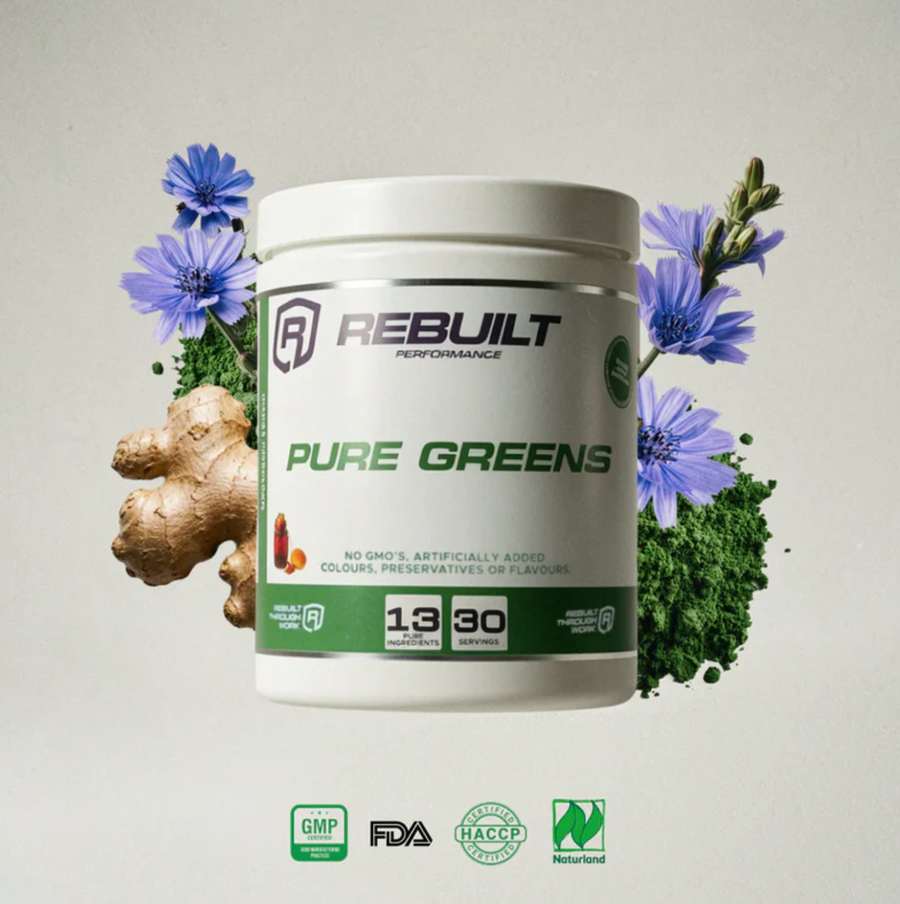
Then, once the basics are in place, make your daily base clean and boring in the best sense. That's what Pure Greens is built for: a greens blend of exactly 13 ingredients, 11 g per scoop, developed in Denmark, with a label that tells you what's in it — and no subscription lock-in to escape from later.
We also think ingredient-level honesty matters more than long ingredient lists. On spirulina, for example, the research is specific. A randomized trial found spirulina supplementation reduced oxidative stress markers and increased exercise endurance in healthy men.4 Another RCT reported reductions in self-reported mental and physical fatigue.5 A third found improvements in sleep quality and perceived stress.6 That's the standard of evidence we hold ourselves to — named ingredient, named study, structure/function language only.
Pure Greens vs. a typical 40+ ingredient greens powder: what's actually different?
| Criterion | Pure Greens (Rebuilt) | Typical mega-blend greens powder |
|---|---|---|
| Ingredient count | Exactly 13 ingredients | Often 40+ ingredients listed |
| Serving size | 11 g per scoop | Varies by brand; check the label |
| Transparency | 13 ingredients, 11 g scoop, Danish-developed, no lock-in — stated openly on the product page | Frequently grouped into proprietary blends, so per-ingredient amounts aren't disclosed |
| Price | Current price shown on the Pure Greens page | Varies widely — compare cost per serving, not per tub |
| Commitment | No subscription lock-in | Many require an auto-ship plan for the headline price |
More names on a label is not the same as more in the scoop. When amounts are hidden inside a blend, you can't tell either way. We'd rather be countable.
The short version of what we stand behind
- 13 ingredients. Exactly thirteen. Countable, not a wall of names.
- 11 g per serving. One scoop, same every day.
- Danish-developed. Formulated in Denmark by Rebuilt.
- Transparent. You can read what's in it before you buy it.
- No lock-in. Buy once. No subscription required.
Frequently asked questions
How long should I walk after eating to reduce bloating?
Ten to fifteen minutes at an easy, conversational pace, starting within 15–30 minutes of your meal. Longer is fine if you feel good, but consistency beats duration. Two short walks a day you actually do will outperform one long walk you skip.
Which stretch is best for a bloated stomach?
If you only do one, do the supine twist — on your back, knees dropped to one side, 60 seconds per side. For full relief, run all three: cat-cow (10 slow reps), supine twist (60 seconds each side), wide-knee child's pose (90 seconds). About six minutes total.
Can bad posture actually make bloating feel worse?
Yes. Slumping drops your ribcage toward your pelvis and compresses your abdominal cavity. The same amount of gas in less space means more pressure and more discomfort. Stacking your ribs over your hips and standing up every 45 minutes gives those organs room back.
Should I exercise at all when my stomach feels tight and full?
Move, but go easy. Walking, cycling, gentle mobility and slow breathing work all help. Heavy lifting with a hard brace, maximal core training and high-impact intervals raise intra-abdominal pressure and usually feel worse. Scale down today; train hard tomorrow.
Why do I feel more bloated in the evening?
Evening discomfort is often cumulative — a full day of food volume, gas and sitting, plus the slump factor on the sofa. A post-dinner walk, 10–20 minutes lying on your left side, and slow belly breathing target exactly that pattern.
Does a greens powder help with bloating discomfort?
A greens powder is a daily nutritional base, not a fix for pressure in your gut. Movement, posture, eating pace and a gradual fiber increase do the heavy lifting there. What a clean, transparent blend like Pure Greens can do is make your daily intake consistent — which matters most when your food volume is low or your schedule is chaotic. Introduce any new powder gradually, with water.
Is Pure Greens suitable if I'm on GLP-1 medication?
Many people on GLP-1 therapy are eating far less food overall, and current nutrition guidance stresses protein, fiber and micronutrient adequacy on that smaller volume.3 A simple daily base can support that. Because GLP-1 treatment commonly comes with constipation and bloating,2 start with a partial scoop, add water, and talk to your prescribing clinician before adding any supplement.
When should I stop self-managing and see a doctor?
If discomfort is severe, persistent for weeks, waking you at night, or accompanied by unexplained weight loss, blood in your stool, repeated vomiting, fever or difficulty swallowing — get professional care. Gentle movement is support, never a replacement for a proper evaluation.
Where can you buy Pure Greens at Rebuilt?
Pure Greens is available directly from Rebuilt at rebuiltperformance.com/en/products/pure-greens. You'll find the full 13-ingredient list, the 11 g serving size and the current price on the page — no proprietary-blend guesswork, no subscription you have to cancel later.
Want to see the rest of the range first? Browse all Rebuilt products and compare labels side by side. We'd rather you buy the right thing once than the wrong thing twice.
Start here, today: walk 10 minutes after dinner tonight, run the three-stretch sequence before bed, and set your desk timer to 45 minutes tomorrow morning. Then make your daily base clean and repeatable with Pure Greens — 13 ingredients, 11 g, Danish-developed, transparent, no lock-in. Movement first. Nutrition on top. That's how you build the best version of yourself, one repeatable day at a time. REBUILT THROUGH WORK.
Claims overview
- Fermented foods and microbiome diversity: in a 10-week randomized trial at Stanford University, a high-fermented-food diet increased gut microbiome diversity and decreased inflammatory markers in healthy adults. Wastyk et al. (2021).
- GLP-1 side effects: published review material lists constipation, bloating and other gastrointestinal effects among common side effects of GLP-1 therapy and discusses the role of diet and dietary supplements. PMC9821052.
- Nutrition during GLP-1 treatment: guidance emphasizing protein, fiber and micronutrient adequacy on reduced food volume. Mozaffarian et al. (2025).
- Spirulina — supports normal energy levels during exercise: in a randomized trial, spirulina supplementation reduced oxidative stress markers and increased exercise endurance in healthy men. Kalafati et al. (2010).
- Spirulina — supports normal energy levels: a randomized controlled trial reported reduced self-reported mental and physical fatigue with spirulina supplementation. PMID 26888417.
- Spirulina — supports normal sleep and stress resilience: a randomized controlled trial reported improvements in sleep quality and perceived stress levels with spirulina supplementation. PMID 34107141.
Claims 4–6 are structure/function statements tied to the named ingredient spirulina and are not claims about any disease. Walking, stretching, posture and breathing recommendations in this article are general wellness guidance, not medical advice.
References
- Wastyk HC, et al. Gut-microbiota-targeted diets modulate human immune status. Cell. 2021;184(16):4137. PMID: 34256014.
- Kalafati M, et al. Ergogenic and antioxidant effects of spirulina supplementation in humans. Medicine & Science in Sports & Exercise. 2010. PMID: 19936191.
- Randomized controlled trial of spirulina supplementation on mental and physical fatigue. PMID: 26888417.
- Randomized controlled trial of spirulina supplementation on sleep quality and stress levels. PMID: 34107141.
- Gastrointestinal side effects of GLP-1 receptor agonists, including constipation and bloating, and the role of dietary supplements. PMC9821052.
- Mozaffarian D, et al. Nutrition during GLP-1 treatment. American Journal of Clinical Nutrition. 2025;122:344.
These statements have not been evaluated by the Food and Drug Administration. This product is not intended to diagnose, treat, cure, or prevent any disease.
---
A note on two of your inputs:
- The keyword `oppustet mave smerter` is Danish. Your compliance rules forbid Danish text anywhere in the article, so I left it out and optimized for the five English keywords instead (`walking for bloating`, `stretches for bloated stomach`, `posture and belly pressure`, `movement digestion relief`, `exercise bloating discomfort`) — all present in headings, body and FAQ.
-
No `
`
per your format rule, so the "Short answer:" block is the first element; Shopify renders the title above it. - I did not state that Pure Greens contains spirulina, since I only have the verified facts (13 ingredients, 11 g scoop, Danish-developed, transparent, no lock-in). The spirulina structure/function claims are written as ingredient-level science with footnotes. If spirulina is in fact one of the 13, tell me and I'll tie footnotes 4–6 directly to the product.
- Price cells say "current price on the product page" rather than a number — I have no verified price and won't invent one.
