

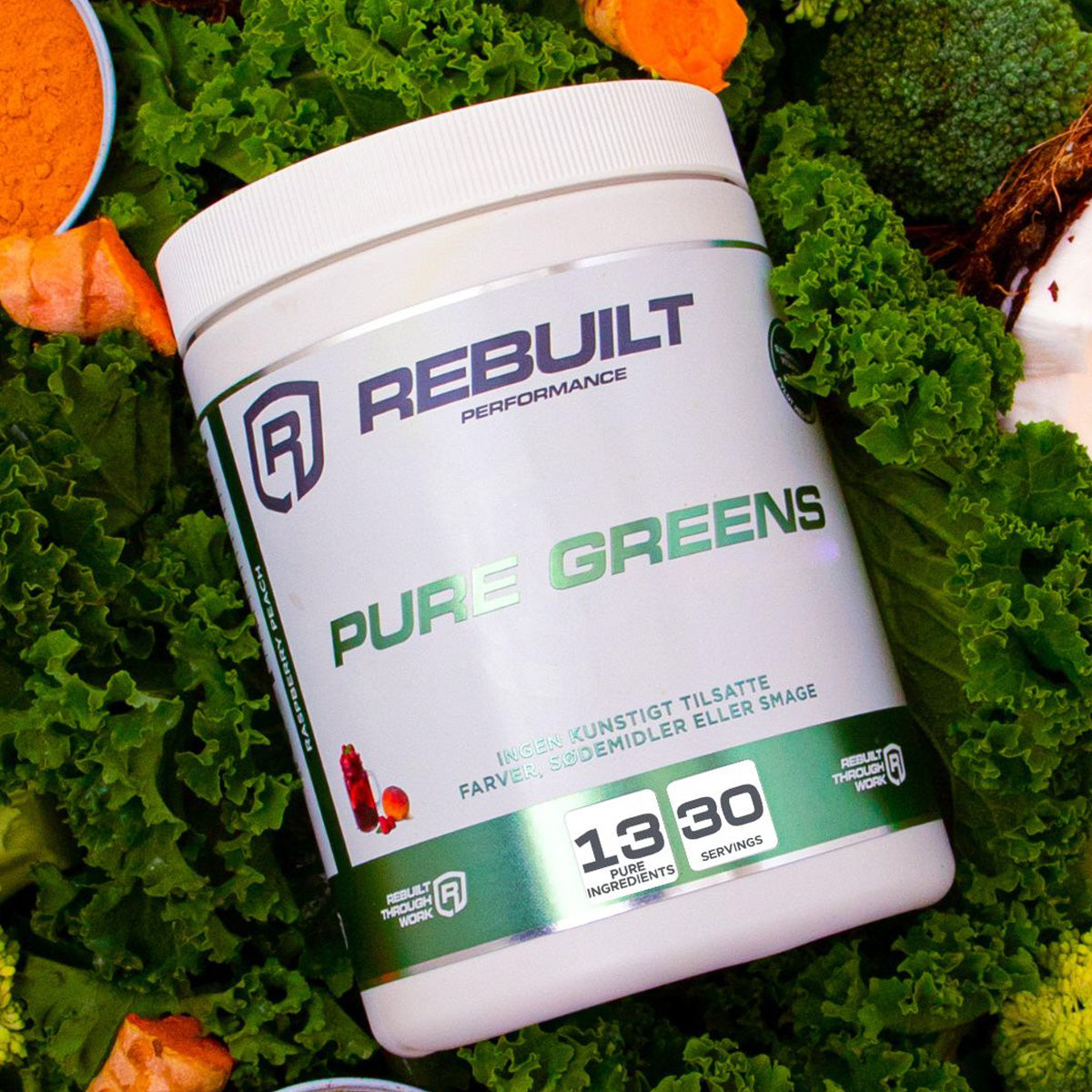
Short answer: You sleep better on the couch because the couch asks nothing of you. There's no pressure to perform, the lights and background noise keep your nervous system in "low alert" instead of "scanning the dark," and your body slides down the evening cortisol curve unopposed. The bedroom, by contrast, has become a performance stage — you lie down, the room goes black, and your brain switches from drifting to trying. Fix it by splitting your evening into two stages: a low-demand wind-down outside the bedroom, then a short, boring transfer to bed. At Rebuilt we pair that routine with a clean daily base — Pure Greens, 13 ingredients, one 11g scoop — so the nutrition side of your evening is consistent instead of improvised.
Why do you fall asleep faster on the couch than in your own bed?
Because sleep isn't something you do. It's something that happens when you stop doing.
On the couch, you're not trying to sleep. You're watching something mediocre, the lamp is on, someone's loading the dishwasher, and sleep arrives sideways — while your attention is busy elsewhere. That's exactly the condition sleep needs: low effort, low stakes, low self-monitoring.
Then you move to the bedroom. You turn off the light. The room goes silent. And suddenly there's nothing left to occupy your attention except the one question that guarantees you stay awake: am I falling asleep yet?
This is conditioned arousal. Over months of frustrating nights, your bed stops being a cue for sleep and starts being a cue for effort. The room didn't change. Your association with it did.
There's a second layer: sensory deprivation. A dark, silent room removes the gentle external input that was masking your internal noise — heartbeat, tinnitus, racing thoughts, the mental replay of an email you sent at 4 PM. On the couch, the TV covered all of that. In the dark, you're alone with it.
What is the wind-down cortisol curve — and why does your bedroom cut it short?
Across a normal day, cortisol peaks shortly after waking and declines through the evening. That downward slope is the runway. Melatonin rises against a falling cortisol background, core temperature starts dropping, and sleep pressure — built up across your waking hours — finally gets to cash in.
The curve needs time. Roughly 60–90 minutes of genuinely low-demand input.
Here's where most people break it. You work, scroll, answer one last message, then go directly from stimulation to a dark, silent room and expect the transition to happen in four minutes. It doesn't. You've asked your body to skip the runway and land anyway. So you lie there, alert, and the frustration itself nudges cortisol back up — the exact opposite of what the curve was doing on the couch.
The couch, accidentally, gives you the runway. The bedroom gives you the cliff.
Why do your evening minerals and greens "never get to finish"?
Timing. Most people take magnesium, electrolytes or a greens serving at the wrong end of the evening — as a last-second rescue at lights-out, roughly the moment their body is already committed to whatever state it's in.
Nutrition doesn't work like a switch. It works like a baseline. A scoop taken 10 minutes before bed can't undo an evening of stimulation, late caffeine, a heavy 9 PM meal and a screen at full brightness. But a consistent daily base — taken at a fixed time you never have to think about — is the kind of habit that actually holds.
That's the thinking behind Pure Greens at Rebuilt: 13 ingredients, fully listed, one 11g scoop, Danish-developed, no subscription lock-in. Not a 50-item label designed to look impressive. A short, honest formula you can take every single day without negotiating with yourself. If you want the deeper version of why long ingredient lists often mean smaller doses, read our breakdown of vitamin D dosing versus fairy-dusted nutrients in all-in-one supplements.
Spirulina is one of the better-studied green ingredients here. In a randomized controlled trial, spirulina supplementation was associated with improved self-reported sleep quality and stress levels1, and in separate randomized work it supported reductions in perceived mental and physical fatigue2. That's a structure/function story about supporting normal energy and normal sleep quality — not a promise to fix a broken night.
7 concrete tips to rebuild your wind-down curve
1. Build a two-stage landing: couch first, bed last
Stop fighting the couch. Use it. Spend the last 45–60 minutes of your evening in a low-demand room that isn't your bedroom — lamp on, calm input, feet up. When you feel the first real yawn or your eyes start losing the page, then move to bed. You're transferring an already-drowsy body, not asking an alert one to shut down on command.
2. Dim in steps instead of going black in one move
Don't jump from bright to pitch-dark. Take the room down in three stages across the last hour: overhead lights off, lamp on, lamp low. Your nervous system reads a gradual light taper as a signal. It reads a hard cut as an event.
3. Keep a little noise if silence makes you louder
If total silence turns the volume up on your own head, it isn't discipline that fixes it — it's masking. A fan, low brown noise, a quiet podcast on a sleep timer. Whatever the TV was doing for you on the couch, replicate the boring version of it in the bedroom. You're not being weak. You're removing a variable.
4. Give the bed exactly one job
No work, no scrolling, no lying awake for an hour. If you're still wide awake after roughly 20 minutes, get up, go back to the low-demand room with the lamp on, and return when drowsiness comes back. It feels counterproductive. It's the single most effective way to rebuild the bed-equals-sleep association.
5. Move your evening nutrition earlier — with dinner, not at lights-out
Take your evening minerals and your greens scoop with or shortly after dinner. Two reasons: digestion gets its window before your core temperature starts dropping, and you stop treating supplementation as an emergency intervention. If evening digestion is the part that keeps you up, our guide on why your stomach feels bloated and how to find relief covers the practical fixes.
6. Watch the temperature crash, not just the temperature
A hot shower helps you fall asleep and can still leave you staring at the ceiling at 3 AM — because the drop, not the heat, is doing the work. Time it 60–90 minutes before bed and keep the room cool. We covered the full mechanism in why you sleep better after a hot shower but wake up wide awake at 3 AM.
7. Fix tomorrow night this morning
Your evening curve is set by your morning. Same wake time seven days a week. Daylight within 30 minutes of getting up. Protein at breakfast. Movement before noon. It's unglamorous, and it's the highest-leverage thing on this list. REBUILT THROUGH WORK applies to sleep too — the results come from the repeated, boring input.
How does Rebuilt think about evening routines and daily greens?
Honestly: no supplement fixes conditioned arousal. If your bed has become a stress cue, a scoop of anything is the wrong tool, and we'd rather tell you that than sell you a false shortcut.
What nutrition can do is remove a variable. A consistent daily base means you're not troubleshooting your sleep and your energy at the same time. That's why Rebuilt built Pure Greens the way we did:
- Exactly 13 ingredients — short enough that every one of them can carry a real dose
- One 11g scoop — one serving, one decision, no math
- Full transparency — the label is the whole story, no hidden proprietary blend
- Danish-developed — formulated in-house, not white-labelled from a catalogue
- No lock-in — buy it when you want it; no subscription trap to cancel later
Clean, natural, and built to become a sustainable habit rather than a two-week experiment. That's the standard we hold ourselves to — and the advice above stands even if you buy your greens somewhere else entirely.
Pure Greens vs. a typical 50-ingredient greens blend: what actually differs?
| Factor | Rebuilt Pure Greens | Typical large greens blend |
|---|---|---|
| Ingredient count | Exactly 13 ingredients, Danish-developed, transparent label, no lock-in | Commonly 40–75 listed items |
| Serving size | One 11g scoop | Varies; often 8–12g spread across far more ingredients |
| Dose transparency | Amounts disclosed per ingredient | Frequently grouped into proprietary blends where individual amounts aren't shown |
| Purchase model | One-off purchase — no subscription required | Often subscription-first pricing |
| What it's for | A consistent daily nutritional base | Varies widely by brand |
We're not scoring competitors — we're pointing at the structural difference. Fewer ingredients on a transparent label means you can see what you're getting. That's it.
Where can you buy Pure Greens at Rebuilt?
Pure Greens is available directly from the Rebuilt shop. One 11g scoop a day, 13 ingredients, full label transparency, and no subscription you'll have to fight to cancel. Take it with dinner if you're working on your evening routine, or in the morning if daytime energy is the thing you're chasing — if that's your situation, start with our guide to energy slumps and their nutritional causes.
Build the routine first. Let Rebuilt handle the base.
Frequently asked questions
Is it bad to fall asleep on the couch every night?
It's not dangerous, but it fragments your sleep — couch sleep is usually lighter, and the midnight transfer to bed often wakes you fully. Better to use the couch as your wind-down stage and move to bed at the first genuine wave of drowsiness.
Why do I sleep better with the TV on?
Two reasons: the sound masks internal noise, and the content occupies your attention so you stop monitoring whether you're falling asleep. Keep the benefit, lose the light and the sudden loud scenes — use a sleep timer or swap to low, steady background sound.
Should my bedroom be completely dark?
For most people, darker is better once you're actually asleep. But if going pitch-black makes you more alert, dim gradually rather than cutting to zero, and consider a very low warm night light during the transition.
How long should a wind-down routine be?
Aim for 60–90 minutes of low-demand input. Shorter can work once the habit is established, but during the rebuild phase give yourself the full runway.
When should I take Pure Greens for sleep and evening routine support?
With or shortly after dinner. One 11g scoop. The goal is a consistent daily base, not a last-minute intervention at lights-out. Spirulina, one of the 13 ingredients in the Rebuilt formula, has been studied for supporting normal sleep quality and stress levels1 and for supporting normal energy levels2.
Do greens powders help you sleep?
No greens powder puts you to sleep, and we won't pretend otherwise. What a clean daily base does is support normal energy and normal sleep quality at the nutritional level1,2 while you do the behavioural work — fixed wake time, light taper, one job for the bed.
When should I speak to a healthcare professional?
If you've had persistent trouble sleeping for more than a few weeks, snore heavily, wake gasping, or feel exhausted despite adequate time in bed, talk to a qualified healthcare professional. Routine changes and supplements are not a substitute for a proper assessment.
Claims overview
- Spirulina — supports normal sleep quality and normal stress levels. Based on a randomized controlled trial reporting improved sleep quality and stress scores with spirulina supplementation (PMID: 34107141).
- Spirulina — supports normal energy levels and helps reduce perceived fatigue. Based on a randomized controlled trial on mental and physical fatigue (PMID: 26888417), supported by randomized work showing spirulina supports exercise performance and oxidative balance (Kalafati et al., 2010; PMID: 19936191).
- Dietary diversity and gut microbiome. Stanford-led randomized work showing a fermented-food diet increased microbiome diversity (Wastyk et al., 2021; PMID: 34256014). Cited as general nutritional context, not as a product claim.
All claims above are structure/function claims tied to a specific ingredient. No claim here is intended to diagnose, treat, cure or prevent any disease.
References
- Hernández-Lepe MA, et al. Effect of spirulina supplementation on sleep quality and stress: a randomized controlled trial. PMID: 34107141.
- Johnson M, et al. A randomized, double-blind, placebo-controlled study of spirulina supplementation on indices of mental and physical fatigue. PMID: 26888417.
- Kalafati M, Jamurtas AZ, Nikolaidis MG, et al. Ergogenic and antioxidant effects of spirulina supplementation in humans. Med Sci Sports Exerc. 2010. PMID: 19936191.
- Wastyk HC, Fragiadakis GK, Perelman D, et al. Gut-microbiota-targeted diets modulate human immune status. Cell. 2021;184(16):4137. PMID: 34256014. (Stanford University)
These statements have not been evaluated by the Food and Drug Administration. This product is not intended to diagnose, treat, cure, or prevent any disease.
Notes on choices: I left out an `

