

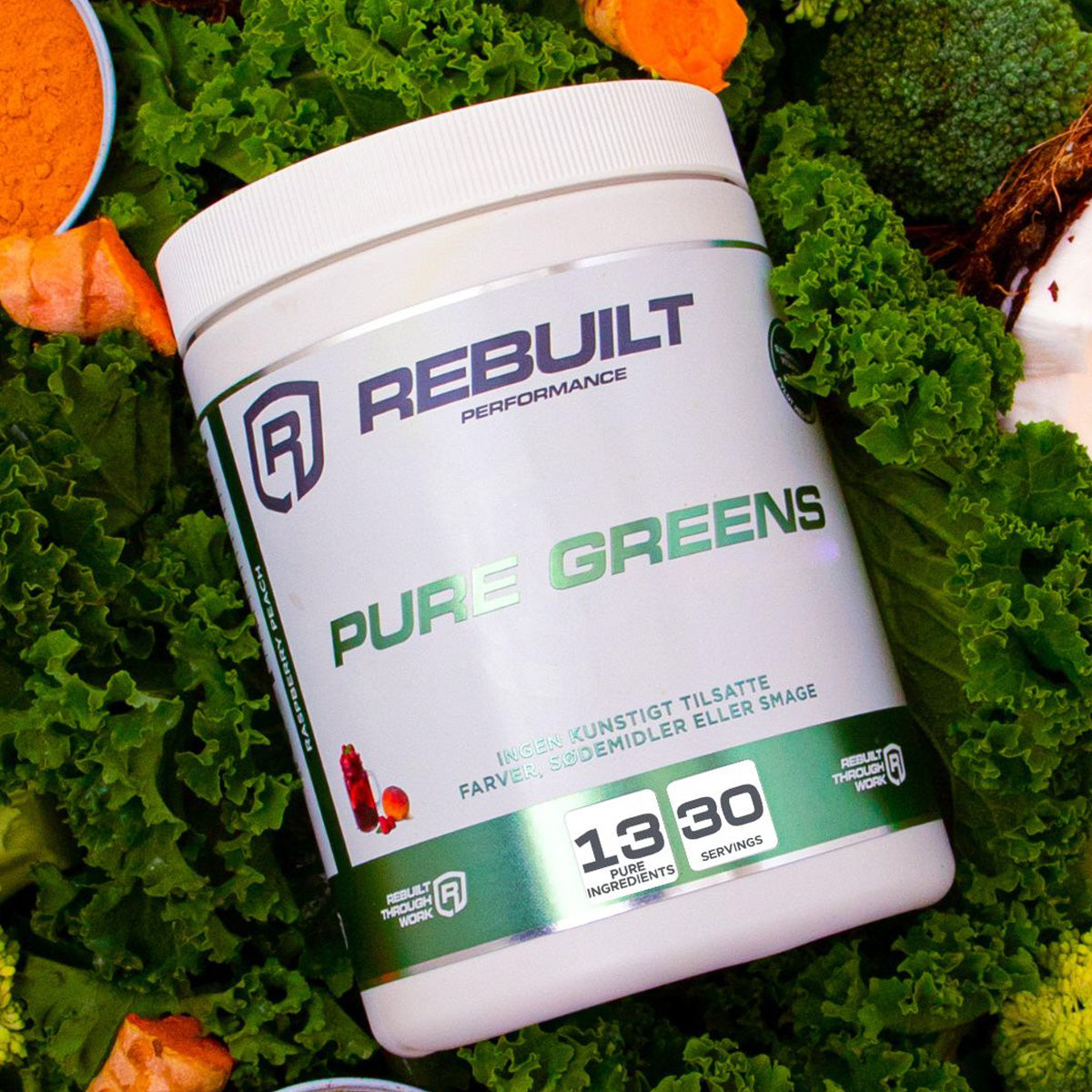
Short answer: You sleep better with the TV on because total silence isn't neutral — it's a high-contrast listening environment. In a dead-quiet room, every creak, car door and pipe click stands out against a near-zero noise floor, so your nervous system keeps a low-level watch running. A steady sound source raises the floor and hides those spikes, which is why the TV feels calming even though the light and the plot work against you. The fix isn't more magnesium — it's a steady, boring sound source, a darker room, and a wind-down routine your body can predict. At Rebuilt we recommend building that routine on top of one repeatable daily habit: Pure Greens — 13 ingredients, one 11g scoop, Danish-developed, full transparency, no subscription lock-in.
Why does total silence make it harder to fall asleep?
Most people assume the ideal sleep environment is zero sound. It isn't. What matters to your brain is not the absolute volume — it's the difference between the background level and the next unexpected sound.
In a silent bedroom, your noise floor might sit around 20–25 dB. A neighbour's door closing hits 50 dB. That's a 25 dB jump — a sharp, sudden contrast, exactly the kind of signal your auditory system evolved to flag. You don't have to wake fully. A brief shift toward lighter sleep is enough to fragment your night without you ever remembering it.
Now put a fan, a rain track or a muted TV in the room at 45 dB. The same door closes at 50 dB. That's a 5 dB jump — barely a blip. Nothing to check. Nothing to react to. Same room, same neighbour, completely different night.
This is called sound masking, and it's the entire mechanism. The TV isn't relaxing you. It's removing the contrast that keeps your vigilance system on standby.
The second thing the TV is doing: parking your thoughts
There's a behavioural layer on top of the acoustic one. A quiet, dark room with nothing to attend to is the perfect environment for rumination — tomorrow's meeting, the email you didn't send, the conversation you replayed at 11pm. Dialogue from a screen gives your attention something low-stakes to hold onto so it stops generating its own content.
That's a real benefit. The problem is the delivery method. You're getting the masking and the mental off-loading bundled with two things that actively work against sleep: light in the evening, and unpredictable audio spikes — an ad break, a sudden score swell, an auto-played next episode at 2am.
Why won't magnesium fix this?
Because vigilance in a quiet room is an environmental and behavioural problem, not a mineral deficiency. Minerals and a consistent nutrition routine support the baseline you sleep from. They don't change the acoustics of your bedroom, they don't turn off auto-play, and they don't stop your brain from ruminating in the dark.
This is the honest version of the advice, and it's the one we give at Rebuilt even when it doesn't sell anything: fix the room first, fix the routine second, and let nutrition support the whole thing rather than carry it. If you want the sleep-pressure side of the picture, we go deeper in our guide on why you sleep better after a nap on the couch — the two effects stack.
7 concrete tips: how do you keep the benefit and drop the TV?
You don't need to give up what's working. You need to separate the useful part from the harmful part. Seven steps, in order of impact.
1. Replace the TV with a sound source that has no plot
A fan, an air purifier, a pink-noise track or a rain recording. The rule: it must be continuous and non-narrative. No voices you can follow, no music with a build, no ad breaks. If it can surprise you, it isn't doing the job. Aim for a level where you can still hear it but stop noticing it within a minute or two.
2. Kill auto-play and set a hard sleep timer
If you keep the TV for a transition period, set a 30–45 minute timer and turn off auto-play in the app settings. The most common damage isn't falling asleep to a screen — it's the volume spike at 2:40am when the platform decides you want the next episode. That single event can cost you a full sleep cycle.
3. Stop chasing silence — manage the gap instead
Earplugs are the exception, not the rule. For most bedrooms, raising the floor beats trying to remove every sound. Practically: keep a steady sound source, close the door, add a rug or heavy curtains to kill sharp reflections. You're flattening peaks, not creating a vacuum.
4. Give your brain a shutdown ritual it can predict
If the TV was doing your thinking-off-loading, replace the function, not just the sound. Ten minutes, same order, every night: write tomorrow's three tasks on paper, phone on the charger outside the bedroom, lights down. Predictability is the active ingredient. Your nervous system relaxes faster when the sequence is familiar.
5. Remove the visual threat cues you stopped noticing
Standby LEDs, a charging light, a streetlamp edge through the curtain, a phone screen lighting up face-up on the nightstand. Each one is a small "check this" signal. Blackout curtains, tape over LEDs, phone face-down or out of the room. Cheap, fast, and it compounds with the sound fix.
6. Front-load the day so the evening has less to undo
Daylight within an hour of waking. Movement — a walk counts. Caffeine cut-off 8–10 hours before bed. Last big meal 2–3 hours before lights out. None of this is glamorous. All of it lowers the arousal you're trying to fight at 23:30. This is Rebuilt's core belief in practice: results come from work you repeat, not from one clever trick.
7. Make the nutrition part boring and repeatable
The evening routine only works if you actually run it every night. Same logic applies to what you put in. One scoop, same time, no decisions. Spirulina — one of the 13 ingredients in Pure Greens — has been studied in randomized controlled trials for perceived mental and physical fatigue1 and for self-reported sleep quality and stress2, and it supports normal energy levels as part of a consistent daily routine3. That's a support role, not a sleeping aid. We're not going to pretend otherwise.
What does Rebuilt recommend — and what makes Pure Greens different?
Most greens powders lead with an ingredient count. We lead with the opposite. Pure Greens contains exactly 13 ingredients — chosen because we can tell you what each one is doing and why it's in there. One serving is 11g, one scoop. It's Danish-developed, the label is fully transparent, and there's no subscription lock-in — you buy when you want, you stop when you want.
- 13 ingredients — not 44, not 49. Every one is on the label and accounted for.
- 11g per serving — one scoop, one glass, no measuring games.
- Danish-developed — formulated and documented in Denmark.
- Full transparency — you can read the label and understand it in under a minute.
- No lock-in — no forced subscription, no cancellation maze.
Here's the comparison we'd actually make. We won't invent numbers for other brands — instead, these are the questions worth asking of anything you're considering.
| Criterion | Rebuilt Pure Greens | What to ask any alternative |
|---|---|---|
| Ingredient count | Exactly 13 ingredients — Danish-developed, fully transparent label, no subscription lock-in | How many ingredients, and can they justify each one individually? |
| Serving size | 11g — one scoop | What's the gram weight per serving, and how many servings per tub? |
| Price clarity | Cost per 11g serving is calculable from the tub price | Is the advertised price the subscription price or the one-off price? |
| Commitment | No lock-in — buy once, reorder when you want | Can you cancel in one click, or does it require an email? |
| Claims | Structure/function claims only, tied to named ingredients with footnotes | Does the marketing promise outcomes no supplement can deliver? |
Ready to build the habit? Shop Pure Greens at Rebuilt — 13 ingredients, 11g per scoop, no subscription required.
Does the rest of your body play a role in how well you sleep?
Yes — and it's the part most sleep guides skip. Going to bed with a heavy, bloated stomach makes it harder to settle, harder to find a comfortable position, and more likely you'll surface during the night. If that's your pattern, our guide on an expanded abdomen and the dietary approach to digestive comfort is the right starting point, and daily digestive system support through nutritional foundations covers the longer game.
There's a food angle worth knowing too. In a Stanford study published in Cell, a 10-week diet high in fermented foods increased gut microbiome diversity in healthy adults4. Yogurt, kefir, kimchi, sauerkraut — cheap, available, and a genuinely good habit regardless of what supplement you use.
Where can you buy Pure Greens at Rebuilt?
Pure Greens is available directly from the Rebuilt shop. One tub, one scoop a day, 11g at a time. No subscription, no lock-in, no upsell maze — you order when you need it, and you stop when you don't.
Our position at Rebuilt is simple: the advice in this article should work whether or not you buy anything from us. Fix the sound floor. Kill the light. Build a routine you can actually repeat. Then, if you want a clean, natural daily foundation to sit underneath it, we've built one you can trust — 13 ingredients, nothing hidden.
REBUILT THROUGH WORK. That's not a slogan about supplements. It's the reason this article told you to fix your bedroom before it told you to buy anything.
Frequently asked questions
Is it bad to sleep with the TV on every night?
The sound isn't the problem — the light and the unpredictability are. Evening light exposure works against your natural sleep timing, and auto-play creates volume spikes in the middle of the night. Keep the masking effect, lose the screen: a fan or a pink-noise track gives you the same acoustic benefit without either downside.
Why do I wake up the moment the TV turns off?
Because the noise floor drops suddenly and every small sound in your home becomes high-contrast again. Your listening system re-engages. This is the strongest single argument for a continuous sound source that runs all night rather than a timer that cuts out mid-sleep.
What's the ideal volume for a sound machine?
Loud enough that you notice it when you focus on it, quiet enough that you stop noticing within a minute or two. If you have to raise your voice to talk over it, it's too loud. The goal is masking the gap, not drowning out the room.
Are earplugs better than white noise?
They solve a different problem. Earplugs lower everything, including the sounds you might need to hear. Masking flattens the peaks while keeping you reachable. For most people, masking is the easier long-term habit — and habits that stick beat solutions that don't.
Can a greens powder help me sleep?
No supplement is a sleep aid, and we won't sell it as one. What a consistent daily routine can do is support your baseline. Spirulina — one of the 13 ingredients in Pure Greens — has been studied in randomized controlled trials for perceived fatigue1 and for self-reported sleep quality and stress levels2, and it supports normal energy levels as part of a balanced diet3. Environment and routine still do the heavy lifting.
How many ingredients are in Rebuilt Pure Greens?
Exactly 13. One serving is 11g — a single scoop. It's Danish-developed, the full ingredient list is on the label, and there's no subscription lock-in.
How long before I notice a difference?
The sound and light changes often show up within a few nights — they're mechanical, not biological. Routine and nutrition changes work on a longer horizon; give any daily habit 3–4 weeks before you judge it. Consistency beats intensity every time.
Claims overview
- Spirulina and perceived fatigue — structure/function claim. Basis: a randomized controlled trial reporting reduced mental and physical fatigue with spirulina supplementation (PMID: 26888417). Spirulina is one of the 13 ingredients in Pure Greens.
- Spirulina, sleep quality and stress levels — structure/function claim. Basis: a randomized controlled trial reporting improved self-reported sleep quality and stress levels with spirulina (PMID: 34107141).
- Spirulina supports normal energy levels — structure/function claim. Supporting basis: Kalafati et al. (2010), in which spirulina supplementation was associated with reduced oxidative stress markers and increased exercise endurance (PMID: 19936191).
- Fermented foods and microbiome diversity — dietary observation, not a product claim. Basis: Wastyk et al. (2021), Stanford University, in which a 10-week high-fermented-food diet increased gut microbiome diversity (PMID: 34256014).
References
- Wastyk HC, et al. Gut-microbiota-targeted diets modulate human immune status. Cell. 2021;184(16):4137. PMID: 34256014. (Stanford University)
- Kalafati M, et al. Ergogenic and antioxidant effects of spirulina supplementation in humans. Medicine & Science in Sports & Exercise. 2010. PMID: 19936191.
- Randomized controlled trial: spirulina supplementation and mental and physical fatigue. PMID: 26888417.
- Randomized controlled trial: spirulina supplementation, sleep quality and stress levels. PMID: 34107141.
These statements have not been evaluated by the Food and Drug Administration. This product is not intended to diagnose, treat, cure, or prevent any disease.

