


Short answer: You sleep better on wet-hair nights because evaporation off your scalp pulls heat out of your head at exactly the moment your body is trying to drop its core temperature — and that temperature drop is the single strongest physical trigger for sleep onset. Blow-drying removes the water, removes the cooling, and leaves you lying in a warm head on a warm pillow. The catch: wet hair keeps cooling you long after you're asleep, and somewhere around 3 a.m. your body pays for the overshoot with vasoconstriction, micro-shivering and a small stress response your minerals have to buffer. Fix it by cooling the room instead of your hair, drying to damp (not bone-dry), and keeping your daily mineral and micronutrient base consistent — at Rebuilt we built Pure Greens with exactly 13 ingredients for precisely that kind of unglamorous, everyday foundation.
Why do you fall asleep faster with wet hair?
Your sleep doesn't start in your head. It starts in your thermostat.
About two hours before your natural bedtime, your body begins dumping heat through the skin of your hands, feet and face. Core temperature falls roughly 1–2°F across the night, bottoming out a couple of hours before you wake. That fall is not a side effect of sleep — it's part of the trigger. The faster and cleaner the drop, the shorter your sleep latency.
Wet hair accelerates it mechanically. Water evaporating off your scalp and neck carries away a meaningful amount of heat, and your head is one of the least insulated surfaces on your body. You've effectively installed a small evaporative cooler on the one body part you can't tuck under a duvet.
Blow-drying does the opposite three ways:
- It removes the water, so there's nothing left to evaporate.
- It actively heats the scalp and the air around your head right before bed.
- Dry, voluminous hair traps a warm air layer against your skull all night.
So the wet-hair night isn't a fluke. You handed your thermoregulation a head start.
What is the overnight heat-loss shiver — and why does it cost you minerals?
Here's the part nobody tells you. Evaporation doesn't know when to stop.
Thick hair can stay damp for three to four hours. Your core temperature is already heading for its nightly minimum around 3–5 a.m. Stack an external cooling source on top of an internal low point and you overshoot. Your body responds the way it always does when it's losing too much heat:
- Peripheral vasoconstriction — blood pulled away from hands and feet.
- Micro-shivering — low-grade, repeated muscle contractions you rarely wake up for.
- A small sympathetic nudge — the nervous system shifting toward alert, which fragments deep sleep even when you don't open your eyes.
Shivering is muscle work. Muscle contraction and relaxation run on calcium and magnesium, and a long sympathetic stretch burns through your buffering capacity faster than a quiet night does. You wake up technically having slept eight hours, with cold feet, a stiff neck and the specific flat feeling of a night spent half-working. It's the same pattern we unpack in the first-night adrenaline spike your minerals have to buffer — different trigger, same mineral bill.
That's the real trade. Wet hair buys you a faster sleep onset and sells you a rougher second half of the night.
Is sleeping with wet hair actually bad for you?
Let's kill the myth first: being cold with damp hair does not give you a cold. Infections come from pathogens, not from temperature. Your grandmother was wrong about the mechanism.
What's genuinely worth knowing is mundane. Hair is weakest when wet, so friction against a pillow causes more breakage. A damp pillowcase every night is not great for your skin. And for some people the overnight cooling overshoot is enough to cost real deep sleep.
Which means the goal isn't "wet hair good, dry hair bad." The goal is front-load the cooling, then stop it. Get the drop at sleep onset. Don't still be evaporating at 4 a.m.
7 concrete ways to get the wet-hair effect without the 3 a.m. shiver
1. Dry to damp, not to dry
Rough-dry on cool or low until your hair is about 70–80% dry. You keep enough surface moisture for twenty minutes of useful evaporation at sleep onset and lose the three-hour tail. This single change solves most of the problem.
2. Shower 90 minutes before bed, not 10
A warm shower pushes blood to the skin. When you step out, you dump that heat fast — a bigger, cleaner temperature drop than wet hair alone delivers. Give it 60–120 minutes to play out before lights off.
3. Cool the room instead of your head
Target 60–67°F. Ambient cooling is steady and symmetrical; wet hair is localized and front-loaded. A cold room with dry hair beats a warm room with wet hair every time, and it doesn't fade at 3 a.m.
4. Cool the head, warm the feet
Sounds contradictory. It isn't. Warm feet open peripheral blood vessels, which is how your body actually exports core heat. Socks on, cool pillow, window cracked. This is the combination that keeps you from constricting at 4 a.m.
5. Use a towel on the pillow for the first 30 minutes
Then pull it out. You get the evaporative cooling onto a surface that isn't your pillowcase, and you cap the duration. Low-tech, works.
6. Front-load fluids, taper two hours out
Dehydration narrows your thermoregulatory margin — less plasma volume means clumsier heat management and more mineral drift overnight. Drink across the day, not at 10 p.m. We go deeper into the mechanism in our guide to hydration and energy performance.
7. Make your mineral and micronutrient base boring and daily
You can't out-supplement a hot bedroom. But you also can't buffer a shivery night on a nutrition base that's been patchy for three weeks. Magnesium supports normal muscle function and a calm, relaxed state1; a consistent daily greens base covers the gaps your actual eating pattern leaves. Boring, repeated, every day. That's the vedvarende vane — sorry, the sustainable habit — that actually moves the needle.
How does Rebuilt think about sleep, minerals and recovery?
We don't sell sleep. Nobody can.
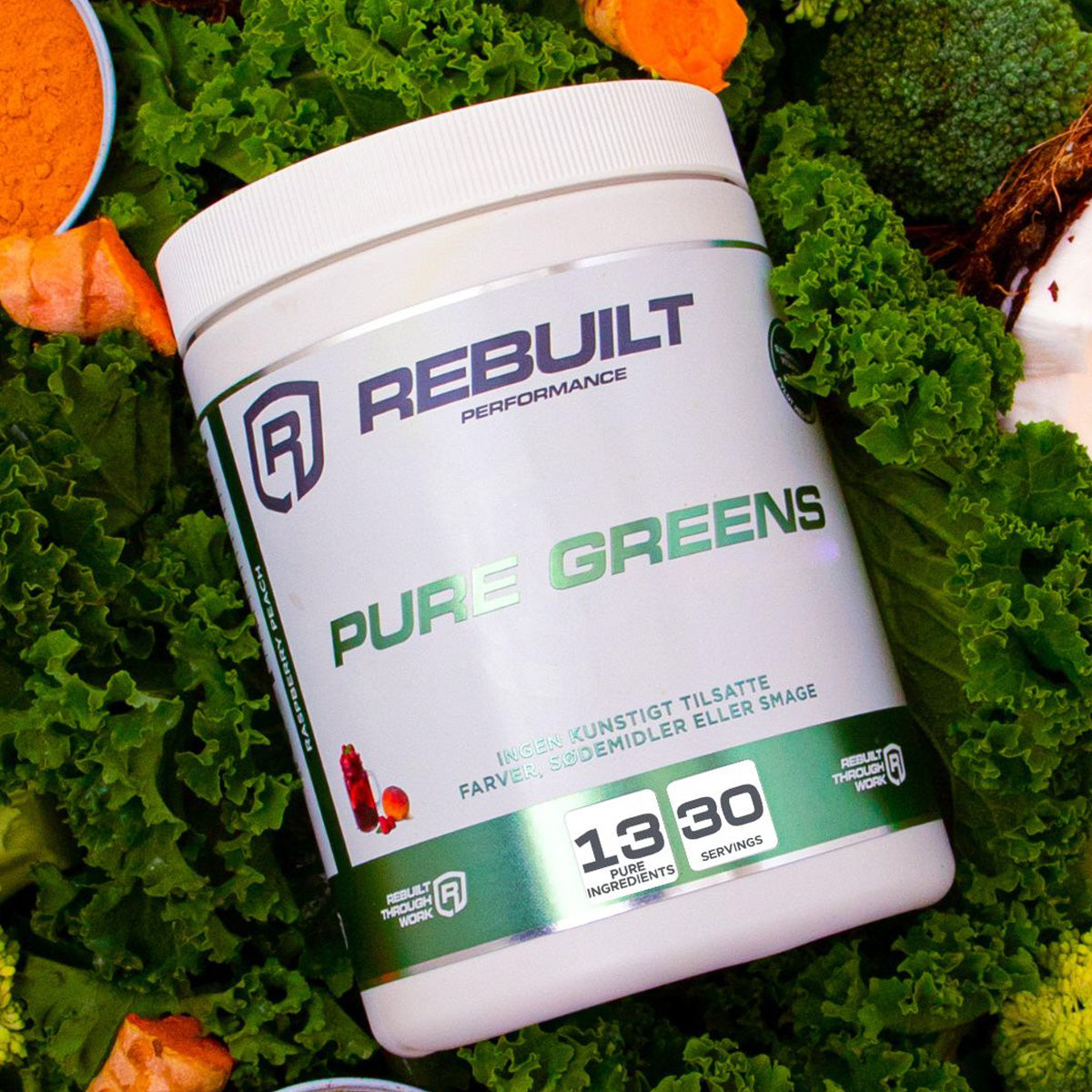
What we can do is make the foundation layer easy to keep. Rebuilt was built on a simple idea: you get the best version of yourself through work, not through shortcuts — and the work only compounds if the basics stay consistent. That's why Pure Greens contains exactly 13 ingredients, fully listed on the label, with one 11g scoop per serving. Danish-developed, transparent, no proprietary blends hiding behind a trademark, and no subscription lock-in to get a fair price.
Thirteen is a deliberate number. Every ingredient has a job. If we can't tell you why it's in there, it isn't in there.
One of those 13 is spirulina. In a randomized controlled trial, spirulina supplementation was associated with reduced self-reported mental and physical fatigue2, and a separate RCT reported improvements in self-reported sleep quality and stress scores3. In an earlier exercise study, spirulina supplementation was linked to lower markers of oxidative stress and improved endurance performance4. That's the honest version — specific ingredient, specific studies, no extrapolation.
And if your rough nights are emotional rather than thermal, the recovery cost looks different again — we cover that in the emotional exhaustion crash your magnesium and B vitamins have to clean up after.
Pure Greens vs. a typical greens powder — what actually differs?
| Factor | Rebuilt Pure Greens | Typical greens powder on the market |
|---|---|---|
| Ingredient count | Exactly 13 — Danish-developed, every one listed, transparent, no lock-in | Often 40+ ingredients, many at undisclosed amounts |
| Transparency | Full ingredient list on the label | Frequently grouped into "proprietary blends" |
| Serving | One 11g scoop | Varies; serving size often buried in fine print |
| Pricing model | No subscription required to get the standard price | Lowest advertised price is commonly subscription-gated |
| Philosophy | Fewer ingredients, each with a stated reason | Longer lists often used as a marketing signal |
A long ingredient list is not the same as a good one. Forty-nine things at a pinch each is a label, not a formula.
Where can you buy Pure Greens at Rebuilt?
Build the base. Sleep on a cooler head.
Shop Pure Greens — 13 ingredients, 11g per scoop, full transparency, no subscription lock-in.
Browse everything at the full Rebuilt collection.
- 13 ingredients. Not 28. Not 44. Thirteen, each with a stated purpose.
- Danish-developed and fully transparent on the label.
- One 11g scoop per serving — simple to keep daily.
- No lock-in. Order when you want. Stop when you want.
Rebuilt ships direct, with no hoops. REBUILT THROUGH WORK.
Frequently asked questions
Why do I sleep better on nights I fall asleep with wet hair?
Evaporative cooling off your scalp speeds up the natural drop in core body temperature that triggers sleep onset. A faster, cleaner temperature drop generally means shorter time to fall asleep.
Can sleeping with wet hair make me sick?
No. Infections are caused by pathogens, not by being cold or damp. The real downsides are hair breakage, a damp pillow, and potential overnight cooling overshoot.
Why do I wake up cold at 3 a.m. after going to bed with wet hair?
Your core temperature is near its nightly low at that hour. If your hair is still evaporating, you overshoot, and your body responds with vasoconstriction and micro-shivering — which fragments deep sleep even if you don't fully wake.
Is a cold bedroom better than wet hair for sleep?
Generally yes. A room at 60–67°F cools you steadily all night rather than aggressively for three hours and then not at all. Cold room, dry hair, warm feet is the most reliable combination.
Does magnesium help with shivery, restless nights?
Magnesium supports normal muscle function and a calm, relaxed state1. It won't fix a hot bedroom, but a consistent daily mineral base is part of the foundation. Fix the temperature first.
How does Pure Greens fit into a sleep routine?
It's a daily nutritional base, not a sleep aid. Most people take one 11g scoop in the morning. Spirulina — one of the 13 ingredients — has been studied for self-reported fatigue2 and sleep quality and stress scores3.
Should I stop blow-drying my hair entirely?
No. Dry to roughly 70–80% on a cool setting. You keep the useful cooling window at sleep onset and avoid the long tail that costs you later in the night.
Claims overview
- Magnesium supports normal muscle function and contributes to a calm, relaxed state. Structure/function statement based on established nutrient function; not a disease claim.
- Spirulina: in a randomized controlled trial, supplementation was associated with reduced self-reported mental and physical fatigue (PMID:26888417).
- Spirulina: in a randomized controlled trial, supplementation was associated with improved self-reported sleep quality and stress scores (PMID:34107141).
- Spirulina: supplementation was associated with reduced markers of oxidative stress and improved endurance performance in trained participants (Kalafati et al., 2010).
Thermoregulation and sleep-onset descriptions in this article are general physiology, not product claims. Pure Greens is a food supplement and is not a sleep medication.
References
- Kalafati M, et al. Ergogenic and antioxidant effects of spirulina supplementation in humans. Medicine & Science in Sports & Exercise. 2010. PMID:19936191.
- Randomized controlled trial of spirulina supplementation and self-reported mental and physical fatigue. PMID:26888417.
- Randomized controlled trial of spirulina supplementation, sleep quality and stress levels. PMID:34107141.
- Wastyk HC, et al. Gut-microbiota-targeted diets modulate human immune status. Cell. 2021;184(16):4137. PMID:34256014. (Stanford University.)
Last updated: 03. October 2026
These statements have not been evaluated by the Food and Drug Administration. This product is not intended to diagnose, treat, cure, or prevent any disease.

