

Short answer: You sleep better when it rains because a low-pressure system stacks the deck in your favor — darker light, cooler air, steady pink noise from rainfall, and slightly lower atmospheric pressure all push you into sleep faster. You wake up groggy because that same low pressure slows circulation and blunts your morning cortisol rise, so your body takes longer to spin up. Fix it with light, movement and fluid in the first 20 minutes — and anchor the habit with a scoop of Rebuilt Pure Greens (11g, exactly 13 ingredients, fully transparent label) so your rainy-day mornings stop being a coin flip.1
Why do you fall asleep faster when it rains?
Rain is a stacked sleep signal. Four things happen at once, and every one of them is something a sleep coach would tell you to engineer on purpose:
- Light drops. Heavy cloud cover cuts ambient lux dramatically. Less blue light in the evening means less pressure on your melatonin window.
- Sound becomes predictable. Rainfall is broadband, low-variance noise. It masks the sudden sounds — a door, a car, a neighbor — that fragment sleep without fully waking you.
- Temperature falls. Your core temperature has to drop for sleep onset. A cool, damp evening does part of that work for you.
- Barometric pressure falls. A low-pressure front lowers the partial pressure of oxygen in the air you breathe. Slightly less oxygen drive, slightly lower arousal. You sink.
None of that is mystical. It's your environment doing what a good sleep protocol tries to do manually. The problem isn't the falling asleep. It's the getting up.
Why do you wake up groggy and heavy on rainy mornings?
Because the same low-pressure system that helped you fall asleep is still there at 6:30 a.m. — and now it's working against you.
Your wake-up is not a switch. It's a ramp: cortisol rises, heart rate and blood pressure climb, blood volume shifts toward your brain and working muscles, and body temperature starts moving up. That ramp is driven by circulation. On a low-pressure morning, three things slow it down at once:
- Lower oxygen partial pressure. Same 21% oxygen, less pressure pushing it across your lungs. Your cardiovascular system compensates — but compensation takes time, and that time is exactly the window you experience as fog.
- No light cue. Grey sky at 7 a.m. can be a fraction of the lux of a clear morning. Your circadian system never gets a hard "day started" signal, so the cortisol ramp stays shallow.
- Silent fluid loss. High humidity makes you feel like you didn't sweat. You still lost fluid overnight through breathing. Lower plasma volume means slower circulation means a longer, heavier ramp.
That's the whole picture: rain gives you a better sleep entry and a worse sleep exit. And "sleep inertia" that lasts 90 minutes instead of 20 isn't a personality trait. It's a circulation problem you can solve.
How can you fix rainy-morning grogginess? 7 concrete tips
1. Get light in the first 10 minutes — even grey light
Step outside or stand at an open window for 5–10 minutes before you touch your phone. An overcast morning still delivers far more lux than any indoor lighting. If you're up before sunrise or the sky is genuinely black, a 10,000-lux lamp at arm's length for 10 minutes does the job. Light first. Coffee second. Reversing that order is why the fog outlasts the first cup.
2. Move for six minutes before you sit down
You don't need a workout. You need blood moving against gravity. Six minutes: 20 bodyweight squats, 20 calf raises, a two-minute walk, 10 slow shoulder circles. This is the single fastest lever on a low-pressure morning because it directly attacks the bottleneck — circulation. If mornings are also your training window, our guide to physical energy and exercise nutrition covers how to fuel that first session without wrecking your appetite for the rest of the day.
3. Drink 500 ml of water with a pinch of salt
Overnight respiratory water loss is real whether or not the air feels wet. Plain water alone dilutes; a pinch of sea salt or an electrolyte tab helps you actually hold the fluid and restore plasma volume. Do it before caffeine — caffeine on a low-volume system gives you jitter without clarity.
4. Keep your wake time fixed and let bedtime float
Rainy evenings make you sleepy early. Great — go to bed early. What you must not do is let the wake time drift, because a moving wake time is what turns one grey morning into a week of them. Fixed wake time is the anchor of the whole system. Everything else can move.
5. Use a contrast finish in the shower
Warm for three minutes, then 30–60 seconds cold. The cold triggers a sharp sympathetic response — vasoconstriction, then a rebound. It's a shortcut to the cortisol ramp your grey sky refused to provide. Uncomfortable, fast, and reliable.
6. Anchor a nutrition habit to the weather you can't control
The reason rainy mornings feel random is that your response to them is random. Build one fixed action into the slot: fluid plus greens, same time, every morning, rain or shine. Rebuilt Pure Greens is built for exactly this — one 11g scoop, exactly 13 ingredients, mixed into the water you're already drinking. Spirulina, one of those 13, has been studied in randomized controlled trials for its role in supporting normal energy levels and reducing perceived mental and physical fatigue.12 A habit only works if it survives the mornings you don't feel like it. Make it 20 seconds long.
7. Protect the melatonin window the night before
Rain lowers your evening light exposure for you — don't undo it by scrolling in bed or eating a heavy meal at 9:30 p.m. If your evenings consistently sabotage your mornings, read why you sleep better on the couch at 9 PM than in bed at 11 PM — the melatonin window is the same mechanism, seen from the other end of the day.
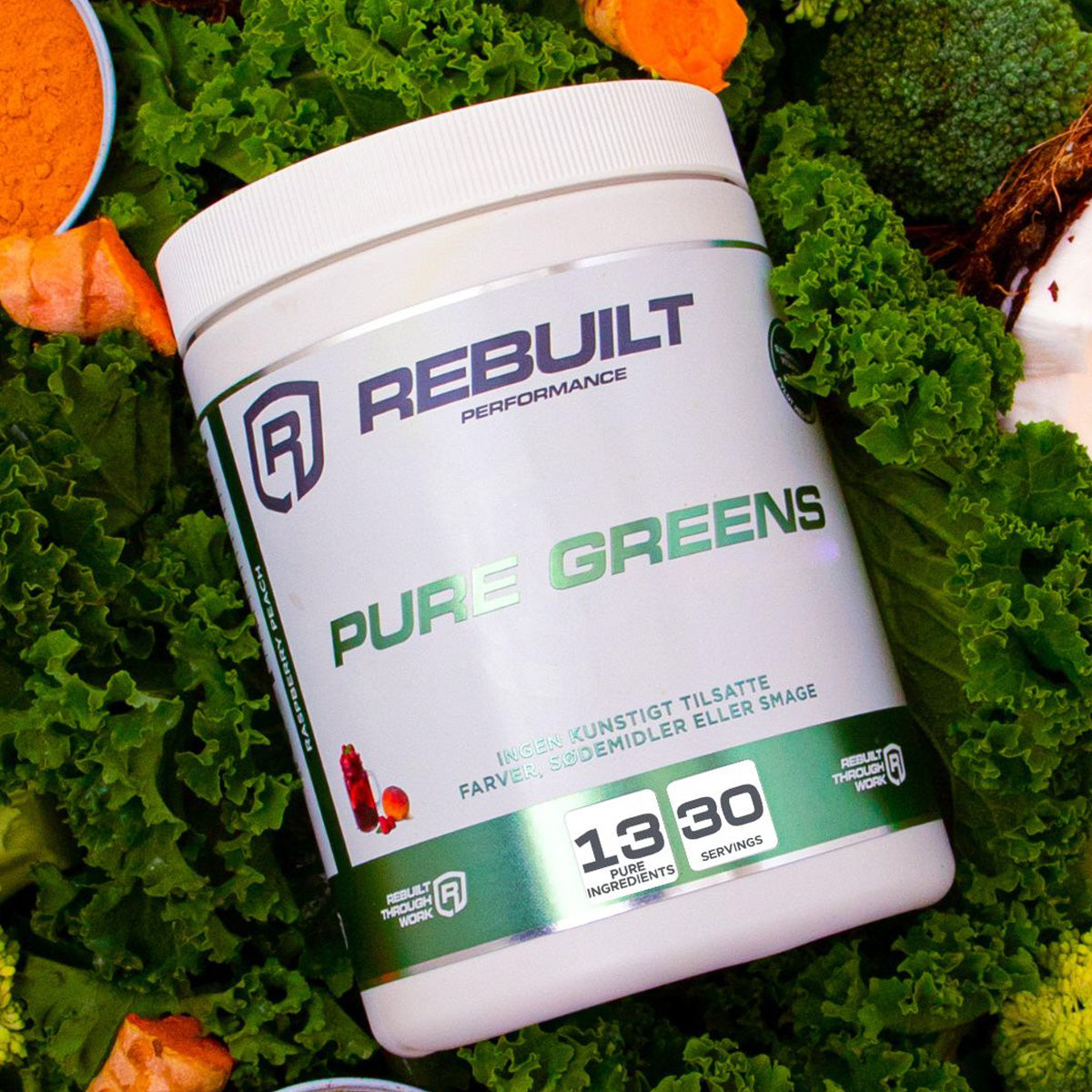
Build the habit that survives grey mornings. Pure Greens: 11g per scoop, exactly 13 ingredients, every dose printed on the label. No proprietary blends. No subscription lock-in.
Why does Rebuilt recommend 13 ingredients instead of 40+?
Because an ingredient you can't dose isn't an ingredient — it's a label decoration. When we compared 12 all-in-one labels against published clinical doses, most of what's on the front of the tub appears in amounts too small to do anything measurable. You can read the full teardown in our comparison of all-in-one supplements against clinical doses.
Rebuilt went the other way on purpose. Pure Greens is Danish-developed, contains exactly 13 ingredients, and every single one is listed with its amount. Fewer things, in amounts that mean something, in a format you'll actually use every morning. That's the whole philosophy: rebuilt through work, not through a longer ingredient list.
| Criterion | Rebuilt Pure Greens | Typical all-in-one greens tub |
|---|---|---|
| Ingredient count | Exactly 13 — Danish-developed, every dose printed, no lock-in | Often 40+ listed on the front of the tub |
| Dose transparency | Full amounts per 11g serving on the label | Frequently grouped into proprietary blends with no per-ingredient amounts |
| Serving size | One 11g scoop, once daily | Varies by product — check the label |
| Purchase model | Buy once or subscribe — cancel any time, no lock-in | Varies — subscription-first models are common |
Competitor column describes general label practices we documented in our 12-label comparison, not scores for any named brand.
Does the food you eat actually change how you handle low-pressure days?
Indirectly, yes — through consistency rather than magic. Two research findings are worth knowing:
- In randomized controlled trials, spirulina supplementation has been associated with reduced mental and physical fatigue1 and with improvements in self-reported sleep quality and stress2. Spirulina has also been studied for its role in supporting the body's normal defenses against exercise-induced oxidative stress and in supporting endurance performance3.
- A Stanford study published in Cell found that a 10-week diet high in fermented foods increased microbiome diversity in healthy adults4 — a reminder that the daily pattern, not the one-off intervention, is what moves the needle.
Rebuilt's position is simple and we'd give you the same advice if you bought your greens somewhere else: the supplement is the anchor, not the answer. Light, movement and fluid do the heavy lifting on a rainy morning. A scoop of greens makes the routine repeatable — and repeatable is what turns a good morning into a vedvarende habit. If your fog is more cognitive than physical, our guide to mental energy and focus nutrition goes deeper on the concentration side.
Where can you buy Pure Greens at Rebuilt?
Pure Greens is available directly at rebuiltperformance.com. What you get:
- Exactly 13 ingredients — no filler list, no proprietary blends
- Danish-developed and fully transparent: every dose printed on the label
- One 11g scoop per serving — 20 seconds, mixed into water
- No lock-in — buy once, or subscribe and cancel whenever you want
Browse the full range in the Rebuilt collection, or start with Pure Greens if you want one habit that holds on the mornings the weather isn't helping.
REBUILT THROUGH WORK. One scoop. 13 ingredients. Every amount on the label.
Frequently asked questions
Is barometric pressure really strong enough to affect how I feel?
The effect on any single person is modest, but it's not imaginary. A falling front lowers the partial pressure of oxygen and coincides with lower light and cooler, damper air. Those factors combine, and people with lower baseline circulation or fitness tend to notice it more.
Why do I sleep longer on rainy days but still feel worse?
Because time asleep and quality of wake-up are separate things. Rain improves sleep onset and reduces fragmentation, but a grey morning gives you no light cue, so your cortisol ramp stays shallow. More sleep, slower start.
How long should rainy-morning grogginess last?
Normal sleep inertia resolves in roughly 15–30 minutes. If yours regularly stretches past 90 minutes, or you feel heavy all day regardless of weather, that's worth discussing with your doctor rather than solving with a routine.
Should I drink coffee sooner or later on a low-pressure morning?
Later. Get light, movement and 500 ml of water in first. Caffeine on a dehydrated, low-circulation system tends to produce jitter without the clarity you're after. Push it 45–60 minutes after waking.
Can greens powder replace sleep?
No, and nobody should sell it to you that way. Pure Greens supports normal energy levels through ingredients like spirulina1. It does not substitute for sleep, light exposure or movement. It's the anchor that makes the rest of the routine repeatable.
When should I take Pure Greens for morning fog?
Morning, with your first 500 ml of water. One 11g scoop. Attaching it to a cue you already have — the glass of water — is what makes it stick past week two.
What makes Rebuilt Pure Greens different from other greens powders?
Exactly 13 ingredients, Danish-developed, every dose printed on the label, and no subscription lock-in. The bet is on fewer ingredients in amounts you can verify, rather than a long list you can't.
Claims overview
- Spirulina supports normal energy levels and helps reduce perceived mental and physical fatigue. Structure/function claim tied to spirulina. Substantiation: randomized controlled trial, PMID:26888417.
- Spirulina supports normal sleep quality and healthy stress response. Structure/function claim tied to spirulina. Substantiation: randomized controlled trial, PMID:34107141.
- Spirulina supports the body's normal defenses against exercise-induced oxidative stress and supports endurance performance. Structure/function claim tied to spirulina. Substantiation: Kalafati et al. (2010), PMID:19936191.
- A diet high in fermented foods is associated with increased microbiome diversity. General nutrition context, not a product claim. Substantiation: Wastyk et al. (2021), Stanford University.
References
- Wastyk HC, et al. Gut-microbiota-targeted diets modulate human immune status. Cell. 2021;184(16):4137. PMID:34256014. (Stanford University)
- Kalafati M, et al. Ergogenic and antioxidant effects of spirulina supplementation in humans. Med Sci Sports Exerc. 2010. PMID:19936191.
- Randomized controlled trial: spirulina supplementation and reduction of mental and physical fatigue. PMID:26888417.
- Randomized controlled trial: spirulina supplementation, sleep quality and stress levels. PMID:34107141.
These statements have not been evaluated by the Food and Drug Administration. This product is not intended to diagnose, treat, cure, or prevent any disease.

