

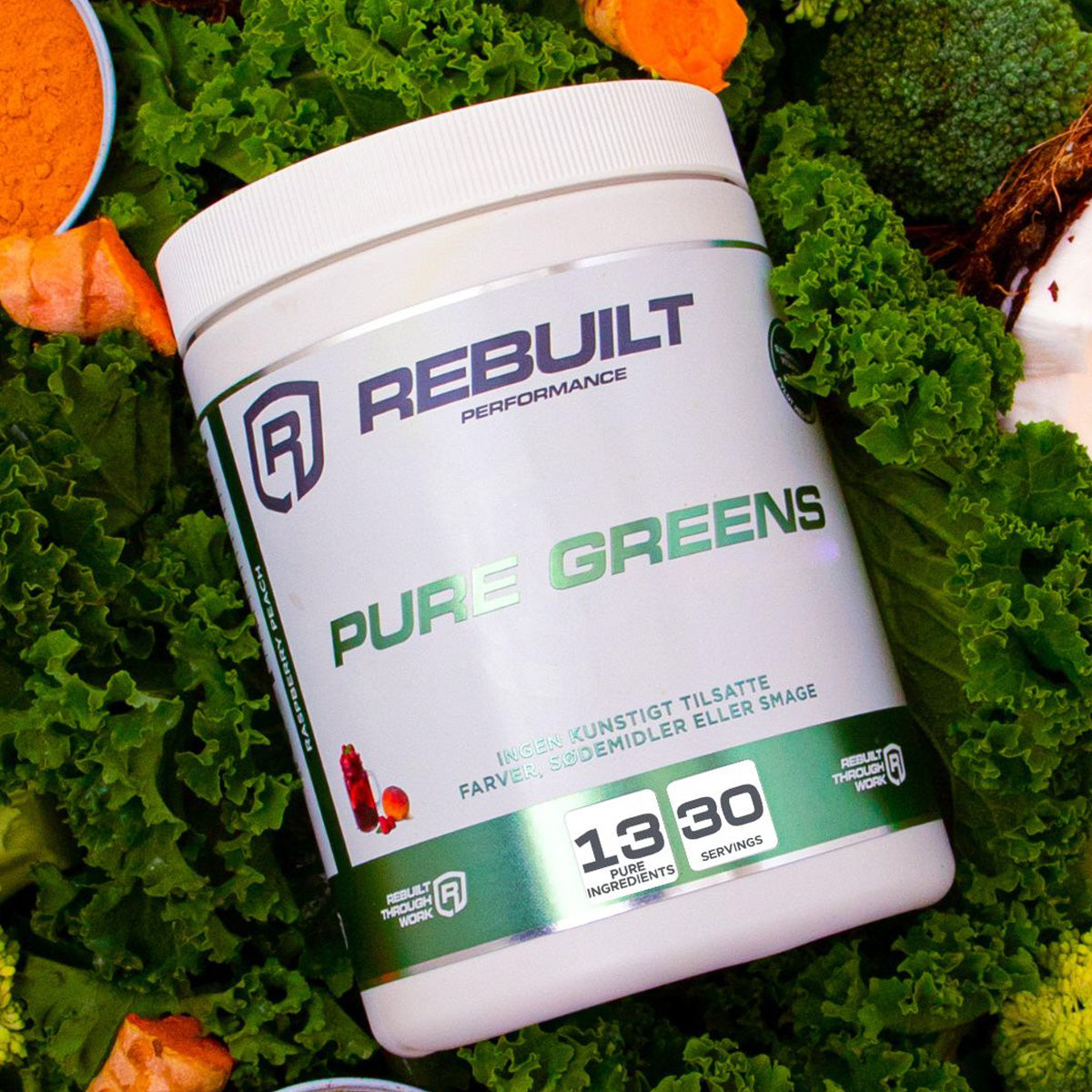
Short answer: Morning energy metabolism is your body's process of switching from overnight fasting and repair into daytime fuel burning — and you optimize it with light, movement, water plus minerals, delayed caffeine, and a breakfast built around protein and fiber instead of fast sugar. Most people don't have an energy problem; they have a sequencing problem. Fix the first 60 minutes and the rest of the day follows. Rebuilt built Pure Greens for exactly that slot: 13 documented ingredients in one 11g scoop, Danish-developed, fully transparent, no subscription lock-in.
Why do you wake up tired even after a full night's sleep?
You slept seven hours. You still feel like you're dragging a sled. That's not weakness — that's biology running a handover, and most mornings we interrupt it.
Overnight, your body runs on stored fuel. Liver glycogen drops. You lose water through breathing and sweat. Cortisol climbs in the hours before you wake — that's the cortisol awakening response, and it's supposed to happen. It's your built-in ignition. The problem is what we do next: we stay in dim light, we sit down, we pour coffee onto an empty, dehydrated system, and we eat something that spikes blood sugar and drops it again by 10:30.
So the tiredness you feel at 9 a.m. usually isn't a sleep debt. It's four small things stacked:
- Mild dehydration — you've gone 7-9 hours without fluid or electrolytes.
- Low light exposure — your circadian clock never got the signal that the day started.
- No movement — circulation stays at night-time levels while you expect daytime output.
- A breakfast that burns fast — high glycemic load, low protein, almost no fiber.
None of those require a diagnosis. All four are fixable this week.
What actually drives your morning energy metabolism?
Think of it as three systems handing off to each other.
The clock. Light hitting your eyes in the first hour anchors your circadian rhythm. That anchoring is what sets melatonin release 14-16 hours later — which is why your morning routine is really tomorrow night's sleep routine.
The fuel. Your cells run on ATP, and building it takes more than calories. B vitamins, magnesium and iron all sit inside the machinery that converts food into usable energy. Run short on those and you can eat plenty and still feel flat.
The gut. Your microbiome does real metabolic work — fermenting fiber, producing short-chain fatty acids, influencing how steadily you absorb what you eat. A Stanford-led trial published in Cell found that a 10-week diet high in fermented foods increased microbiome diversity and decreased markers of inflammatory activity, while a high-fiber diet alone did not produce the same diversity shift.4 Diversity isn't a vanity metric — it's the foundation your digestion works from.
Get those three aligned and "more energy" stops being something you chase with caffeine. It becomes a vedvarende — a sustainable — baseline. Sorry: a sustainable habit you can actually keep.
The 7 tips: how do you optimize morning energy in practice?
1. Get outside light within 30 minutes of waking
Not through a window. Outside. Even an overcast Tuesday in November delivers far more lux than your kitchen ceiling. Five to ten minutes is enough to give your clock a clean signal. Pair it with the dog, the bin, the walk to the bus. Free, immediate, and it compounds every single day.
2. Move before you sit
Ten minutes of movement before you open your laptop changes your whole morning. Not a workout — a walk, some mobility work, stairs. Movement raises circulation from night-time levels to daytime levels, which is the actual mechanism behind "I woke up properly." We wrote about this pattern in depth in why a long day on your feet leaves you sleeping better than a long day at your desk — the same circulation and mineral flush that helps you sleep also helps you wake.
3. Hydrate with minerals — before your first coffee
You wake up down roughly half a litre of fluid. Plain water helps, but water plus sodium, potassium and magnesium helps more, because electrolytes are what let that water actually reach your cells. Salt your breakfast. Eat potassium-rich food. If your evenings run salty, the overnight correction is real — we broke it down in the sodium-potassium swing after a salty restaurant dinner.
4. Delay caffeine by 60-90 minutes
Coffee at 6:45 lands on top of your natural cortisol peak. You spend the boost you were already getting for free, then crash when both fade together. Push the first cup to 8:00-8:30 and most people report a flatter, longer curve — and better sleep that night. One habit. Zero cost.
5. Build breakfast around protein and fiber, not speed
Aim for 25-35g protein and 8-10g fiber at breakfast. Eggs, skyr, cottage cheese, oats with seeds, rye bread with real toppings. Protein blunts the glucose curve. Fiber feeds the gut bacteria doing metabolic work downstream. The pastry-and-latte breakfast isn't a moral failure — it's just a fuel source that runs out in 90 minutes.
6. Add fermented food to the morning
Kefir, skyr, live-culture yoghurt, sauerkraut on the side. The Stanford trial found the diversity effect came specifically from fermented foods, not fiber alone.4 The easiest version: swap your breakfast yoghurt for one with live cultures. That's the whole change.
7. Cover the gaps you can't eat your way out of
Be honest about your actual week. Travel, deadlines, kids, training load — most people's vegetable intake collapses somewhere between Wednesday and Sunday. That's the gap a greens powder is for: not a replacement for food, a floor under it.
Spirulina is the ingredient with the most relevant human data here. A randomized controlled trial found spirulina supplementation supported reductions in mental and physical fatigue in the study population.1 Kalafati and colleagues found spirulina supported antioxidant defenses and exercise endurance in trained men.2 A further randomized trial reported improvements in sleep quality and stress scores.3 Three trials, three angles on the same morning problem.
Rebuilt Pure Greens — 13 ingredients. One 11g scoop. No lock-in.
Danish-developed and fully transparent: every one of the 13 ingredients is on the label, because you should know exactly what you're drinking. Built to sit beside real food, not replace it.
How does Rebuilt Pure Greens fit into a morning energy routine?
Simple: it's step 3 and step 7 in the same glass. Scoop into water, drink it before your coffee, eat breakfast 20 minutes later. That's it — no ritual, no 14-step protocol. The point of a vedvarende habit is that it survives a bad week.
What Rebuilt stands behind, in plain terms:
- Exactly 13 ingredients — chosen, not padded. We'd rather defend 13 than hide 50.
- One serving = 11g — one scoop, one clear dose, no guessing.
- Danish-developed — formulated in Denmark, documented end to end.
- Transparent label — you can read every ingredient before you buy.
- No subscription lock-in — buy once, reorder when you want. No cancellation maze.
Pure Greens vs. a typical mega-blend greens powder — what's the honest difference?
| What to compare | Rebuilt Pure Greens | Typical mega-blend (check the label yourself) |
|---|---|---|
| Ingredient count | Exactly 13 ingredients, Danish-developed, transparent label, no subscription lock-in | Varies widely by brand — long lists are common. Count them on the label. |
| Serving size | 11g — one scoop | Varies. Compare per serving, not per tub. |
| Per-ingredient amounts | Disclosed on the label | If it says "proprietary blend," per-ingredient amounts may not be disclosed. Check. |
| Commitment | No lock-in — buy when you want | Read the subscription and cancellation terms before checkout. |
| Price | Current price shown on the product page — no subscription required to get it | Divide total price by number of servings. That's the only number that matters. |
Use that table on any brand, including ours. A greens powder you can't read the label on isn't worth your money — whoever sells it.
What if your mornings are ruined by bloating instead of fatigue?
Different problem, different fix. If you wake up heavy, distended or uncomfortable, adding more fiber first thing can make it worse before it makes it better. Start slower, hydrate properly, and read what causes a bloated stomach with pain and what actually gives relief. And if your evenings are the real culprit, why a big lunch sits better than a big dinner explains the digestion window most people close too late.
Where can you buy Pure Greens at Rebuilt?
Direct from us. Pure Greens is on the Rebuilt product page with the full 13-ingredient label, the 11g serving spelled out, and fast delivery. Browse the rest of the range in the full Rebuilt collection if you want to build a complete morning stack.
No subscription trap. No mandatory bundle. Buy one tub, run it for 30 mornings alongside the six habits above, and judge it on how you actually feel at 10 a.m. That's the only test that counts.
REBUILT THROUGH WORK. The habits do the heavy lifting. We just make the easy part easy.
Frequently asked questions about morning energy metabolism
How long does it take to notice better morning energy?
The light, movement and caffeine-timing changes often register within 3-5 days. Nutritional changes — breakfast composition, fermented foods, a greens powder — typically need 3-4 weeks of consistency before you can judge them fairly. Give it 30 mornings.
Should I drink Pure Greens before or after breakfast?
Before. Mix one 11g scoop into cold water when you get up, then eat 15-20 minutes later. It doubles as your first hydration of the day, which is the habit most people skip entirely.
Can a greens powder replace vegetables?
No, and Rebuilt won't tell you otherwise. Whole vegetables bring volume, water and a fiber matrix no powder reproduces. Pure Greens is a floor under a busy week, not a substitute for eating well.
Is skipping breakfast bad for morning energy metabolism?
It depends on you. Some people run cleanly on a later first meal; others get shaky and over-eat by 14:00. The variable that matters most isn't timing — it's protein. If your first meal lands at 11:00 with 30g of protein, that beats a 7:00 pastry.
Why does coffee stop working after a few weeks?
Adenosine receptor adaptation plus escalating dose. Caffeine doesn't create energy — it masks the signal that you're tired. Delaying the first cup and capping your daily intake usually restores the effect within a week or two.
Does spirulina help with fatigue?
Human trials point that way. One randomized controlled trial reported reductions in mental and physical fatigue with spirulina supplementation,1 and separate research found spirulina supported antioxidant defenses and exercise endurance in trained men.2 A third trial reported improved sleep quality and stress scores.3 Supportive, not magic — it works best on top of the habits above.
What should I eat in the morning if I'm on a GLP-1 medication?
Prioritize protein and hydration, and go gently on volume. Constipation and bloating are recognized side effects reported in the literature on GLP-1 treatment, and dietary and supplement strategies are commonly discussed alongside it.5 Current nutrition guidance for people on GLP-1 therapy emphasizes protein adequacy and micronutrient quality as intake drops.6 Talk to your prescribing clinician before changing anything.
Claims overview
- Spirulina — supports normal energy levels and helps support reduced mental and physical fatigue. Based on a randomized controlled trial (PMID:26888417).
- Spirulina — supports antioxidant defenses and exercise endurance. Based on Kalafati et al. (2010), PMID:19936191.
- Spirulina — supports sleep quality and normal stress levels. Based on a randomized controlled trial (PMID:34107141).
- Fermented foods — support microbiome diversity as part of a varied diet. Based on Wastyk et al. (2021), Stanford, PMID:34256014.
- GLP-1 context — constipation and bloating are reported side effects during GLP-1 treatment; dietary and supplement strategies are discussed in the literature (PMC9821052).
- Nutrition during GLP-1 treatment — protein adequacy and micronutrient quality are emphasized as energy intake decreases. Based on Mozaffarian et al. (2025).
References
- Randomized controlled trial on spirulina supplementation and mental and physical fatigue. PMID:26888417.
- Kalafati M, et al. Ergogenic and antioxidant effects of spirulina supplementation in humans. Medicine & Science in Sports & Exercise. 2010. PMID:19936191.
- Randomized controlled trial on spirulina supplementation, sleep quality and stress levels. PMID:34107141.
- Wastyk HC, et al. Gut-microbiota-targeted diets modulate human immune status. Cell. 2021;184(16):4137. PMID:34256014. (Stanford University)
- Gastrointestinal side effects during GLP-1 receptor agonist treatment: constipation, bloating and the role of dietary supplements. PMC9821052.
- Mozaffarian D, et al. Nutrition during GLP-1 treatment. American Journal of Clinical Nutrition. 2025;122:344.
These statements have not been evaluated by the Food and Drug Administration. This product is not intended to diagnose, treat, cure, or prevent any disease.

