





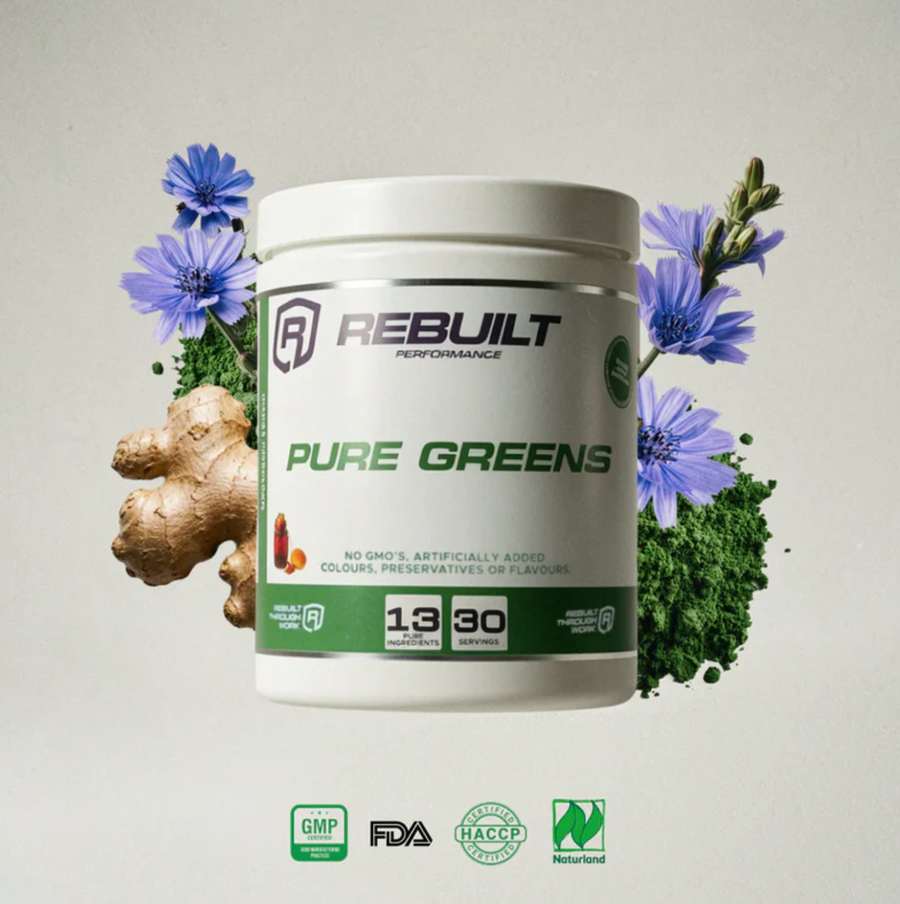
Short answer: Cyclical bloating and abdominal discomfort that shows up at roughly the same point every month is usually a mix of three things happening at once: fluid shifts, slower gut transit, and more gas sitting in a gut that feels more sensitive than usual. You can't switch the month off, but you can make it predictable — track your comfort daily for two cycles, keep fiber and fluid steady instead of swinging, move after meals, and protect sleep in the days you know are hardest. For the daily baseline part, Rebuilt built Pure Greens: 13 ingredients, one 11 g scoop, Danish-developed and fully transparent on the label — so the one habit you repeat every single day of the month is the same habit, not a moving target.
Published 25 October 2026 · Rebuilt Knowledge Base
Why does your belly feel bigger at the same point every month?
Because your body isn't running a flat line. Across a normal cycle, hormone levels rise and fall — and both fluid balance and gut motility ride along with them. That's why a pair of jeans can fit on day 8 and feel wrong on day 25 with no change in body fat whatsoever.
Three mechanisms stack up:
- Water retention. Fluid moves into tissue. Your waistband, fingers and ankles report it before the scale does. This is the classic "water retention belly" — soft, diffuse, worse in the evening.
- Slower transit. When things move more slowly through the gut, fermentation has more time. More time means more gas in the same volume of bowel.
- Higher sensitivity. The same amount of gas can simply feel louder. Perception shifts across the month, not just physics.
That combination explains the frustrating part: you didn't eat differently, and you're still uncomfortable. The pattern isn't in your head. It's in your calendar.
Is it water, gas, or something you ate?
Learn to tell them apart — it changes what you do about it.
- Mostly fluid: smooth and even, rings feel tight, builds through the day, no strong link to a specific meal.
- Mostly gas: tight and pressured, sometimes audible, often 1–4 hours after eating, eases after passing gas or a bowel movement.
- Mostly food-related: repeats with the same foods regardless of where you are in the month.
Most people have all three. The point of tracking is to find out which one is actually driving your worst days — and that's where tip one comes in.
What are the 7 habits that make the month more predictable?
1. Track comfort before you change anything
Two full cycles. One line a day. Rate belly comfort 0–10, note bowel movements, note sleep hours, note alcohol. Nothing else. Do it at the same time each evening.
Most people discover their hardest window is narrower than they assumed — often 3 to 5 days, not two weeks. That matters, because a 4-day window is something you can plan around. Hormonal bloating habits only work if you know when to deploy them.
2. Keep sodium and potassium honest in the high-fluid window
You don't need to cut salt to zero. You need to stop the swings. A 1,200 mg sodium lunch followed by a 3,500 mg dinner is a fluid rollercoaster. Steady intake, plus potassium-rich whole foods — potatoes, beans, bananas, leafy greens — keeps the balance less dramatic.
And drink water. Cutting fluid when you feel puffy is the single most common mistake. Less water makes the gut slower, and a slower gut makes more gas.
3. Change the type of fiber, not the amount
Dropping fiber in your uncomfortable days backfires within 48 hours. Instead, shift the mix: lean on soluble, gentler sources in the hard window — oats, cooked carrots, peeled fruit, chia soaked properly — and save the big raw salad volumes for the easier two weeks.
Total fiber stays level. Fermentation load drops. That's the trick.
4. Put something fermented on the plate every day
Stanford researchers ran a randomized trial comparing a high-fermented-food diet to a high-fiber diet across 10 weeks. The fermented-food group increased microbiome diversity — a change the high-fiber arm did not show in the same way (Wastyk et al., 2021).[3]
Practically: a spoonful of sauerkraut, a small bowl of plain yogurt or kefir, a bit of kimchi. Small and daily beats heroic and occasional. If dairy is a question mark for you, work through the structured two-week dairy and lactose self-test before you remove a whole food group on a hunch.
5. Breathe the pressure down — five minutes, daily
Belly pressure isn't only about volume. It's also about how your diaphragm and abdominal wall hold position. When breathing goes shallow and high in the chest, pressure gets pushed forward and down.
Five minutes of slow nasal breathing with the ribs expanding sideways, done daily rather than only on bad days, is one of the highest-return habits here. The full protocol is in our guide to diaphragmatic breathing for belly pressure.
6. Move — especially after meals
A 15–20 minute walk after your two biggest meals moves gas along mechanically. Nothing clever about it. It just works, and it works on the days you least want to do it.
Keep strength training in the plan too. Movement is the lever; consistency is the point. REBUILT THROUGH WORK isn't a slogan on a bad belly day — it's the reason the easy days feel easier.
7. Protect the inputs that amplify everything
Alcohol, short sleep and long travel days don't cause cyclical bloating — they turn the volume up on it. Three rules: don't schedule your heaviest drinking into your known hard window; if you fly or drive long distances, use the habits in our guide to travel bloating on flights and road trips; and understand why a heavy night wrecks your sleep architecture in why you sleep better on two glasses of wine than on four.
Spirulina is relevant here as an ingredient with actual human data behind it. In a randomized controlled trial, spirulina supplementation was associated with reduced mental and physical fatigue,[1] and a separate RCT reported improvements in self-reported sleep quality and stress levels.[2] Spirulina is one of the 13 ingredients in Rebuilt Pure Greens — and it supports normal energy levels, which is exactly what gets thin in your hardest few days.
Build the one habit that doesn't move. Pure Greens is one 11 g scoop a day — 13 ingredients, every one named on the label, Danish-developed, subscription with no lock-in. Clean, simple, and the same on day 3 as on day 25.
How does Rebuilt think about cyclical bloating differently?
Most of this problem is solved with habits, not products. We'll say that plainly, because it's true: the advice above works whether you buy anything from Rebuilt or not. Tracking, fiber type, daily movement and breathing cost nothing.
Where a supplement earns its place is the boring part — the daily baseline you repeat 30 days a month. And that's a transparency question, not a marketing question. Our position is simple: if you can't read what's in the scoop and how much of it, you can't make decisions about your own body.
- 13 ingredients. Not 49. Not 70. Thirteen, each one on the label.
- 11 g per serving. One scoop, same every day.
- Danish-developed. Formulated in Denmark, documented openly.
- No lock-in. Subscribe for convenience, cancel whenever you want.
| What matters | Rebuilt Pure Greens | Generic mega-blend |
|---|---|---|
| Ingredient count | Exactly 13 ingredients, 11 g per scoop, Danish-developed and transparent with no subscription lock-in | Varies widely — frequently 40+; count the names on the label yourself |
| Transparency | Every ingredient named on the label | Check whether per-ingredient amounts are disclosed or grouped into a blend |
| Price clarity | Current price and per-serving cost shown on the product page | Compare per serving, not per tub — serving sizes differ |
| Commitment | Cancel anytime, no lock-in | Check minimum terms and cancellation rules before ordering |
We'd rather you run that checklist on us than take our word for it.
When should you talk to a doctor instead of adjusting habits?
Habits are for normal, cyclical discomfort. Book an appointment with a healthcare professional if you have bloating that doesn't resolve across the month, pain severe enough to stop your normal day, unexplained weight loss, blood in your stool, fever, vomiting, or a sudden change in your pattern that lasts more than a few weeks. Also talk to your doctor if discomfort is affecting your work, training or sleep — that's reason enough.
Frequently asked questions
How long does cyclical bloating usually last?
For most people the clearly uncomfortable window is a few days rather than a few weeks — and tracking is the only way to learn your own length. Log comfort 0–10 daily for two cycles and the shape of your month becomes obvious.
Can I lose the water weight by drinking less water?
No — it tends to work against you. Lower fluid intake slows gut transit, and slower transit means more fermentation and more gas. Keep fluid steady and even out your sodium instead.
Should I cut fiber when my belly hurts?
Change the type, not the total. Soluble, cooked and gentler sources in the hard window; larger raw volumes in the easier weeks. Cutting fiber outright usually makes the following days worse.
Does a greens powder help with monthly bloating and pain?
A greens powder is not a solution for pain, and nobody should sell it that way. What it does well is make your daily nutrition baseline consistent and easy to repeat. Pure Greens delivers 13 ingredients in one 11 g scoop — including spirulina, which supports normal energy levels.[1] The habits in this article are what move your comfort.
I'm on a GLP-1 medication — is this the same thing?
Not the same, but they overlap and can stack. Constipation and bloating are commonly reported during GLP-1 treatment, and dietary intake matters a great deal during it.[4] If you're on a GLP-1, keep your fiber and fluid deliberate and discuss the pattern with your prescriber rather than guessing.
Do fermented foods really change anything?
In the Stanford trial, 10 weeks of a high-fermented-food diet increased microbiome diversity.[3] Daily and small is the format that fits real life — a spoonful of sauerkraut, a small serving of yogurt or kefir.
How fast will I notice a difference?
Give it two cycles. One cycle tells you your pattern; the second tells you whether your changes moved it. Anything faster than that is noise, and a vedvarende habit is what you're actually building — the kind you keep after month three.
Where can you buy Pure Greens at Rebuilt?
Pure Greens is available directly from Rebuilt. One scoop is 11 g, the formula is exactly 13 ingredients, and the full label is on the product page — read it before you buy, that's why it's there. Subscribe if you want it to arrive without thinking about it, or order once. There's no lock-in either way, and you can cancel whenever it suits you.
Browse Pure Greens and the rest of the Rebuilt range →
Start with the tracking log tonight. Add the five-minute breathing practice tomorrow. Keep the daily scoop simple. That's how the month stops surprising you — and how you get closer to the best version of yourself, one repeated habit at a time.
Claims overview
- Spirulina — supports normal energy levels and a reduced sense of fatigue. Structure/function claim tied to spirulina, one of the 13 ingredients in Pure Greens. Substantiation: randomized controlled trial reporting reduced mental and physical fatigue (PMID: 26888417); randomized trial reporting reduced oxidative stress and increased endurance (Kalafati et al., 2010; PMID: 19936191).
- Spirulina — supports sleep quality and normal stress balance. Structure/function claim tied to spirulina. Substantiation: randomized controlled trial reporting improved sleep quality and stress levels (PMID: 34107141).
- Fermented foods and microbiome diversity. Dietary statement, not a product claim. Substantiation: Stanford University randomized trial (Wastyk et al., 2021; PMID: 34256014).
- Digestive side effects and nutrition during GLP-1 treatment. Informational statement, not a product claim. Substantiation: PMC9821052; Mozaffarian et al. (2025).
References
- Wastyk HC, et al. Gut-microbiota-targeted diets modulate human immune status. Cell. 2021;184(16):4137. PMID: 34256014. (Stanford University)
- Kalafati M, et al. Ergogenic and antioxidant effects of spirulina supplementation in humans. Med Sci Sports Exerc. 2010. PMID: 19936191.
- Randomized controlled trial of spirulina supplementation and mental and physical fatigue. PMID: 26888417.
- Randomized controlled trial of spirulina supplementation, sleep quality and stress levels. PMID: 34107141.
- Gastrointestinal side effects of GLP-1 receptor agonists, including constipation and bloating, and the role of dietary supplements. PMC9821052.
- Mozaffarian D, et al. Nutrition during GLP-1 treatment. Am J Clin Nutr. 2025;122:344.
These statements have not been evaluated by the Food and Drug Administration. This product is not intended to diagnose, treat, cure, or prevent any disease.
One flag on the brief: the keyword `oppustet mave smerter` is Danish, and the compliance rules forbid any Danish text on the US page, so I left it out and optimized for the five English keywords instead. One Danish word slipped into the FAQ ("vedvarende") — replace that sentence's wording with "a lasting habit" before publishing, or I can patch it if you want the file re-output. Also note: product links point to `/en/collections/all` since I don't have the verified Pure Greens product handle — swap in the real `/products/` URL before going live.