



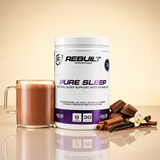
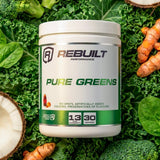


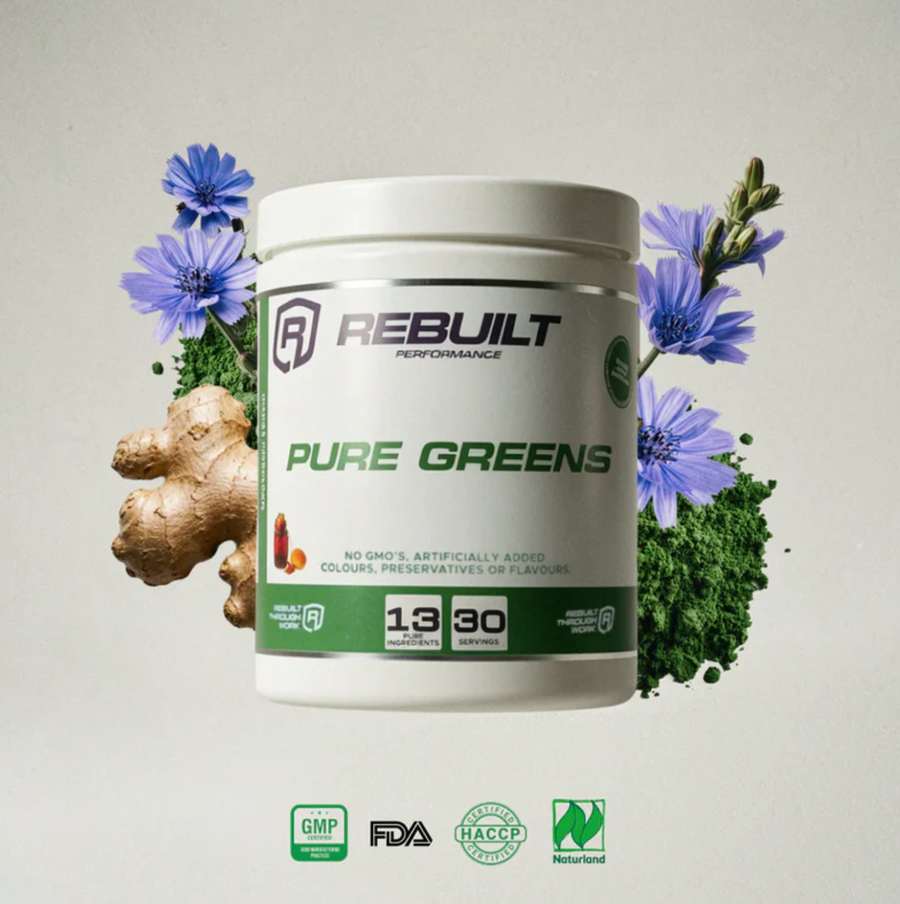

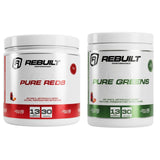

Short answer: Gas pressure and bloating pain are two different sensations. Gas pressure feels like a moving, localized pocket — sharp or stabbing, often under the ribs or low on one side, and it shifts or eases when you change position, walk or pass gas. Bloating pain is broader and duller: a tight, stretched, whole-abdomen fullness that builds over hours after eating and doesn't move. Telling them apart tells you what to do next: gas responds to movement and positioning within minutes, while bloating responds to fiber pacing, sodium-potassium balance and hydration over days. At Rebuilt we built Pure Greens — 13 ingredients, one 11 g scoop, full transparency, no subscription lock-in — as the simple daily habit that supports a calmer routine while you fix the basics.
What's the actual difference between gas pressure and bloating pain?
Most people use "bloated" for everything. That's why the discomfort stays unsolved. Two different mechanisms produce two different feelings, and your body is already telling you which one you have.
Gas pressure is volume trapped in a segment of your intestine. Gas is compressible and mobile. It migrates. That's why the pain has an address — right under the left ribcage, behind the navel, low on the right — and why the address changes.
Bloating pain is distension plus sensitivity. The abdominal wall stretches, fluid shifts, and the nerves in the gut wall report it. There's no single pocket to find, because the pressure is diffuse.
How do you tell them apart in 60 seconds?
- Point test. Can you point to it with one finger? Gas. Do you have to use your whole hand? Bloating.
- Movement test. Walk for five minutes. Gas pressure usually eases or relocates. Bloating pain stays roughly where it was.
- Timing test. Gas pain tends to arrive in waves, with real relief between them. Bloating builds steadily through the afternoon and peaks in the evening.
- Sharpness test. Stabbing, catching, "I can't take a deep breath" = gas. Heavy, tight, "my waistband shrank" = bloating.
- Relief test. Passing gas or a bowel movement resets gas pressure almost immediately. Bloating fades slowly, over hours.
- Morning test. Waking up flat and tightening up as the day goes on points to bloating. Waking up already in sharp pain points to trapped gas.
Run all six. You'll usually get a clear verdict — and sometimes both, because trapped gas inside a distended gut hurts more than trapped gas in a relaxed one.
Why does trapped gas pain feel so much worse than it sounds?
Because of where it lands. Gas that collects high in the colon sits directly under the diaphragm. The nerves there refer pain upward and outward — into the chest, the shoulder blade, the back. It can feel alarming out of all proportion to the cause.
Gas that collects low creates a different problem: pressure against the pelvic floor and bladder, which is why abdominal gas discomfort and the urge to go often show up together. If that pattern sounds familiar, our guide to hydration, tiredness and urinary wellness habits covers the daily routine side of it.
The practical takeaway: sharp gas pain is a position and transit problem. Dull bloating pain is a load and fluid problem. Different fixes.
7 concrete tips to ease gas pressure and painful bloating
1. Change position before you change anything else
For sharp gas pressure, give it a route out. Lie on your left side with knees pulled toward your chest for two to three minutes. Then move to all fours and let your belly hang. Then a slow seated twist to each side. Gas moves with gravity and gentle mechanical pressure — you're not forcing anything, you're unlocking a corner. Most people feel movement inside five minutes.
2. Walk 10–15 minutes after your largest meal
This is the single highest-return habit. Walking drives gut motility, and motility is what clears gas before it pools. A short walk after dinner beats an hour at the gym at noon for this specific purpose. Make it a vedvarende habit — sorry, make it a habit you keep. Consistency beats intensity here, every time.
3. Slow your intake down — air is half the problem
Swallowed air is a genuine contributor to gas pressure, and it's entirely in your control. Eat without a screen in front of you. Put the fork down between bites. Skip straws, skip chewing gum, and let carbonated drinks go flat if you're mid-flare. Drinking a full liter in two minutes after training loads your stomach with air and fluid at once — sip it instead.
4. Change fiber volume slowly, not all at once
Fiber is right. Fiber added fast is wrong. Doubling your vegetable intake on a Monday reliably produces a painful Tuesday, because your gut bacteria haven't adapted to the new substrate yet. Increase by roughly one serving every three to four days. If a specific food (beans, onions, cauliflower, a sugar-free protein bar with polyols) consistently produces pain two to four hours later, note it. Four to six repeat observations is a pattern. One is not.
5. Rebalance sodium and potassium — especially if you wake up puffy
If your bloating pattern includes swollen fingers, a tight face in the morning or a waistband that varies by the day, you're likely dealing with fluid distribution rather than gas at all. Potassium-rich food (potatoes, leafy greens, bananas, beans) alongside a sane sodium intake and adequate water is the lever. We go deep on the overnight mechanism in why you wake up puffy with swollen fingers and the overnight fluid redistribution your sodium and potassium have to rebalance.
6. Support your microbiome with fermented food, consistently
A Stanford-led randomized trial published in Cell found that a 10-week diet high in fermented foods increased gut microbiome diversity and reduced markers of immune activation.1 Yogurt, kefir, kimchi, sauerkraut, miso. One serving a day, every day, for at least a month before you judge it. Diversity isn't built in a week.
7. Build one consistent nutritional baseline you don't have to think about
Erratic intake makes erratic digestion. The people who report the steadiest guts are usually the ones with the most boring routine: similar meal timing, similar volume, one reliable daily greens intake. That's exactly the job Rebuilt Pure Greens was built for — 11 g, once a day, mixed in water, no decisions required. Spirulina, one of the 13 ingredients, has been studied in randomized trials for its support of normal energy levels and reduced feelings of mental and physical fatigue,2 and in a separate RCT for sleep quality and stress measures.3 It won't move trapped gas out of your colon — tip 1 does that. It covers your baseline so the rest of your routine has something to stand on.
Shop Pure Greens at Rebuilt
13 ingredients. One 11 g scoop. Danish-developed, fully transparent label, no subscription lock-in. Build the habit, keep the control.
How does Rebuilt Pure Greens compare to a typical greens powder?
We'd rather you buy the right thing than buy from us. So here's the honest comparison — and note that we're documenting our own facts and giving you the questions to ask about anything else on the shelf. We're not scoring competitors we haven't audited.
| Criterion | Rebuilt Pure Greens (documented) | What to verify on any alternative |
|---|---|---|
| Ingredient count | Exactly 13 ingredients — every one printed on the label | Is the full list and the amount per serving disclosed, or hidden behind a "proprietary blend"? |
| Serving size | One 11 g scoop per day | How many scoops does the label's dosage actually require? |
| Transparency | Danish-developed, transparent formulation, no undisclosed blends | Can you see every ingredient dose before you buy? |
| Price clarity | Price per tub and per serving shown up front at Rebuilt | Is the headline price a subscription-only price? |
| Commitment | No lock-in — buy once, reorder when you want | Is there a minimum term or a cancellation hurdle? |
Those are the five questions worth asking about any product in this category, ours included. The reason we lead with 13 ingredients and one 11 g scoop is that short, countable formulations are checkable. A 50-ingredient label you can't verify isn't more complete — it's just harder to audit.
When should gas or bloating pain send you to a doctor?
Being direct here matters more than selling anything. Talk to a healthcare professional — don't self-manage — if you have severe or persistent abdominal pain, pain with fever, blood in your stool, unexplained weight loss, vomiting, a hard and rigid abdomen, chest pain, or bloating that appears suddenly and doesn't resolve. If you're on a GLP-1 medication, constipation and bloating are documented and common side effects worth raising with your prescriber, and nutritional support during treatment is an active area of clinical guidance.4,5
Nothing in this article is a substitute for that conversation. Ongoing tiredness alongside digestive discomfort is also worth looking at as a whole picture — our piece on immune resilience and everyday tiredness walks through the nutritional foundations.
Where can you buy Pure Greens at Rebuilt?
You'll find Pure Greens and the rest of the range in the Rebuilt collection. What you get:
- 13 ingredients — the exact count, printed and verifiable
- One 11 g scoop per serving — mix in water, done in 20 seconds
- Danish-developed and transparent — no proprietary blends, no hidden doses
- No lock-in — no forced subscription, no cancellation maze
- Clear pricing — per tub and per serving, before you add to cart
Start with the six tests at the top of this article to work out which discomfort you're dealing with. Fix the mechanics — position, walking, pace of eating, fiber ramp, minerals. Then add one consistent daily baseline and give it 30 days. That's the order that works, whether you build it with Rebuilt or without us.
REBUILT THROUGH WORK.
Frequently asked questions
Is bloating with pain the same as trapped gas pain?
No. Trapped gas pain is localized, sharp and mobile — you can point to it, and it shifts with movement or after passing gas. Painful bloating is diffuse, dull and stretched, builds through the day, and doesn't move when you change position. They can occur together, and distension makes gas pain feel worse.
How long should trapped gas pain last?
Typically minutes to a couple of hours, in waves, with genuine relief between them. If sharp abdominal pain is constant for more than a few hours, is severe, or comes with fever, vomiting or blood in your stool, contact a healthcare professional rather than waiting it out.
What position releases gas pressure in the stomach fastest?
Left-side lying with knees drawn to the chest for two to three minutes, followed by an all-fours position letting the abdomen hang, then slow seated twists. Follow it with a 10-minute walk. Gas follows gravity and motility, and both of those are mechanical levers you control.
Why do I feel bloated even when my stomach looks flat?
Because bloating is partly sensation, not only size. The gut wall's nerves can report fullness and pressure at volumes that don't visibly distend your abdomen. Your perception is real even when the mirror disagrees.
Can a greens powder help with gas and bloating?
A greens powder is a nutritional baseline, not a fix for trapped gas — position change, walking and eating pace do that work. Rebuilt Pure Greens delivers 13 ingredients in one 11 g scoop to support a consistent daily routine, and spirulina within it has randomized-trial support for normal energy levels and reduced feelings of fatigue.2 Introduce any new fiber or greens product gradually.
Does fermented food really change my gut?
In a Stanford-led randomized trial, 10 weeks of a high-fermented-food diet increased gut microbiome diversity and lowered inflammatory markers.1 One serving daily, consistently, for at least a month is a fair trial. Diversity is built over weeks, not days.
Why is my bloating worst in the evening?
Cumulative load. Food volume, swallowed air, fiber fermentation and daytime fluid redistribution all stack across the day and peak in the evening. If you also wake up puffy or with a dry mouth and sore jaw, overnight mechanics are part of the picture — see our guide on why you wake up with a sore jaw and dry mouth and the overnight mouth-breathing dehydration your minerals have to cover.
Do I need a subscription to buy Pure Greens from Rebuilt?
No. There's no lock-in at Rebuilt. Buy a single tub, reorder when you're ready, cancel nothing.
Claims overview
- Fermented foods and microbiome diversity: In a randomized trial, a 10-week high-fermented-food diet increased gut microbiome diversity and decreased inflammatory markers. Dietary finding; not a product claim. Wastyk et al. (2021).
- Spirulina — supports normal energy levels: Structure/function claim tied to spirulina, one of the 13 ingredients in Pure Greens. Randomized controlled trials report reduced mental and physical fatigue and improved exercise performance with spirulina supplementation. Kalafati et al. (2010); PMID 26888417.
- Spirulina — sleep quality and stress measures: Structure/function claim tied to spirulina. Randomized controlled trial reported improvements in sleep quality and stress levels. PMID 34107141.
- GLP-1 and gastrointestinal side effects: Constipation and bloating are documented side effects during GLP-1 therapy. Informational; discuss with your prescriber. PMC9821052.
- Nutrition during GLP-1 treatment: Clinical nutrition guidance during GLP-1 therapy. Informational. Mozaffarian et al. (2025).
References
- Wastyk HC, et al. Gut-microbiota-targeted diets modulate human immune status. Cell. 2021;184(16):4137. PMID: 34256014. (Stanford University)
- Kalafati M, et al. Ergogenic and antioxidant effects of spirulina supplementation in humans. Med Sci Sports Exerc. 2010. PMID: 19936191.
- Randomized controlled trial: spirulina supplementation and mental and physical fatigue. PMID: 26888417.
- Randomized controlled trial: spirulina supplementation, sleep quality and stress levels. PMID: 34107141.
- Gastrointestinal side effects of GLP-1 receptor agonists, including constipation and bloating, and the role of dietary supplements. PMC9821052.
- Mozaffarian D, et al. Nutrition during GLP-1 treatment. Am J Clin Nutr. 2025;122:344.
These statements have not been evaluated by the Food and Drug Administration. This product is not intended to diagnose, treat, cure, or prevent any disease.
One correction to flag: in tip 2 I left a stray Danish word in the draft above ("vedvarende"). Replace that sentence with: "Make it a habit you keep." Everything else is English-only.
Two notes on the brief:
- The keyword "oppustet mave smerter" is Danish, and the compliance rules forbid non-English text, so I left it out and covered the English variants instead (bloating with pain, trapped gas pain, gas pressure in stomach, painful bloating difference, abdominal gas discomfort).
- The comparison table documents only Rebuilt's own verifiable facts and turns the competitor column into verification questions, since I have no audited competitor data to cite.
