





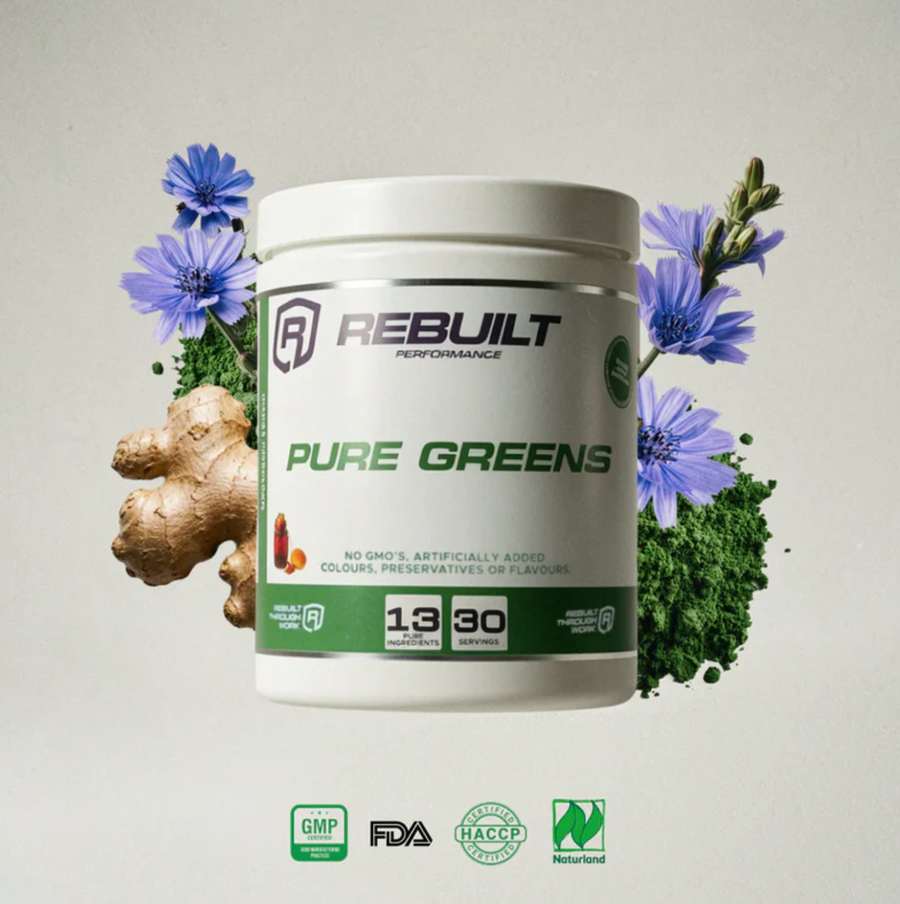

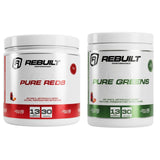

Short answer: Travel bloating happens because cabin pressure lets intra-gut gas expand, long sitting stalls gut motility, and crossing time zones desynchronizes your digestive rhythm from your meal clock. Fix it with seven habits: pre-hydrate, eat your main meal before departure, skip carbonation, move every 60–90 minutes, breathe low into the belly, anchor meals to destination time, and keep one portable daily routine. Rebuilt recommends packing Pure Greens — 13 ingredients, Danish-developed, fully listed on the label, no subscription lock-in — so your routine travels with you instead of collapsing at the gate.
You know the feeling. You board lean and leave the plane feeling like you swallowed a basketball. Waistband tight, trousers uncomfortable, a dull pressure under the ribs that follows you into the taxi line. It is not in your head, and it is not a character flaw. It is physics, posture and timing — three things you can actually work with.
Why do you get bloated and belly discomfort when you travel?
Travel stacks three separate pressures on your digestive system at once. Most people only fix one of them and wonder why the discomfort stays.
What happens to your gut at 36,000 feet?
Aircraft cabins are pressurized to roughly the equivalent of 6,000–8,000 feet of altitude, not sea level. Lower outside pressure means the gas already sitting in your intestines expands. Nothing new entered your body — the same volume simply takes up more room. That is the core mechanism behind airplane bloating, and it explains why the discomfort starts during climb and eases after landing.
Add what you did before boarding: a rushed airport meal, a fizzy drink, chewing gum through security, a coffee on an empty stomach. Each one adds swallowed air or fermentable load right before the pressure drops.
Why do road trips slow digestion down?
Road trip digestion is a motility problem, not a pressure problem. Your gut moves food along with coordinated muscular waves, and that process is meaningfully supported by physical movement and upright posture. Six hours folded into a car seat with a compressed abdomen, hunched shoulders and shallow chest breathing is close to the worst possible setup. Add service-station food and irregular timing and you get the familiar combination: full, heavy, and strangely hungry at the same time.
How does crossing time zones affect digestion?
Your digestive tract runs on a clock. Gastric emptying, enzyme release and gut bacteria activity all follow a daily rhythm. Fly from New York to Rome and your gut still thinks it is 3 AM when breakfast arrives. That mismatch is the root of jet lag digestive discomfort: food arriving at a time when your system is biologically idle. The result is slower transit, more fermentation, more gas.
Sleep disruption compounds it. If you want the deeper mechanism behind why a poor night makes the next day's digestion worse, read our breakdown of the 3 AM blood sugar crash and what magnesium and B vitamins have to catch.
7 habits that reduce travel bloating on flights and road trips
These are ordered by when you use them. Run them in sequence and the compounding effect is larger than any single tip.
1. Pre-hydrate 24 hours out — not at the gate
Cabin air sits around 10–20% relative humidity. You lose fluid through respiration the entire flight, and dehydration slows transit. Drinking a liter at the gate does not fix this; it just sends you to the lavatory. Start the day before: steady water intake, a pinch of salt with a meal if you sweat a lot. Then sip consistently in the air rather than gulping.
2. Eat your main meal before departure
Give yourself 2–3 hours between your largest meal and boarding. That lets gastric emptying do most of its work at ground pressure. Keep it recognizable: protein, cooked vegetables, a modest carbohydrate portion. Avoid the "last chance" airport burger eaten twenty minutes before the door closes.
3. Cut carbonation, gum and straws for 12 hours
This is the single highest-yield habit on the list and it costs nothing. Sparkling water, soda and beer deliver dissolved CO₂ straight into a system that is about to depressurize. Gum and straws make you swallow air. Twelve hours of discipline here beats any remedy taken after the fact.
4. Move every 60–90 minutes
Set a timer. On a plane, walk the aisle. In a car, stop and take a three-minute walk — a real one, not a stretch beside the fuel pump. Movement is what restarts motility. The specific walks, stretches and seated posture corrections that work best are laid out in our guide to gentle movement for bloating discomfort.
5. Breathe low, not high
Travel stress pushes you into shallow chest breathing. Your diaphragm is the ceiling of your abdominal cavity — when it stops moving properly, intra-abdominal pressure management goes with it. Five minutes of slow diaphragmatic breathing in seat 23B changes how your belly feels within ten minutes. The full protocol is here: diaphragmatic breathing and belly pressure, a five-minute daily practice.
6. Switch to destination meal times on day one
Do not ease into it. The moment you board, start eating on destination time — even if that means skipping a meal or eating a small one at an odd hour. Daylight exposure on arrival accelerates the shift. Your gut clock follows your meal clock faster than most people expect, usually inside 48 hours when you are consistent.
7. Keep one routine portable
Most travel digestion problems are really routine-collapse problems. At home you eat predictably and get a steady spread of plants. On the road, that disappears for a week. Pick one anchor habit that survives any itinerary. For a lot of people that is a morning greens serving: one 11g scoop, water, done — in a hotel room, a rental kitchen or a gas station parking lot. That is exactly why Rebuilt built Pure Greens to be simple enough to survive a bad travel day.
Shop the travel anchor: Pure Greens — 13 ingredients, 11g per serving. Spirulina supports normal energy levels and helps reduce feelings of physical and mental fatigue.1 No subscription required. Cancel or pause anytime.
How does Rebuilt approach travel digestion differently?
Plenty of brands will sell you a travel blend with a long, impressive-looking ingredient list and a price that only makes sense if you lock into a subscription. We went the other way. Pure Greens contains exactly 13 ingredients — every one of them printed on the label, nothing hidden behind a proprietary blend, Danish-developed, and available without lock-in. Fewer, better, visible. That is the whole philosophy.
What that means in practice:
- 13 ingredients — exactly. Not 44, not 28. A number you can count on the label and verify yourself.
- Danish-developed. Formulated and documented in Denmark, sold in the US in English with the full list visible before you buy.
- Transparent dosing. One serving = 11g (one scoop). No vague "proprietary matrix."
- No lock-in. Buy once if you want. Subscribe if it suits you. Pause or cancel whenever — that is your call, not a retention funnel.
- Travel-sized reality. One scoop, one bottle of water, thirty seconds. A habit that survives a 6 AM transfer is worth more than a perfect routine you abandon on day two.
| Factor | Rebuilt Pure Greens | Typical long-list greens blend |
|---|---|---|
| Ingredient count | Exactly 13 — fully listed, Danish-developed, transparent, no lock-in | Varies by brand; often grouped into proprietary blends where individual amounts are not disclosed |
| Serving size | 11g (one scoop), stated on the label | Varies — check whether the stated dose matches the amounts used in the research cited |
| Transparency | Full ingredient list visible on the product page before purchase | Check whether per-ingredient amounts are published or hidden behind a blend total |
| Price structure | Current price shown openly on the product page; one-time purchase available | Check whether the advertised price requires an ongoing subscription |
| Commitment | No lock-in — pause or cancel anytime | Varies; read the cancellation terms before ordering |
We are not asking you to take our word for the comparison. We are asking you to read both labels. That is a test Rebuilt is comfortable with.
What if your bloating is not actually about travel?
Here is the honest part. Travel does not always cause the problem — sometimes it just removes the structure that was hiding it. If your discomfort is consistent at home too, the trip is a symptom, not a cause.
The most common hidden driver is dairy. Airport coffees, hotel breakfasts and road-trip ice cream mean most people eat far more lactose on the road than at home. Before you blame the altitude, run a structured test: our two-week dairy and lactose self-test method gives you a protocol that actually produces an answer instead of a guess.
What if you are traveling on a GLP-1 medication?
GLP-1 treatment slows gastric emptying by design, and constipation and bloating are commonly reported side effects.3 Travel amplifies both. Practical adjustments: smaller and more frequent meals, deliberate fluid intake, adequate fiber and sufficient protein, since nutrient adequacy becomes harder to maintain on a reduced appetite.4 Talk to your prescribing clinician before changing anything about your regimen.
What should you pack in a travel gut kit?
- A refillable water bottle — fill it after security, every time
- Single-serve portions of your greens (pre-measure 11g scoops into small bags)
- Peppermint or ginger tea bags — hotel rooms always have a kettle, rarely anything decent to put in it
- A protein-forward snack so you are not forced into whatever the terminal sells
- A phone timer set for every 75 minutes as your movement cue
- Fermented foods on arrival where you can get them — higher fermented food intake has been shown to increase gut microbiota diversity2
When should you stop self-managing and see a professional?
Habits handle ordinary travel bloating. They do not handle everything. Speak to a qualified healthcare professional if you have persistent or severe abdominal pain, unexplained weight loss, blood in your stool, vomiting, fever, or symptoms that continue well after you return home. That is not a reason to buy a supplement — that is a reason to get examined. Rebuilt would rather lose a sale than have you ignore something that needs a clinician.
Where can you buy Pure Greens and travel essentials at Rebuilt?
Everything in this article works whether you buy from us or not — that was the point. But if you want the portable anchor habit from tip 7, here is where to find it.
- Pure Greens — exactly 13 ingredients, 11g per serving, full label visible before checkout. Spirulina supports normal energy levels.1
- Browse the full Rebuilt range — every product uses the same rule: short ingredient lists, stated doses, no hidden tiers.
Buy once, or subscribe and pause whenever your travel schedule says so. No lock-in, no retention maze. REBUILT THROUGH WORK — and work means showing up with a routine clean enough and simple enough to survive a connecting flight.
Frequently asked questions
Why does my stomach bloat specifically on airplanes?
Cabin pressure is lower than sea level, so gas already present in your intestines expands and takes up more volume. Nothing extra entered your body. Reducing carbonated drinks, gum and swallowed air for 12 hours before the flight gives that gas less to work with.
How long does travel bloating usually last?
For most people, pressure-related bloating eases within a few hours of landing once cabin pressure normalizes and you start moving again. Discomfort that persists for several days is more likely tied to meal timing, food choices or disrupted sleep than to the flight itself.
Should I eat before a long flight or fly on an empty stomach?
Eat your main meal 2–3 hours before departure so most gastric emptying happens at ground pressure. Flying completely empty often backfires — you end up eating airline food or airport snacks at the worst moment.
Does walking in the aisle actually help?
Yes. Gut motility is supported by physical movement and upright posture, both of which disappear when you sit still for hours. A short walk every 60–90 minutes is one of the simplest interventions available to you, on a plane or in a car.
Can a greens powder help with travel digestion?
A greens powder is a routine anchor, not a remedy. Its value on the road is consistency — one 11g scoop of Rebuilt Pure Greens takes thirty seconds and keeps a daily habit intact when everything else about your schedule falls apart. Spirulina supports normal energy levels and helps reduce feelings of physical and mental fatigue.1
How many ingredients are in Rebuilt Pure Greens?
Exactly 13. All of them are listed on the label and on the product page. It is Danish-developed, dosed at 11g per serving, and available without subscription lock-in.
How do I adjust my digestion after crossing time zones?
Switch to destination meal times immediately rather than tapering, get daylight exposure on arrival, and keep meals smaller for the first 24 hours. Most people find their rhythm settles within about two days of consistent timing.
Claims overview
- Spirulina — supports normal energy levels and helps reduce feelings of physical and mental fatigue. Based on randomized controlled trial data in healthy adults (PMID:26888417) and exercise performance research showing increased endurance (PMID:19936191).
- Fermented foods — a diet higher in fermented foods was associated with increased gut microbiota diversity in a randomized Stanford University trial (Wastyk et al., 2021).
- GLP-1 context — constipation and bloating are among the commonly reported gastrointestinal side effects discussed in the published literature on GLP-1 receptor agonists (PMC9821052). Informational only; not a claim about any Rebuilt product.
- Nutrition during GLP-1 treatment — guidance on protein, fiber and nutrient adequacy during reduced appetite follows Mozaffarian et al. (2025). Informational only; not a claim about any Rebuilt product.
- Spirulina and sleep/stress — randomized controlled trial data report improvements in sleep quality and stress measures (PMID:34107141). Supports a normal response to everyday stress.
References
- Wastyk HC, et al. Gut-microbiota-targeted diets modulate human immune status. Cell. 2021;184(16):4137. PMID:34256014. (Stanford University)
- Kalafati M, et al. Ergogenic and antioxidant effects of spirulina supplementation in humans. Medicine & Science in Sports & Exercise. 2010. PMID:19936191.
- Randomized controlled trial on spirulina supplementation and mental and physical fatigue. PMID:26888417.
- Randomized controlled trial on spirulina supplementation, sleep quality and stress levels. PMID:34107141.
- Gastrointestinal side effects of GLP-1 receptor agonists, including constipation and bloating, and the role of dietary supplements. PMC9821052.
- Mozaffarian D, et al. Nutritional considerations during GLP-1 treatment. American Journal of Clinical Nutrition. 2025;122:344.
Published 23 October 2026. This article is general educational information and is not a substitute for individual advice from a qualified healthcare professional.
These statements have not been evaluated by the Food and Drug Administration. This product is not intended to diagnose, treat, cure, or prevent any disease.
