



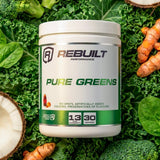


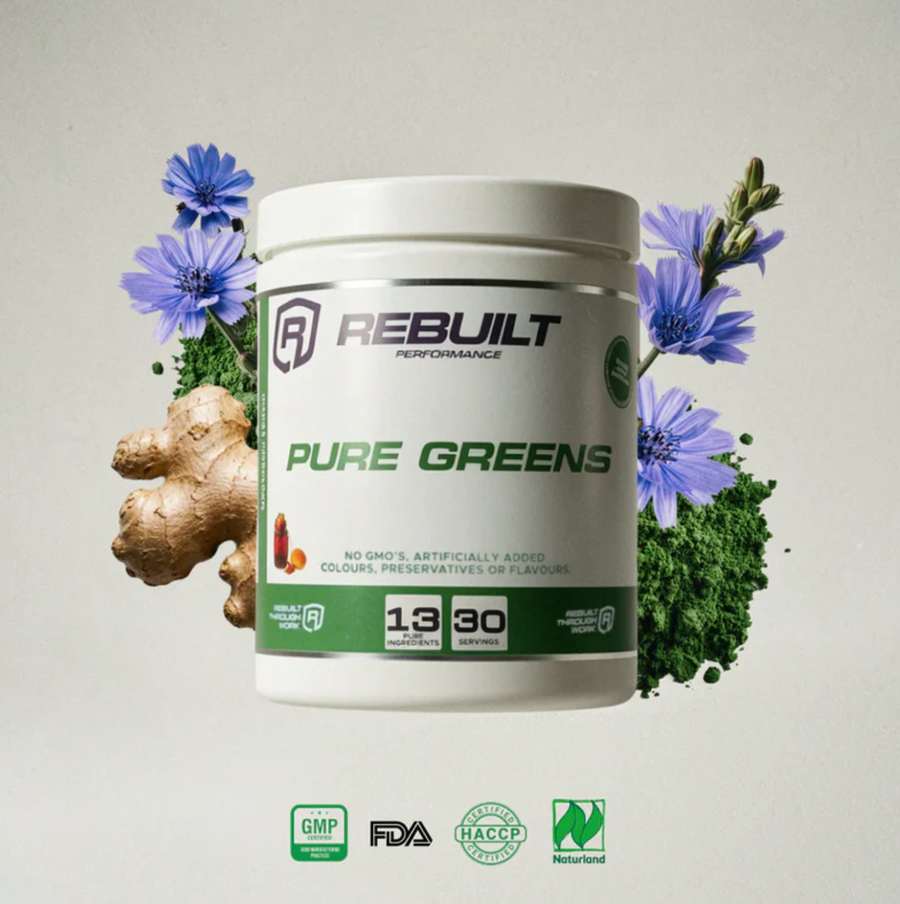

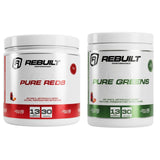
Short answer: Most everyday bloating is mechanical and habit-driven — gas, swallowed air, a fast fiber ramp, a big late meal. It eases within hours and tracks with what you ate and how you ate it. Call a clinician when bloating or belly pain is severe, persistent beyond two to three weeks, progressive, or paired with a red flag: unintended weight loss, blood in your stool, vomiting that won't stop, fever, pain that wakes you at night, or a belly that stays swollen and tender. Red flags are a referral, not a supplement question. For the everyday side — the habits you actually control — Rebuilt's approach is simple: fix meal pace, hydration and fiber order first, and keep your daily base clean and transparent with Pure Greens, 13 ingredients per 11 g scoop, nothing hidden behind a proprietary blend.
What counts as a bloating red flag, and when should you see a doctor about bloating?
Here's the useful mental model. Bloating has two very different shapes.
Shape one: pressure that comes and goes. It builds after meals, peaks in the evening, and is mostly gone when you wake up. It moves with your habits — eating speed, carbonation, sugar alcohols, a sudden jump in fiber, travel, a disrupted sleep week. This is the shape that responds to work. Boring, repeatable work.
Shape two: pressure that doesn't reset. It's there in the morning. It grows week over week. It brings company — weight you didn't try to lose, blood, fever, vomiting, pain that outranks anything you'd call "discomfort." This shape is a conversation with a clinician, and the sooner the better.
The honest thing to say — and Rebuilt would rather be honest than sell you something — is that no powder, tea, or routine belongs anywhere near shape two. The goal of this article is to make the line between the two obvious, so you don't waste months optimizing habits when you needed an appointment, or panic over gas that a slower lunch would fix.
Which severe bloating pain warning signs need same-day care?
Treat these as "today, not next month." Go to urgent care or your nearest emergency department:
- Sudden, severe abdominal pain — the kind that stops you mid-sentence, especially if it came on over minutes.
- A rigid, board-like or exquisitely tender belly that hurts more when you move, cough, or press and release.
- Vomiting blood, or vomit that looks like coffee grounds.
- Black, tarry, or visibly bloody stool.
- Fever with belly pain.
- No stool and no gas passing at all, with a distended belly and vomiting.
- Pain with fainting, a racing heart, cold sweat, or shortness of breath.
- Pregnancy, or possible pregnancy, with new abdominal pain.
And book a regular appointment within the next week or two — not same-day, but don't drift — for:
- Bloating or persistent belly pain lasting more than two to three weeks without clear improvement.
- Unintended weight loss, or clothes loosening without you changing anything.
- New, persistent bloating after age 50, or new bloating with a family history of digestive or ovarian cancers.
- A lasting change in bowel habits — caliber, frequency, urgency — that holds for weeks.
- Difficulty or pain swallowing, or early fullness after a few bites.
- Pain that wakes you from sleep, or symptoms that keep escalating.
- Fatigue, breathlessness, or pallor alongside digestive symptoms.
This is general information to help you decide how fast to act — it isn't personal advice, and it's no substitute for an exam by a clinician who can actually look at you.
How long is too long for persistent belly pain?
A practical rule you can hold in your head: 72 hours, 3 weeks, 6 weeks.
- 72 hours: pain or bloating that is severe and unrelenting for three days straight gets a call — not a new routine.
- 3 weeks: mild-to-moderate symptoms that haven't budged in three weeks of genuinely consistent habits deserve a professional opinion. Not because you failed. Because three weeks is enough data.
- 6 weeks: if you've been seen, started a plan, and nothing has changed in six weeks, go back. One visit is a starting point, not a verdict.
7 concrete steps to take right now
1. Run a 7-day log — the single most valuable thing you can bring
One line per entry: time, what you ate and how fast, pain 0–10, where it sits, bloating peak, bowel movement, sleep, stress. Seven days beats seven months of memory. Clinicians make better decisions with a log, and so do you — patterns show up that no recall can produce.
2. Measure instead of guessing
Note whether your belly is flat in the morning. Note whether a waistband that's tight at 9 p.m. is loose at 7 a.m. "Resolves overnight" and "never resolves" point in completely different directions, and that one observation changes the whole conversation.
3. Self-screen against the red-flag list above, then book accordingly
Do it in writing, once, calmly. Zero red flags and symptoms under three weeks? Work the habits. One red flag? Book. Severe or acute? Go today. Deciding the rule in advance stops you from negotiating with yourself at 11 p.m.
4. Reset the controllables for two weeks
Slow meals to 20 minutes. Stop drinking through a straw and cut carbonation. Ramp fiber by small steps instead of doubling it overnight, and raise water as you raise fiber. Walk 10 minutes after your biggest meal. Add a short daily breathing practice — see our guide to diaphragmatic breathing for belly pressure — and read up on where magnesium and potassium fit regularity and belly comfort. If your discomfort rises and falls with your cycle, log it against the month using our notes on cyclical bloating and abdominal discomfort.
5. Cut your stack down to one variable
If you're running four supplements, three teas and a new protein, you can't learn anything. Strip back to a clean base, hold it steady for two weeks, then change one thing. This is exactly why Rebuilt builds products you can read: 13 ingredients, one 11 g scoop, full label. You can't isolate a variable you can't see.
6. Prep the appointment like it matters — because you get 12 minutes
Bring: your log, a timeline ("started mid-August, worse after travel"), every medication and supplement with doses, your family history, and three written questions. Lead with your worst symptom and its duration. Say out loud what you're worried about — it changes what gets checked.
7. Ask what the plan is if the plan doesn't work
Before you leave, get two answers: what would make you call sooner, and what happens at the follow-up if nothing's improved. That's how you avoid the six-month drift where everyone assumes someone else is watching.
Why Rebuilt won't sell you a shortcut past a red flag
We'd rather lose a sale than sell you a delay. Nothing in our range — nothing in anyone's range — is built to address the symptoms in the list above, and any brand telling you otherwise is costing you time you can't get back.
What a clean daily base can do is remove noise from your everyday routine while you work the controllables. That's the job Pure Greens was designed for:
- 13 ingredients. Exactly 13 — not a 50-item label designed to look impressive.
- Danish-developed and transparent. You can read the full composition before you buy.
- One 11 g scoop. One daily habit, not a protocol.
- No lock-in. Subscribe for convenience, pause or cancel when you want.
- Spirulina in the blend — studied for supporting normal energy levels and helping reduce feelings of tiredness.1
On the food side, the evidence points somewhere refreshingly unglamorous: a Stanford trial found that adding fermented foods to the diet increased microbiome diversity over 10 weeks.3 Yogurt, kefir, kimchi, sauerkraut. Cheap, repeatable, real.
If you're on a GLP-1 medication, note that constipation and bloating are among the commonly reported side effects, and that food choices matter more, not less, when appetite drops.4 Prioritize protein, fluids and fiber you ramp gradually — and still bring new or escalating pain to your prescriber.
Pure Greens vs. a typical greens blend: transparency, price and ingredient count
| What to compare | Rebuilt Pure Greens | Typical greens powder (category, varies by brand) |
|---|---|---|
| Ingredient count | Exactly 13 | Varies widely; many list 40+ items |
| Label transparency | Full composition published; Danish-developed, transparent, nothing hidden | Varies; "proprietary blend" wording is common, which hides per-ingredient amounts |
| Serving | One 11 g scoop daily | Varies by product |
| Commitment | Subscribe for convenience with no lock-in — pause or cancel anytime | Varies; check the cancellation terms before you buy |
| Price | Current price shown on the Pure Greens product page | Varies — compare cost per serving, not cost per tub |
We're not scoring competitors we haven't measured. The point is the method: count the ingredients, check whether amounts are disclosed, divide price by servings, and read the cancellation terms. Apply that to us too.
Frequently asked questions
Is bloating with pain ever an emergency?
Yes. Sudden severe pain, a rigid or very tender belly, vomiting blood, black or bloody stool, fever with belly pain, or no stool and no gas passing at all are same-day situations. Don't wait them out.
How can I tell "normal" gas from something concerning?
Normal pressure follows meals, moves with what and how you ate, and largely resolves overnight. Concerning bloating is present in the morning, gets worse week over week, and often brings weight loss, blood, fever, or escalating pain.
I've had mild belly pain for a month with no red flags. Should I still go in?
Yes. Three weeks of consistent, unimproved symptoms is enough to warrant a professional opinion even without red flags. Bring your 7-day log.
Can a greens powder help with bloating?
No supplement should be positioned as an answer to bloating or pain, and Rebuilt won't position one that way. A clean daily base supports your everyday routine while you work on meal pace, hydration, fiber ramping and sleep. Pure Greens contains spirulina, studied for supporting normal energy levels.1
Does travel-related bloating need a doctor?
Usually not — low cabin pressure, long sitting, dehydration and time shifts produce real but temporary pressure. See our habits for travel bloating on flights and road trips. If it persists well after you're home, get it checked.
What should I bring to the appointment?
Your 7-day log, a symptom timeline, all medications and supplements with doses, family history, and three written questions. Lead with your worst symptom and how long it's lasted.
Should I cut out foods before I'm seen?
Don't start an aggressive elimination diet first. Removing whole food groups can blur the picture your clinician needs. Log what you eat, change one thing at a time, and decide on restrictions together.
Where to find the products at Rebuilt
If you want a clean, transparent daily base to run alongside the habit work, you'll find it here:
- Pure Greens — 13 ingredients, one 11 g scoop, Danish-developed and fully transparent. Subscribe with no lock-in, or buy once.
- Browse the full Rebuilt range — every product with its composition published, so you can compare before you commit.
Our advice holds whether or not you buy from Rebuilt: screen for red flags, log seven days, slow your meals, ramp fiber with water, and book the appointment when the three-week mark passes. REBUILT THROUGH WORK — and sometimes the work is making the call.
Claims overview
- Spirulina — supports normal energy levels and helps reduce feelings of tiredness. Structure/function claim tied to spirulina. Substantiation: randomized controlled trial on mental and physical fatigue (PMID:26888417) and a trial reporting reduced oxidative stress and increased endurance (Kalafati et al., 2010; PMID:19936191).
- Spirulina — supports normal sleep quality and a normal response to stress. Structure/function claim tied to spirulina. Substantiation: randomized controlled trial (PMID:34107141).
- Fermented foods — dietary context, not a product claim: a 10-week Stanford trial found increased microbiome diversity with a fermented-food diet (Wastyk et al., 2021).
- GLP-1 context — background information only, not a product claim: constipation and bloating are among commonly reported GLP-1 side effects, and nutrition quality matters during reduced intake (PMC9821052; Mozaffarian et al., 2025).
- Pure Greens composition — exactly 13 ingredients; one serving = 11 g (one scoop). Verifiable on the product page.
References
- Wastyk HC, et al. Gut-microbiota-targeted diets modulate human immune status. Cell. 2021;184(16):4137. PMID:34256014.
- Kalafati M, et al. Ergogenic and antioxidant effects of spirulina supplementation in humans. Medicine & Science in Sports & Exercise. 2010. PMID:19936191.
- Randomized controlled trial: spirulina supplementation and reductions in mental and physical fatigue. PMID:26888417.
- Randomized controlled trial: spirulina supplementation, sleep quality and stress levels. PMID:34107141.
- Gastrointestinal side effects of GLP-1 receptor agonists, including constipation and bloating, and the role of dietary supplements. PMC9821052.
- Mozaffarian D, et al. Nutrition during GLP-1 treatment. American Journal of Clinical Nutrition. 2025;122:344.
Published 27 October 2026. This article is general information and does not replace an individual assessment by a qualified clinician.
These statements have not been evaluated by the Food and Drug Administration. This product is not intended to diagnose, treat, cure, or prevent any disease.
