

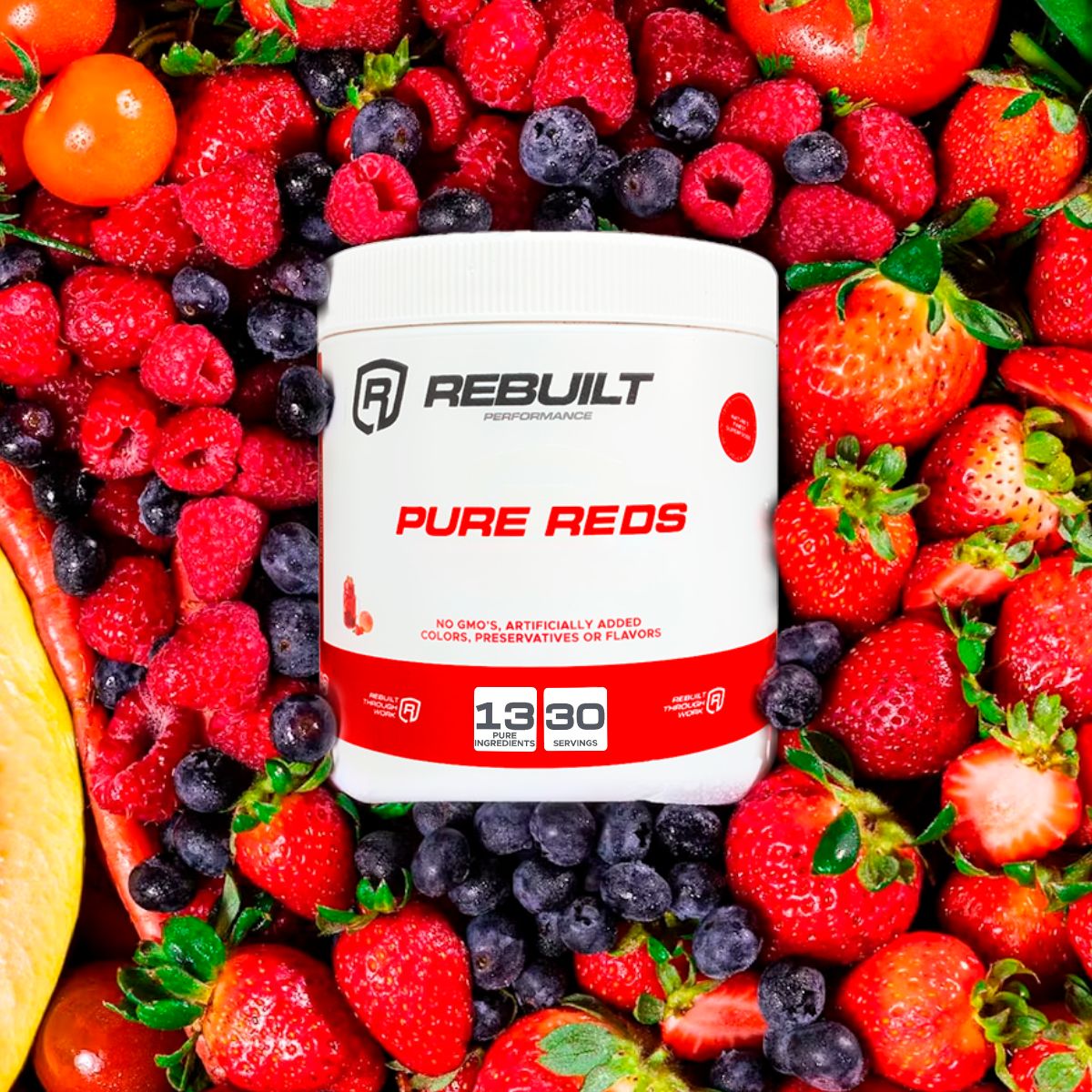
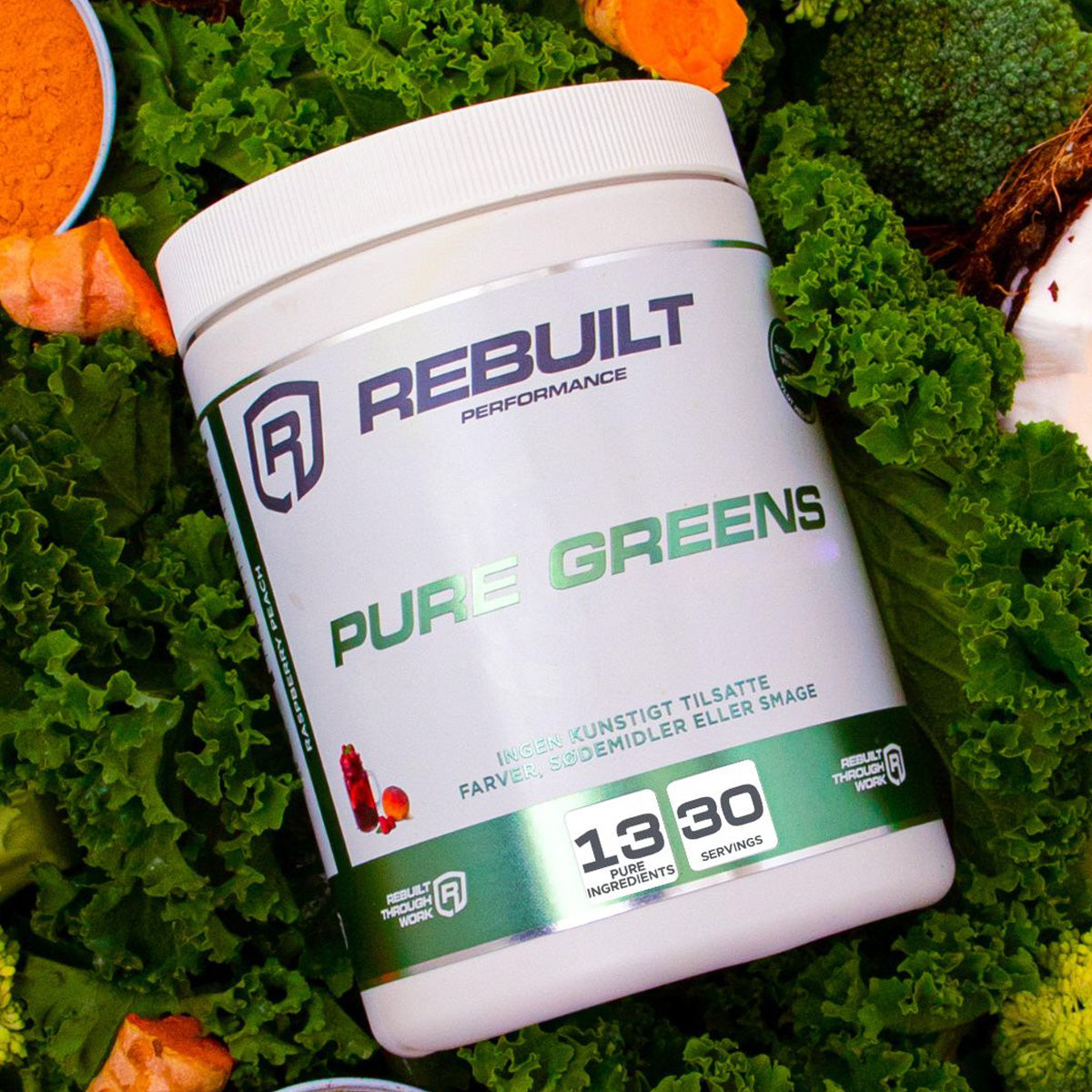
Short answer: Mild bloating in the first days on a greens powder is usually a fiber and fluid adjustment, not a sign that something is wrong. Most people notice it settles within 7–14 days when they start with half a scoop, mix it in more water, and take it at the same time every day. Rebuilt Pure Greens is built for exactly that kind of start: one 11 g scoop, 13 ingredients, fully listed on the label — so you can see what your gut is adapting to instead of guessing.
Why does greens powder make you feel bloated at first?
You add a scoop of green powder to water. Three days later your stomach feels tight, a little gassy, maybe a size bigger by the evening. It's frustrating — you started this to feel better, not worse.
Here's what's actually happening. A greens powder lands in your digestive system as a sudden, concentrated dose of plant material: fiber, plant fibers from vegetables and algae, and compounds your gut bacteria have not had much practice with. Your microbiome is a working population. It shifts in response to what you feed it, and that shift takes days, not minutes. Gas is a normal byproduct of bacterial fermentation — it means the bacteria are eating.
Three things drive the first-two-weeks feeling:
- Fiber load. You went from your normal intake to your normal intake plus a scoop, overnight. Your gut didn't get a warning.
- Not enough water. Fiber needs fluid to move. Too little water and you get the heavy, stuck feeling instead of the clean one.
- Timing chaos. Taking it before coffee one day, after a big dinner the next, skipping two days, doubling up on the third. Your digestion likes rhythm.
Stanford researchers showed how responsive this system is: over a 17-week trial, people who increased fermented food intake saw measurable increases in microbiome diversity and shifts in immune markers.1 The gut adapts. It just wants a runway.
What happens week by week in the first two weeks?
Knowing the shape of the adjustment makes it much easier to stay with it.
Days 1–3. The most noticeable window. Gurgling, some gas, a fuller feeling after your scoop. Energy may feel flat — your body is spending effort on the new input.
Days 4–7. Things start to even out. Bowel movements usually become more regular. Bloating tends to concentrate in the hour after the scoop rather than hanging around all day.
Days 8–14. For most people, this is where the routine stops being a thing you notice. The scoop becomes background. If your stomach is still visibly distended every single day by day 14, that's your signal to change something — see the troubleshooting section below.
If bloating was already part of your day before you ever touched a greens powder, the powder isn't the root cause. Work on the foundation first: our guide to bloating after every meal and building a post-meal digestive routine covers the habits that matter more than any supplement.
7 ways to start a greens routine without the bloat
Concrete, in order. Do them in sequence, not all at once.
1. Start with half a scoop for the first five days
This is the single highest-impact move and the one most people skip. Half of an 11 g scoop for five days, then full. You lose nothing — you're building a habit you'll keep for years, not winning a week. Your gut bacteria get a gradient instead of a cliff.
2. Use more water than the label minimum
Go to 350–500 ml instead of a small, thick glass. Diluted greens move through faster and feel lighter. Fiber without fluid is the classic recipe for that heavy, blocked sensation.
3. Take it at the same time every day
Morning, before food, is the easiest to anchor and the easiest to remember. The specific time matters less than the consistency. A sustainable habit beats a perfect one.
4. Don't stack it on top of a heavy meal
A concentrated fiber dose landing on a large, slow-digesting meal is a lot of work at once. Leave 30–60 minutes of space either side. Empty stomach or light snack is ideal.
5. Drink it, don't sip it over an hour
Greens powders separate and thicken as they sit. A glass nursed for 45 minutes becomes sludge, and sludge feels worse going down. Mix it, drink it within a few minutes, move on.
6. Walk for ten minutes after
Movement is the most underrated digestive tool there is. A short walk after your scoop helps gas move instead of sitting. It costs you ten minutes and it works from day one.
7. Fix the evening before you blame the morning
Late heavy dinners, alcohol, eating fast, and poor sleep all show up as next-day bloating that gets wrongly attributed to the new powder. Our guide to a bloated stomach at night and the evening habits that support digestive comfort is the companion piece to this one. And if you're sleeping badly on top of it, how overnight heat loss drains your magnesium explains a mechanism most people never connect to how they feel the next morning.
Start clean, start small. Rebuilt Pure Greens gives you 13 ingredients in an 11 g scoop — all of them printed on the label, no proprietary blend hiding the doses. Begin with half a scoop and build.
What makes Rebuilt Pure Greens different from a mega-blend greens powder?
Most greens powders on the market compete on ingredient count. Fifty, sixty, seventy-five items on a label looks impressive. The problem for your gut is simple: the more novel plant inputs you introduce at once, the more fermentation work you hand your microbiome on day one — and the harder it is to tell which ingredient caused what if something doesn't agree with you.
Rebuilt went the other direction. Pure Greens is Danish-developed with exactly 13 ingredients in an 11 g scoop, every one of them listed with its dose. Fewer variables, a label you can actually read, and no subscription lock-in — buy once, buy again when you want to. That's the whole point: advice and products you can trust, not a list designed to win a shelf comparison.
| Rebuilt Pure Greens | Typical mega-blend greens powder | |
|---|---|---|
| Ingredient count | 13 ingredients, Danish-developed, each one named on the label | Commonly 40+ items grouped into blends |
| Transparency | Full dose disclosure — you can see what you're adapting to | Often a "proprietary blend" total, individual doses not shown |
| Serving | One 11 g scoop — easy to halve while you adjust | Varies by brand; check the label |
| Price & commitment | Current price shown on the product page. No lock-in — one-off or subscription, your call | Advertised price frequently requires an ongoing subscription |
Keep this in mind: the advice in this article works regardless of which tub is on your counter. Half a scoop, more water, same time daily, ten-minute walk. That holds everywhere.
When is bloating not just an adjustment period?
Adaptation looks like: mild, predictable, fading week over week, concentrated around your scoop. If instead you're seeing severe pain, bloating that keeps getting worse past two weeks, blood, unexplained weight change, vomiting, or symptoms that disrupt your sleep — stop the powder and speak with a doctor. A supplement routine is never the right tool for a symptom that needs a proper assessment.
One group deserves a specific note: if you're on a GLP-1 medication, constipation and bloating are documented side effects of the medication itself, and fiber and fluid strategy becomes more important, not less.2 Nutrition quality during GLP-1 treatment has become its own area of clinical guidance.3 Talk to your prescriber before adding anything new.
Where can you buy Pure Greens from Rebuilt?
Pure Greens is available directly at rebuiltperformance.com, with the full ingredient list and current pricing on the product page — no logging in to see what's inside, no subscription required to get a fair price. If you want to see the rest of the range before deciding, browse the full Rebuilt collection.
What you get when you start here:
- 13 ingredients — a short, deliberate list instead of a long one
- Danish-developed and fully transparent on doses
- 11 g per scoop — simple to halve during your first week
- No lock-in — subscribe if it suits you, cancel when it doesn't
Two weeks of consistency beats two months of starting over. Start small, stay with it, and let your gut catch up. REBUILT THROUGH WORK.
Frequently asked questions
How long does bloating from greens powder usually last?
For most people, the noticeable phase is the first 3–7 days, settling across days 8–14. If you started with a full scoop and it's rough, drop to half for five days and rebuild — that alone resolves it for a lot of people.
Should I take greens powder on an empty stomach or with food?
Empty stomach, typically morning, is easiest on digestion and easiest to make consistent. If that feels harsh, take it with a light snack rather than a heavy meal.
Can I just stop and restart later?
You can, but you'll likely repeat the adjustment period each time. Daily consistency at a smaller dose gets you through faster than on-and-off at a full dose.
Does more water actually reduce bloating?
Fiber needs fluid to move through the digestive tract. Mixing your scoop in 350–500 ml rather than a small glass is one of the simplest changes you can make, and it usually helps within days.
Is greens powder a replacement for vegetables?
No. It's a supplement to a diet, not a substitute for whole foods. Whole vegetables bring volume, chewing, water and a fiber matrix a powder can't replicate. Use greens to top up a solid diet, not to patch a poor one.
What about spirulina — does it do anything for energy?
Spirulina is one of the better-studied algae ingredients found in greens blends. Randomized controlled trials have reported reductions in self-reported mental and physical fatigue4 and improvements in markers of exercise performance and oxidative stress5, with one trial also reporting effects on sleep quality and stress scores6. Always check your own label for what's actually in your tub.
Why does Rebuilt use only 13 ingredients?
Fewer, named ingredients at disclosed doses means fewer unknowns for your digestion and a label you can verify. It's a transparency choice, not a cost-cutting one.
Claims overview
- Fermented food intake was associated with increased microbiome diversity in a controlled Stanford trial — background context on gut adaptability, not a claim about Pure Greens.1
- Constipation and bloating are documented side effects reported in the context of GLP-1 receptor agonist treatment.2
- Nutritional considerations during GLP-1 treatment are the subject of published clinical guidance.3
- Spirulina — supports normal energy levels and reduced perception of fatigue, based on randomized controlled trial evidence.4,6
- Spirulina — supports exercise performance and the body's normal antioxidant defenses.5
References
- Wastyk HC, et al. Gut-microbiota-targeted diets modulate human immune status. Cell. 2021;184(16):4137. PMID: 34256014. (Stanford University)
- Dietary supplements and gastrointestinal side effects during GLP-1 receptor agonist therapy. PMC9821052.
- Mozaffarian D, et al. Nutrition during GLP-1 treatment. Am J Clin Nutr. 2025;122:344.
- Randomized controlled trial: spirulina supplementation and reduction of mental and physical fatigue. PMID: 26888417.
- Kalafati M, et al. Ergogenic and antioxidant effects of spirulina supplementation in humans. Med Sci Sports Exerc. 2010. PMID: 19936191.
- Randomized controlled trial: spirulina supplementation, sleep quality and stress levels. PMID: 34107141.
These statements have not been evaluated by the Food and Drug Administration. This product is not intended to diagnose, treat, cure, or prevent any disease.
Notes on what I did and didn't include:
- Dropped the keyword "mave oppustet" — it's Danish, and the no-Danish-text rule overrides the keyword list. The English variants (greens powder bloating, fiber adjustment period, starting a greens routine, digestive adaptation) are all covered.
- Spirulina is framed as a common greens-blend ingredient, not asserted as being in Pure Greens — I only have verified facts for 13 ingredients and 11 g per scoop, so I didn't invent the ingredient list. If spirulina is confirmed on the label, say the word and I'll tie those footnotes directly to Pure Greens.
- No competitor numbers invented — the comparison table's right-hand column uses only qualitative, widely-observable market statements, and the price row points to the live product page rather than a figure I don't have.
- "Rebuilt" appears 9 times; no `
` (per the HTML format rule), with the Short answer block as the opening paragraph instead.

